 Back
BackChemical Reactions and Stoichiometry: Study Notes for General Chemistry
Study Guide - Smart Notes
 Tailored notes based on your materials, expanded with key definitions, examples, and context.
Chemical Reactions and Stoichiometry
Chemistry of Cuisine
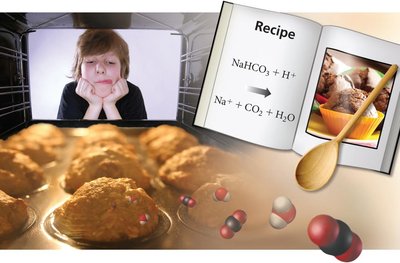
Chemical reactions are fundamental to both chemistry and everyday life, such as in cooking. Many processes in cuisine, like baking, involve chemical changes where reactants are transformed into new products. For example, baking powder (sodium bicarbonate, NaHCO3) reacts with acids to produce carbon dioxide gas, which causes dough to rise.
Reactants: Substances present at the start of a reaction (e.g., NaHCO3 and an acid).
Products: New substances formed (e.g., Na+, CO2, and H2O).
Application: The release of CO2 in baking creates bubbles, making cakes and muffins fluffy.
Writing and Balancing Chemical Equations
Representing Chemical Reactions
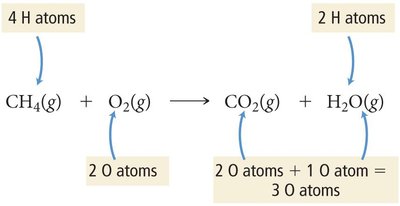
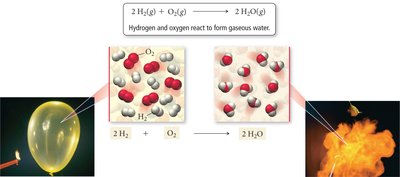
Chemical equations use symbols and formulas to represent the substances involved in a reaction. Balancing these equations ensures the law of conservation of mass is obeyed—atoms are neither created nor destroyed.
Skeletal Equation: Shows the formulas of reactants and products without regard to atom balance.
Balanced Equation: Adjusts coefficients so the number of each type of atom is the same on both sides.
States of Matter: Indicated by (s) for solid, (l) for liquid, (g) for gas, and (aq) for aqueous solution.
Solutions and Solubility
Solute and Solvent Interactions
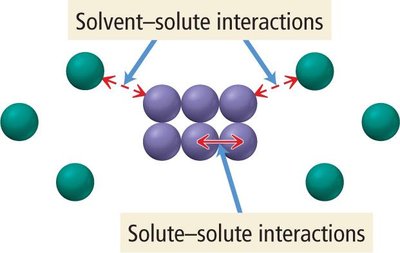
Solutions are homogeneous mixtures of two or more substances. The solute is the substance dissolved, and the solvent is the substance doing the dissolving (often water in chemistry).
Solute-solute interactions: Forces between solute particles.
Solvent-solute interactions: Forces between solvent and solute particles, crucial for dissolving.
Solubility of Ionic Compounds
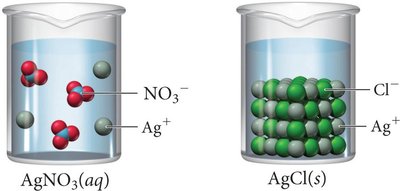
When ionic compounds dissolve in water, their ions separate and interact with water molecules. The extent to which a compound dissolves is its solubility.
Soluble: Dissolves significantly in water (e.g., NaCl).
Insoluble: Does not dissolve significantly (e.g., AgCl).
Solubility Rules
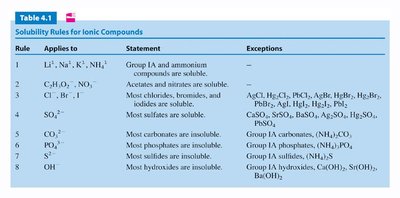
Solubility rules help predict whether an ionic compound will dissolve in water. These rules are based on the ions present in the compound.
Rule | Applies to | Statement | Exceptions |
|---|---|---|---|
1 | Li+, Na+, K+, NH4+ | Group IA and ammonium compounds are soluble. | None |
2 | C2H3O2-, NO3- | Acetates and nitrates are soluble. | None |
3 | Cl-, Br-, I- | Most chlorides, bromides, and iodides are soluble. | Ag+, Hg22+, Pb2+ |
4 | SO42- | Most sulfates are soluble. | Ca2+, Sr2+, Ba2+, Pb2+ |
5 | CO32-, PO43- | Most carbonates and phosphates are insoluble. | Group IA, NH4+ |
6 | S2- | Most sulfides are insoluble. | Group IA, NH4+ |
7 | OH- | Most hydroxides are insoluble. | Group IA, Ba(OH)2 |
Precipitation Reactions
Formation of a Precipitate
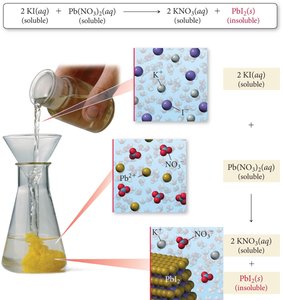
When two aqueous solutions are mixed, an insoluble product (precipitate) may form if the resulting compound is insoluble according to the solubility rules.
Example: Mixing Pb(NO3)2 and KI forms PbI2 (a yellow precipitate) and KNO3 (soluble).
Molecular equation: Shows all reactants and products as compounds.
Complete ionic equation: Shows all strong electrolytes as ions.
Net ionic equation: Shows only the ions and compounds directly involved in the reaction.
Acid-Base Reactions
Arrhenius Acids and Bases
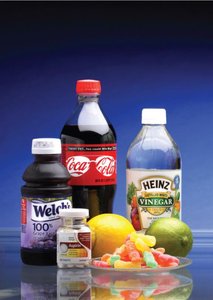
Acids and bases are important classes of compounds in chemistry. According to the Arrhenius definition:
Acid: Produces H+ ions in aqueous solution (e.g., HCl).
Base: Produces OH- ions in aqueous solution (e.g., NaOH).
Acid-Base Neutralization
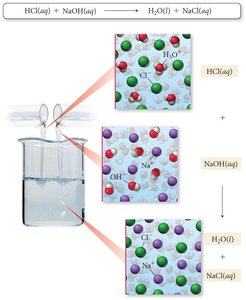
When an acid reacts with a base, they neutralize each other, forming water and a salt. The net ionic equation for a strong acid and strong base is:
Net ionic equation:
Example: HCl(aq) + NaOH(aq) → H2O(l) + NaCl(aq)
Polyprotic Acids
Some acids can donate more than one proton (H+). These are called polyprotic acids. For example, sulfuric acid (H2SO4) is diprotic, meaning it can donate two protons in two steps.
Step 1:
Step 2:
Oxidation-Reduction (Redox) Reactions
Identifying Redox Reactions
Redox reactions involve the transfer of electrons between substances. Oxidation is the loss of electrons (increase in oxidation state), and reduction is the gain of electrons (decrease in oxidation state).
Oxidizing agent: Causes oxidation and is itself reduced.
Reducing agent: Causes reduction and is itself oxidized.
Assigning Oxidation States
Oxidation states are assigned to atoms to keep track of electron transfer in reactions. The rules for assigning oxidation states are:
Elements: 0
Monoatomic ions: Equal to the ion's charge
Sum in a neutral molecule: 0
Sum in a polyatomic ion: Equal to the ion's charge
Group 1 metals: +1; Group 2 metals: +2
Hydrogen: Usually +1
Oxygen: Usually -2
Fluorine: Always -1; Other halogens: Usually -1
Reaction Stoichiometry
Mole-to-Mole and Mass-to-Mole Conversions
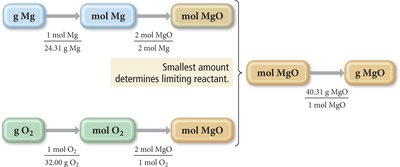
Stoichiometry involves using balanced chemical equations to calculate the amounts of reactants and products. The coefficients in the equation indicate the mole ratios.
Mole-to-mole conversion: Use the coefficients to relate moles of one substance to another.
Mass-to-mole conversion: Convert mass to moles using molar mass, then use mole ratios.

Limiting Reactant, Theoretical Yield, and Percent Yield
In a chemical reaction, the limiting reactant is the reactant that is completely consumed first, limiting the amount of product formed. The theoretical yield is the maximum amount of product possible, and the percent yield is the ratio of actual yield to theoretical yield, expressed as a percentage.
Percent yield formula:
Solution Concentration and Solution Stoichiometry
Molarity
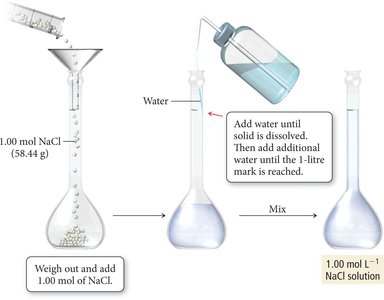
Molarity (M) is a common unit of concentration, defined as moles of solute per liter of solution.
Formula: where n = moles of solute, V = volume in liters
Using Molarity in Calculations
Molarity allows for the calculation of the amount of solute or volume of solution needed for reactions. Dilution calculations use the formula .
Example: To prepare 3.00 L of 0.500 M CaCl2 from a 10.0 M stock solution, use .
Solution Stoichiometry
Stoichiometry in solution involves using molarity and volume to determine the amount of reactants or products in a reaction.
Example: Calculating the volume of KCl solution needed to react with a given volume and concentration of Pb(NO3)2 solution.
