 Back
BackConservation of Momentum and Energy: The Linear Air Track Experiment
Study Guide - Smart Notes
 Tailored notes based on your materials, expanded with key definitions, examples, and context.
Conservation Laws in Collisions and Free Fall
Introduction to Conservation Laws
The study of collisions and energy transformations is fundamental in understanding the principles of classical mechanics, which underpin much of general chemistry and physics. This experiment focuses on the conservation of momentum and energy during collisions and the conversion of gravitational potential energy to kinetic energy in a nearly frictionless environment.
Momentum Conservation in Collisions
Principle of Conservation of Momentum
Momentum is a vector quantity defined as the product of an object's mass and velocity. In a closed system, the total momentum before and after a collision remains constant, regardless of the type of collision.
Definition: Momentum, p, is given by p = mv, where m is mass and v is velocity.
Conservation Equation: For two bodies in one dimension, the conservation of momentum is expressed as:
Here, p_1 and p_2 are the momenta before the collision, and p_1' and p_2' are the momenta after the collision.
Momentum can be positive or negative, depending on the direction of motion.
Types of Collisions
Elastic Collisions: Both momentum and kinetic energy are conserved.
Inelastic Collisions: Momentum is conserved, but kinetic energy is not. Some energy is transformed into other forms, such as heat or deformation.
Energy Conservation in Collisions
Kinetic Energy in Collisions
Kinetic energy is the energy of motion, given by:
For elastic collisions, the total kinetic energy before and after the collision is conserved:
For inelastic collisions, kinetic energy is not conserved, but the total energy (including other forms) is.
Gravitational Potential Energy and Energy Conversion
Gravitational Potential Energy
The gravitational potential energy (Ug) of a body of mass m at a height h above the Earth's surface is:
g is the acceleration due to gravity (approximately 9.8 m/s2 near Earth's surface).
Conversion of Potential Energy to Kinetic Energy
When a mass m falls through a height h and is connected to a mass M on a frictionless track, the final velocity v of the system can be found using energy conservation:
Solving for v:
This equation assumes negligible friction and that all potential energy is converted to kinetic energy.
Experimental Apparatus and Procedures
The Linear Air Track
The linear air track provides a nearly frictionless environment for studying collisions and energy transformations. Compressed air flows through holes in the track, allowing vehicles to float and minimizing energy loss due to friction.
Timing Devices
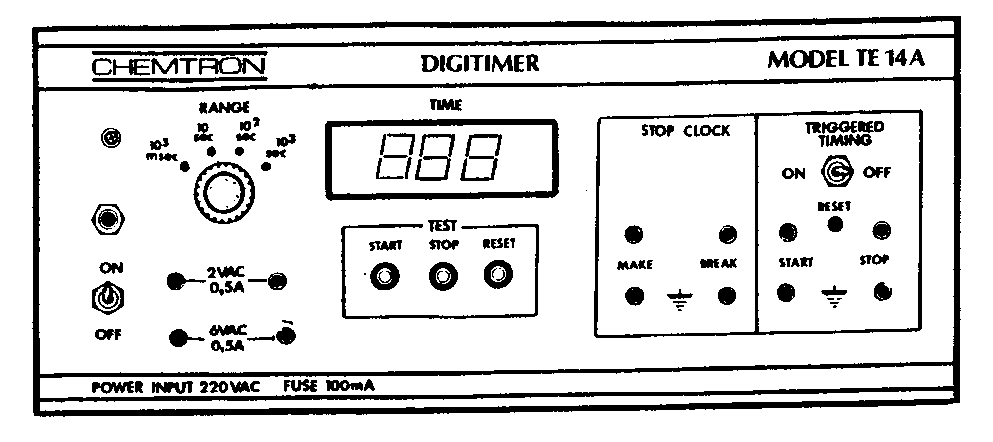
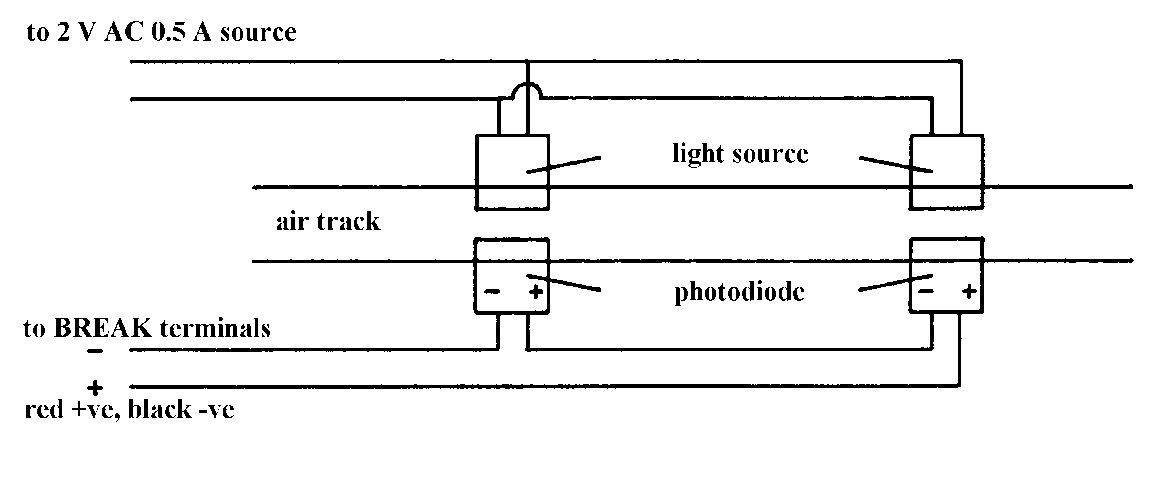
Accurate measurement of velocity requires precise timing. The experiment uses a datalogger or digitimer connected to light gates or photodiode assemblies to measure the time intervals as vehicles pass through the beams.


Levelling the Track
Cross-wise levelling: Use a spirit level for rough adjustment.
Horizontal levelling: Essential for accurate results. The vehicle should remain stationary when placed at rest at various points on the track.
Determining Effective Length
The effective length of the vehicle card is measured by marking the positions where the timing starts and stops as the card passes through the light beam. The distance between these marks is used to calculate velocity.
Collision Experiments
Elastic Collisions
Equip vehicles with magnetic buffers to ensure elastic collisions.
Measure velocities before and after collision using the timing system.
Verify conservation of momentum and kinetic energy by comparing calculated values before and after the collision.
Inelastic Collisions
Replace magnetic buffers with a steel buffer and a plasticine-filled buffer to create inelastic collisions.
Measure velocities and analyze the conservation of momentum and the loss of kinetic energy.
Gravitational Potential Energy Experiment
Experimental Setup
A mass is attached to a vehicle on the air track via a cotton thread and pulley. As the mass falls, it pulls the vehicle, converting gravitational potential energy into kinetic energy. The velocity is measured as the mass reaches the floor.
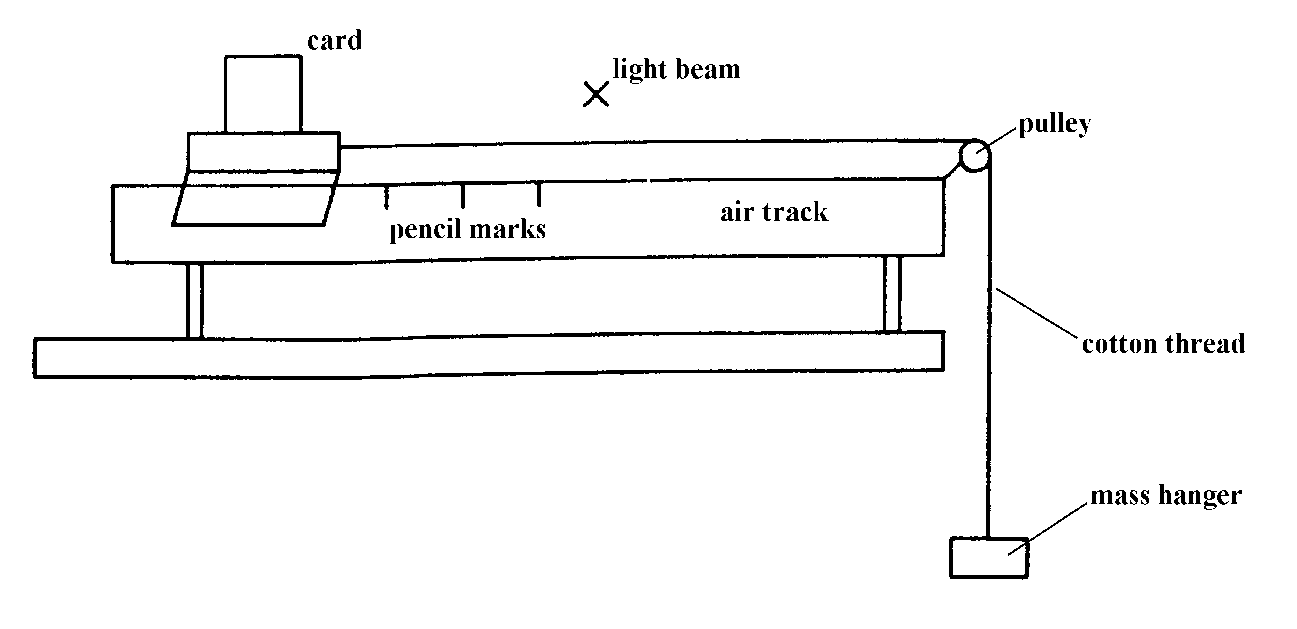
Mark intervals on the track to vary the distance the mass falls.
Measure the final velocity for different heights and analyze the data to determine the acceleration due to gravity.
Data Analysis
Collision Data
Compare measured momenta and kinetic energies before and after collisions to verify conservation laws.
Perform error analysis to assess the accuracy of the results.
Potential Energy Data
Plot a graph to linearize the energy equation and determine the local value of g (acceleration due to gravity).
Compare experimental results with standard values.
Summary Table: Types of Collisions
Type of Collision | Momentum Conserved? | Kinetic Energy Conserved? | Example |
|---|---|---|---|
Elastic | Yes | Yes | Billiard balls, air track with magnetic buffers |
Inelastic | Yes | No | Clay balls sticking together, air track with plasticine buffer |
Key Equations
Momentum:
Kinetic Energy:
Gravitational Potential Energy:
Energy Conservation (falling mass and air track):
