Back
BackElectrophilic Addition Reactions of Alkenes: Mechanisms, Regioselectivity, and Stereochemistry
Study Guide - Smart Notes
 Tailored notes based on your materials, expanded with key definitions, examples, and context.
The Reactions of Alkenes
Introduction to Electrophilic Addition
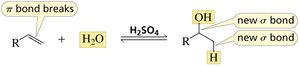
Alkenes are hydrocarbons containing carbon-carbon double bonds, which are regions of high electron density and thus highly reactive toward electrophiles. The most common reactions of alkenes are electrophilic addition reactions, where the π bond is broken and two new σ bonds are formed.
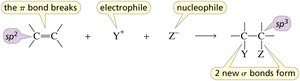
Electrophile: An electron-deficient species that seeks electrons.
Nucleophile: An electron-rich species that donates electrons.
During the reaction, the π bond acts as a nucleophile and attacks the electrophile, leading to the formation of a carbocation intermediate (in many cases).
Mechanism of Electrophilic Addition Reactions
General Features
All electrophilic addition reactions share common mechanistic features. The π bond of the alkene attacks the electrophile, generating a carbocation intermediate, which is then attacked by a nucleophile.
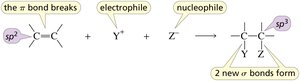
The π bond breaks and two new σ bonds are formed.
The reaction proceeds via a carbocation intermediate in many cases.
Addition of Hydrogen Halides (HX)
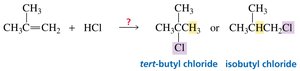
When an alkene reacts with a hydrogen halide (HX, where X = Cl, Br, I), the hydrogen adds to one carbon of the double bond and the halide adds to the other.
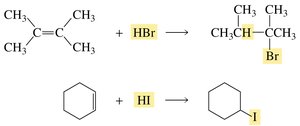
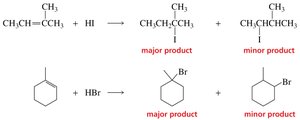
The reaction is regioselective: the hydrogen atom bonds to the less substituted carbon (Markovnikov's rule), and the halide bonds to the more substituted carbon.
Regioselectivity: Which sp2 Carbon Gets the H+?
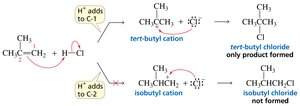
The regioselectivity of the addition is determined by the stability of the carbocation intermediate formed during the reaction. The hydrogen adds to the carbon that leads to the more stable carbocation.
Mechanism and Carbocation Stability
The rate-limiting step is the formation of the carbocation. The more stable the carbocation, the faster it forms, and thus the major product is derived from the more stable carbocation intermediate.
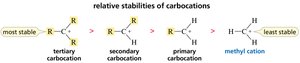
Carbocation stability order: tertiary > secondary > primary > methyl.
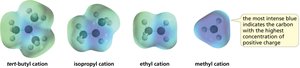
Hyperconjugation
Hyperconjugation is the delocalization of electrons from adjacent σ bonds (usually C-H or C-C) into the empty p orbital of the carbocation, stabilizing the positive charge.
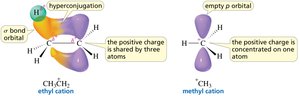
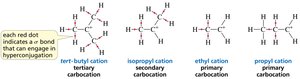
Tertiary carbocations are stabilized by more hyperconjugative interactions than secondary or primary carbocations.
Transition State and Product Distribution
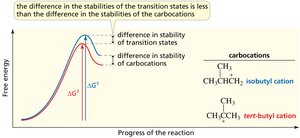
The transition state of the rate-limiting step resembles the carbocation intermediate. Therefore, the more stable the carbocation, the lower the activation energy and the faster the reaction.
Major and Minor Products
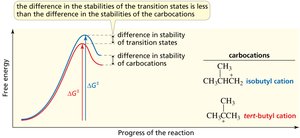
The major product of an electrophilic addition reaction is the one formed via the more stable carbocation intermediate. Primary carbocations are so unstable that they are rarely formed.
Regioselectivity and Non-Regioselective Reactions
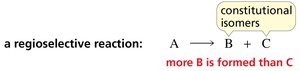
A regioselective reaction forms more of one constitutional isomer than another. If both possible carbocations are equally stable, the reaction is not regioselective and forms a mixture of products.

Markovnikov's Rule
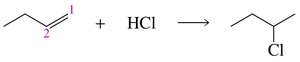
Markovnikov's rule states that in the addition of HX to an alkene, the hydrogen atom bonds to the less substituted carbon, and the halide bonds to the more substituted carbon.
Acid-Catalyzed Addition of Water and Alcohols
Hydration of Alkenes
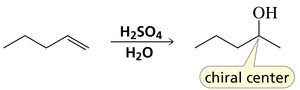
Alkenes can react with water in the presence of an acid catalyst (usually H2SO4) to form alcohols. This reaction is called acid-catalyzed hydration.

No reaction occurs without acid because water is a weak electrophile.
Mechanism of Acid-Catalyzed Hydration
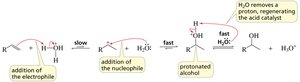
The mechanism involves three steps: protonation of the alkene to form a carbocation, nucleophilic attack by water, and deprotonation to yield the alcohol.
Acid-Catalyzed Addition of Alcohols
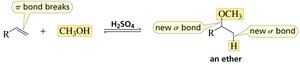
Similarly, alkenes react with alcohols in the presence of acid to form ethers via an analogous mechanism.

Carbocation Rearrangements
Sometimes, the initially formed carbocation can rearrange to a more stable carbocation via a 1,2-hydride shift or a 1,2-methyl shift. This can lead to unexpected ("surprise") major products.
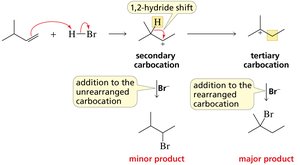
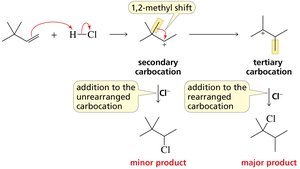
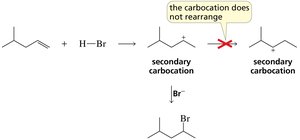
Carbocation rearrangement only occurs if it leads to a more stable carbocation.
Limitations of Acid-Catalyzed Hydration
There are two main problems with acid-catalyzed hydration:
Acidic conditions can cause side reactions or decompose sensitive compounds.
Carbocation rearrangements can lead to mixtures of products.

Summary of Electrophilic Addition Reactions
Reactions That Form Carbocation Intermediates
Addition of hydrogen halides (HX)
Acid-catalyzed addition of water
Acid-catalyzed addition of alcohols

Reactions That Do Not Form Carbocation Intermediates
Addition of H2 (hydrogenation)
Addition of BH3 or R2BH (hydroboration)


Regioselectivity and Stereochemistry in Addition Reactions
Regioselective Reactions
A reaction is regioselective if it forms more of one constitutional isomer than another.
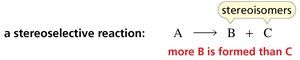
Stereoselective and Stereospecific Reactions
A reaction is stereoselective if it forms more of one stereoisomer than another. It is stereospecific if each stereoisomer of the reactant forms a different stereoisomer of the product.

Formation of Chiral Centers and Stereoisomers
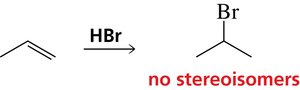
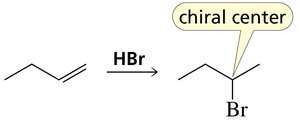
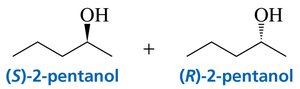
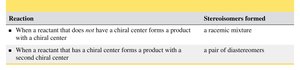
If the product of an addition reaction has a chiral center, stereoisomers can form. If the reactant is achiral and the product has one chiral center, a racemic mixture results.
Why Racemic Mixtures Form
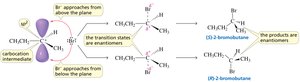
The nucleophile can attack the planar carbocation intermediate from either side, leading to equal amounts of enantiomers.
Formation of Diastereomers
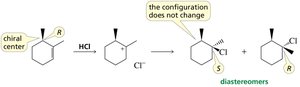
If the reactant already has a chiral center and a new chiral center is formed, the product will be a pair of diastereomers.
Summary Table: Stereoisomers Formed in Addition Reactions
Reaction | Stereoisomers formed |
|---|---|
When a reactant that does not have a chiral center forms a product with a chiral center | a racemic mixture |
When a reactant that has a chiral center forms a product with a second chiral center | a pair of diastereomers |
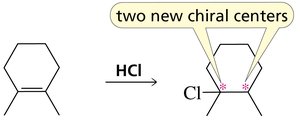
Reactions Forming Two Chiral Centers
When two new chiral centers are formed, the stereoisomers produced depend on the mechanism of the reaction.