 Back
BackEquilibria, Precipitation, and Acid-Base Chemistry: Study Notes
Study Guide - Smart Notes
 Tailored notes based on your materials, expanded with key definitions, examples, and context.
Equilibria: Precipitation, Acid-Base, and Solubility
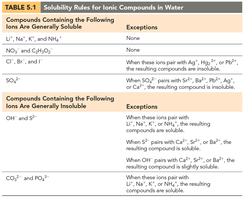
Solubility and Solubility Rules
Solubility describes how much of a substance can dissolve in a solvent at a given temperature. Solubility rules help predict whether an ionic compound will dissolve in water, but there are exceptions due to the nature of ionic interactions and lattice energies.
Soluble Compounds: Most compounds containing Li+, Na+, K+, NH4+, NO3-, and C2H3O2- are soluble.
Insoluble Compounds: Most compounds containing OH-, CO32-, and PO43- are insoluble, except when paired with alkali metals or NH4+.
Exceptions: Some ions form insoluble salts with Ag+, Pb2+, or Hg22+.
Solubility Product Constant (Ksp)
The solubility product constant, Ksp, quantifies the equilibrium between a solid and its ions in solution. It is specific for each compound at a given temperature.
Expression: For a salt AB that dissociates as AB(s) ↔ A+(aq) + B-(aq),
Application: Used to calculate molar solubility and predict precipitation.
Molar Solubility and Ksp Calculations
Molar solubility is the number of moles of solute that can dissolve per liter of solution before the solution becomes saturated. It is related to Ksp and depends on the stoichiometry of dissolution.
ICE Table: Used to set up equilibrium concentrations for solubility calculations.
Example: For PbCl2 in water,
Common Ion Effect
The common ion effect occurs when a compound is dissolved in a solution that already contains one of its ions. This decreases the solubility of the compound due to Le Châtelier’s Principle.
Le Châtelier’s Principle: Adding a common ion shifts the equilibrium to the left, reducing solubility.
Example: AgCl is less soluble in a NaCl solution than in pure water.
Precipitation and the Reaction Quotient (Q)
Precipitation occurs when the product of ion concentrations (Q) exceeds Ksp. The relationship between Q and Ksp determines whether a precipitate forms:
If Q < Ksp: No precipitate forms (unsaturated solution).
If Q = Ksp: Solution is saturated (at equilibrium).
If Q > Ksp: Precipitate forms (supersaturated solution).
Selective Precipitation and Qualitative Analysis
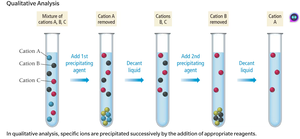
Selective precipitation is used to separate ions in a mixture by adding reagents that precipitate specific ions first, based on their Ksp values.
Process: Add a precipitating agent to remove one ion at a time.
Application: Used in qualitative analysis to identify ions in solution.
Complex Ions and Solubility
Complex ions are formed when metal ions bond with ligands (molecules or ions that donate electron pairs). Formation of complex ions can increase the solubility of otherwise insoluble salts.
Example: AgCl dissolves in ammonia due to formation of [Ag(NH3)2]+.
Equilibrium: The overall equilibrium constant is the product of the Ksp and the formation constant (Kf).

Acids and Bases: Definitions and Properties
Arrhenius, Brønsted-Lowry, and Lewis Definitions
Arrhenius: Acids produce H+ in water; bases produce OH-.
Brønsted-Lowry: Acids donate H+; bases accept H+. Conjugate acid-base pairs are formed.
Lewis: Acids accept electron pairs; bases donate electron pairs. Not limited to H+ transfer.
Acid and Base Nomenclature
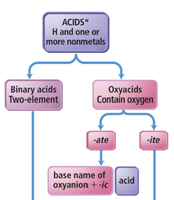
Acids are named based on their composition:
Binary acids: "Hydro-" + base name + "-ic acid" (e.g., HCl: hydrochloric acid).
Oxyacids: Based on the polyatomic ion: "-ate" becomes "-ic acid"; "-ite" becomes "-ous acid" (e.g., HNO3: nitric acid, HNO2: nitrous acid).
Conjugate Acid-Base Pairs
Every acid has a conjugate base, and every base has a conjugate acid, formed by the loss or gain of a proton (H+).
Example: NH3 (base) + H2O (acid) ↔ NH4+ (conjugate acid) + OH- (conjugate base)
Autoionization of Water and the Ion Product (Kw)
Water can act as both an acid and a base (amphiprotic). It autoionizes to form H+ and OH-:
at 25°C
Strong and Weak Acids/Bases
Strong acids/bases: Completely ionize in solution (e.g., HCl, NaOH).
Weak acids/bases: Partially ionize; equilibrium exists between reactants and products (e.g., CH3COOH, NH3).
Equilibrium constants: for acids, for bases.
The pH Scale and Calculations
pH is a logarithmic measure of hydrogen ion concentration:
pH < 7: acidic; pH = 7: neutral; pH > 7: basic
Buffers
Buffer Solutions
A buffer is a solution that resists changes in pH when small amounts of acid or base are added. It consists of a weak acid and its conjugate base, or a weak base and its conjugate acid.
Example: Acetic acid (CH3COOH) and sodium acetate (CH3COONa)
Mechanism: Added acid is neutralized by the base; added base is neutralized by the acid.
Buffer Capacity and Limitations
Buffers can be overwhelmed if too much strong acid or base is added, exceeding the buffer's capacity.
Tables and Data
Solubility Rules Table
This table summarizes the general solubility rules for ionic compounds in water, including exceptions.
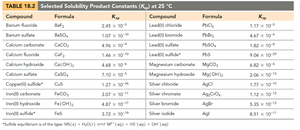
Selected Ksp Values
This table lists the solubility product constants (Ksp) for various ionic compounds at 25°C, which are essential for predicting precipitation and calculating solubility.
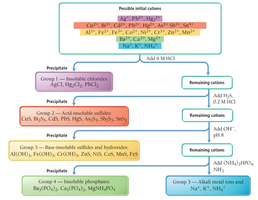
Qualitative Analysis Flowchart
This flowchart outlines the stepwise process for separating and identifying cations in a mixture using selective precipitation.
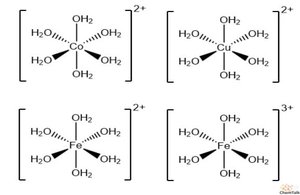
Complex Ion Structures
These diagrams show examples of complex ions formed by transition metals with water ligands, illustrating the geometry and bonding in coordination complexes.
Example Problem: Equilibrium Calculation
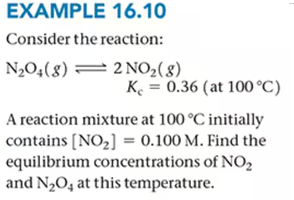
Consider the reaction: N2O4(g) ↔ 2 NO2(g), Kc = 0.36 at 100°C. If the initial [NO2] = 0.100 M, calculate the equilibrium concentrations of NO2 and N2O4 at this temperature.
Set up an ICE table and solve for equilibrium concentrations using the Kc expression:
Summary Table: Solubility Rules for Ionic Compounds in Water
Compounds Generally Soluble | Exceptions |
|---|---|
Li+, Na+, K+, NH4+ | None |
NO3-, C2H3O2- | None |
Cl-, Br-, I- | Ag+, Hg22+, Pb2+ |
SO42- | Sr2+, Ba2+, Pb2+, Ag+, Ca2+ |
Compounds Generally Insoluble | Exceptions |
|---|---|
OH-, S2- | Li+, Na+, K+, NH4+, Ca2+, Sr2+, Ba2+ |
CO32-, PO43- | Li+, Na+, K+, NH4+ |
Summary Table: Selected Ksp Values
Compound | Formula | Ksp |
|---|---|---|
Barium fluoride | BaF2 | 2.45 × 10⁻⁵ |
Barium sulfate | BaSO4 | 1.08 × 10⁻¹⁰ |
Calcium carbonate | CaCO3 | 4.8 × 10⁻⁹ |
Silver chloride | AgCl | 1.77 × 10⁻¹⁰ |
Lead(II) iodide | PbI2 | 8.5 × 10⁻⁹ |
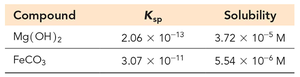
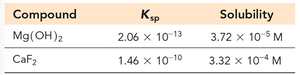
Summary Table: Ksp and Solubility
Compound | Ksp | Solubility (M) |
|---|---|---|
Mg(OH)2 | 2.06 × 10⁻¹³ | 3.72 × 10⁻⁵ |
FeCO3 | 3.07 × 10⁻¹¹ | 5.54 × 10⁻⁶ |
CaF2 | 1.46 × 10⁻¹⁰ | 3.32 × 10⁻⁴ |
