 Back
BackExam 2 Study Guide: Reactions in Aqueous Solution & Electronic Structure of Atoms
Study Guide - Smart Notes
 Tailored notes based on your materials, expanded with key definitions, examples, and context.
Chapter 4 – Reactions in Aqueous Solution
4.1 – General Properties of Aqueous Solutions
An aqueous solution is a solution in which water is the solvent. Understanding the behavior of substances in water is fundamental to chemistry.
Electrolyte: A substance that dissolves in water to produce ions, thus conducting electricity. Strong electrolytes dissociate completely (e.g., NaCl), while weak electrolytes only partially dissociate (e.g., acetic acid).
Nonelectrolyte: A substance that dissolves in water but does not produce ions (e.g., sugar).
Example: NaCl is a strong electrolyte; glucose is a nonelectrolyte.
4.2 – Precipitation Reactions
Precipitation reactions occur when two solutions of ionic compounds are mixed and an insoluble product (precipitate) forms.
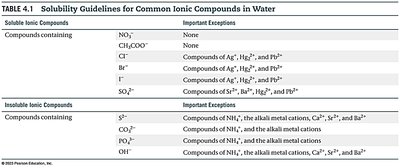
Use a solubility chart to determine if a compound is soluble (aq) or insoluble (s) in water.
Precipitate: An insoluble solid formed in a reaction, usually denoted as (s).
Ionic equation: Shows all ions present in the reaction.
Net ionic equation: Shows only the ions and molecules directly involved in the reaction.
Spectator ions: Ions that do not participate in the reaction.
Example: Mixing AgNO3 and NaCl forms AgCl (s) as a precipitate.
Soluble Ionic Compounds | Important Exceptions |
|---|---|
NO3- | None |
CH3COO- | None |
Cl- | Compounds of Ag+, Hg22+, and Pb2+ |
Br- | Compounds of Ag+, Hg22+, and Pb2+ |
I- | Compounds of Ag+, Hg22+, and Pb2+ |
SO42- | Compounds of Ba2+, Hg22+, and Pb2+ |
Insoluble Ionic Compounds | Important Exceptions |
|---|---|
S2- | Compounds of NH4+, alkali metals, Ca2+, Sr2+, Ba2+ |
CO32- | Compounds of NH4+, alkali metals |
PO43- | Compounds of NH4+, alkali metals |
OH- | Compounds of NH4+, alkali metals, Ca2+, Sr2+, Ba2+ |
4.3 – Acids, Bases, and Neutralization Reactions
Acids and bases are fundamental to aqueous chemistry. Their strength and reactions are important for understanding solution behavior.
Acid: Produces H+ ions in solution; often has a sour taste and reacts with metals.
Base: Produces OH- ions in solution; often has a bitter taste and feels slippery.
Strong acids/bases: Completely dissociate in water. Weak acids/bases: Partially dissociate.
Neutralization reaction: Acid reacts with base to form water and a salt.
Example: HCl + NaOH → NaCl + H2O
4.4 – Oxidation-Reduction Reactions
Redox reactions involve the transfer of electrons between substances. Understanding oxidation numbers is key to identifying these reactions.
Oxidation: Loss of electrons (OIL: Oxidation Is Loss).
Reduction: Gain of electrons (RIG: Reduction Is Gain).
Oxidation number: A value assigned to an element in a compound based on electron distribution.
Example: In NaCl, Na has an oxidation number of +1, Cl is -1.
4.5 – Concentrations of Solutions
Concentration describes the amount of solute in a given volume of solution. Molarity is the most common unit.
Molarity (M):
Conversion: 1 L = 1000 mL
Dilution equation:
Example: If you dilute 50 mL of 2 M NaCl to 100 mL, the new concentration is 1 M.
4.6 – Solution Stoichiometry and Chemical Analysis
Stoichiometry in solutions involves using concentrations and volumes to calculate reactant and product quantities.
Use molarity and volume to find moles:
Apply balanced equations to relate moles of reactants and products.
Titration: A technique to determine concentration by reacting a known volume with a standard solution.
Chapter 6 – Electronic Structure of Atoms
6.1-6.4 – Nature/Behavior of Light, Quantized Energy, and the Bohr Model
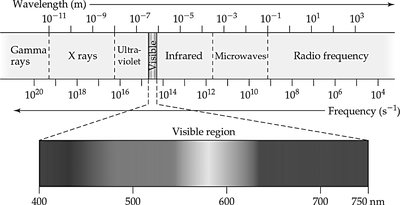
Light and energy are quantized, meaning they exist in discrete packets. The Bohr model explains electron transitions in atoms.
Frequency (ν): Number of wave cycles per second (Hz).
Wavelength (λ): Distance between wave peaks (meters).
Relationship: where is the speed of light ( m/s).
Energy of a photon: where is Planck's constant ( J·s).
Bohr model: Electrons occupy quantized energy levels; transitions emit or absorb photons.
Quantized energy: Only specific energy values are allowed.
Electron transitions:
Emission: Electron drops to a lower energy level, releasing energy.
Excitation: Electron absorbs energy and moves to a higher level.
6.5/6.6 – Quantum Mechanics, Atomic Orbitals/Representations of Orbitals
Quantum numbers describe the properties of atomic orbitals and electrons.
Principal quantum number (n): Indicates energy level; n = 1, 2, 3, ...
Angular momentum quantum number (l): Defines orbital shape; l = 0 (s), 1 (p), 2 (d), 3 (f)
Magnetic quantum number (ml): Specifies orbital orientation; ml = -l to +l
Example: For n = 3, l can be 0, 1, or 2; ml ranges from -2 to +2 for d orbitals.
6.7-6.9 – Many-Electron Atoms, Orbital Diagrams, and Electron Configurations
Electron configurations and orbital diagrams show how electrons are arranged in atoms.
Spin quantum number (ms): Indicates electron spin; ms = +1/2 or -1/2
Pauli Exclusion Principle: No two electrons in an atom can have the same set of quantum numbers.
Hund’s Rule: Electrons fill degenerate orbitals singly before pairing.
Electron configuration: Notation showing distribution of electrons among orbitals (e.g., 1s2 2s2 2p6).
Condensed configuration: Uses noble gas core to simplify notation (e.g., [Ne] 3s2 3p1).
Orbital capacity: s (2 electrons), p (6), d (10)
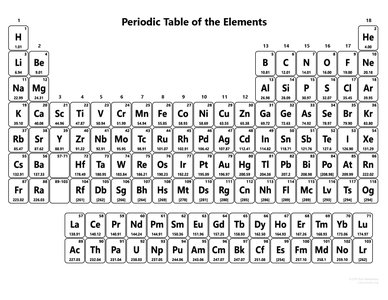
Additional info: Figures 6.27 and 6.28 referenced in the notes are not provided, but the periodic table (image_3) is useful for electron configuration practice.
