 Back
BackLesson 10.1: Galvanic Cells: Transforming Chemical Energy into Electrical Energy
Study Guide - Smart Notes
 Tailored notes based on your materials, expanded with key definitions, examples, and context.
Galvanic Cells
Introduction to Galvanic Cells
Galvanic cells, also known as voltaic cells, are devices that convert chemical energy from spontaneous redox reactions into electrical energy. Everyday experiences, such as the tingling sensation when metal touches dental work, are due to small galvanic cells forming in the mouth. Batteries used in portable devices operate on the same principle.
Redox Reaction: Involves the transfer of electrons from one substance (oxidized) to another (reduced).
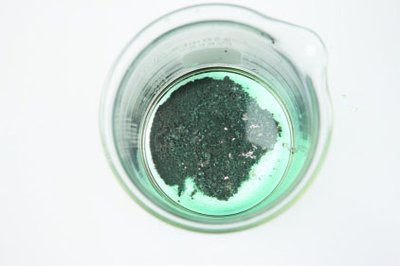
Example: The reaction between zinc metal and copper(II) sulfate solution:

Half-Reactions:
Oxidation (at anode): Reduction (at cathode):
Net Ionic Equation:
Key Point: When the reactants are in direct contact, the energy is released as heat and cannot be harnessed as electrical energy.
Structure and Function of a Galvanic Cell
To harness the energy, the oxidizing and reducing agents are separated into two half-cells, connected by a wire and a salt bridge. This setup forces electrons to flow through the wire, generating an electric current.
Half-Cell: Consists of an electrode in contact with an electrolyte solution.
Electrode: A solid electrical conductor (e.g., metal strip).
Cell: Two electrodes connected by a wire and a salt bridge.
Salt Bridge: A U-shaped tube containing a non-reactive electrolyte (e.g., sodium sulfate) that allows ion flow to maintain electrical neutrality in each half-cell.
Electron Flow: From the anode (oxidation) to the cathode (reduction) through the external wire.
Ion Flow: Anions move toward the anode; cations move toward the cathode through the salt bridge.
Key Definitions
Anode: Electrode where oxidation occurs (loss of electrons).
Cathode: Electrode where reduction occurs (gain of electrons).
Galvanic Cell: Arrangement of two connected half-cells that spontaneously produces electric current.
Salt Bridge: Maintains charge balance by allowing ion migration between half-cells.
Evidence and Interpretation in a Zinc–Copper Cell
Evidence | Interpretation |
|---|---|
The zinc electrode decreases in mass. | Oxidation of zinc at the anode: |
The copper electrode increases in mass; blue color fades. | Reduction of copper(II) ions at the cathode: |
Voltmeter: zinc negative, copper positive. | Electrons move from zinc to copper. |
Ammeter: current flows from zinc to copper. | Electrons leave zinc half-cell, enter copper half-cell. |
Predicting Cell Reactions and Equations
The direction of electron flow is determined by the relative strengths of the oxidizing and reducing agents. The stronger oxidizing agent is reduced at the cathode, and the stronger reducing agent is oxidized at the anode.
Example: In a Zn–Cu cell, is the stronger oxidizing agent, and Zn is the stronger reducing agent.
Half-Reactions:
Anode (oxidation): Cathode (reduction):
Net Ionic Equation:
Galvanic Cells with Inert Electrodes
Some galvanic cells use inert electrodes (e.g., platinum or graphite) when the redox reaction involves only ions in solution. The inert electrode provides a surface for the reaction but does not participate chemically.
Example: Reaction between permanganate and iron(II) ions:
Reduction (cathode):
Oxidation (anode):
Line Notation for Galvanic Cells
Line notation is a shorthand way to represent galvanic cells. The anode is written on the left, the cathode on the right, and a double vertical line indicates the salt bridge.
Example (Zn–Cu cell):
Example (Fe–MnO4 cell with inert electrodes):
Summary Table: Key Features of a Galvanic Cell
Component | Role |
|---|---|
Anode | Site of oxidation; electrons released |
Cathode | Site of reduction; electrons accepted |
Salt Bridge | Maintains charge balance by allowing ion flow |
Wire | Pathway for electron flow from anode to cathode |
Key Points to Remember
Galvanic cells convert chemical energy to electrical energy via spontaneous redox reactions.
Electrons flow from the anode to the cathode through an external circuit.
Ions migrate through the salt bridge to maintain electrical neutrality.
Line notation provides a concise way to represent cell components and reactions.
