 Back
BackGeneral Chemistry Exam I Review – Step-by-Step Guidance
Study Guide - Smart Notes
 Tailored notes based on your materials, expanded with key definitions, examples, and context.
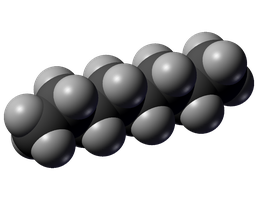
Q1. Octane is a component of fuel used in internal combustion engines. The dominant intermolecular forces in octane are:
Background
Topic: Intermolecular Forces
This question tests your understanding of the types of intermolecular forces present in molecules, specifically in hydrocarbons like octane.
Key Terms:
Intermolecular forces: Forces of attraction between molecules.
Dispersion forces (London forces): Weak forces present in all molecules, especially nonpolar ones.
Dipole-dipole forces: Forces between polar molecules.
Hydrogen bonding: Strong dipole-dipole interaction involving H bonded to N, O, or F.
Step-by-Step Guidance
Examine the structure of octane. Octane is a hydrocarbon with only C and H atoms, and its structure is nonpolar.
Recall that nonpolar molecules primarily exhibit dispersion forces, since they lack permanent dipoles.
Consider the other options: Dipole-dipole forces require polarity, hydrogen bonding requires H bonded to N, O, or F, and covalent bonds are intramolecular (within molecules, not between).
Identify which intermolecular force is dominant for nonpolar molecules like octane.
Try solving on your own before revealing the answer!
Final Answer: Dispersion forces
Octane is nonpolar, so the dominant intermolecular force is dispersion (London) forces.
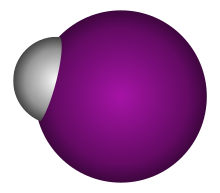
Q2. In hydrogen iodide, __________________ are the most important intermolecular forces.
Background
Topic: Intermolecular Forces
This question tests your ability to identify the dominant intermolecular force in a polar molecule, specifically hydrogen iodide (HI).
Key Terms:
Dipole-dipole forces: Present in polar molecules.
Dispersion forces: Present in all molecules, but not always dominant.
Hydrogen bonding: Requires H bonded to N, O, or F.
Step-by-Step Guidance
Analyze the structure of HI. It is a diatomic molecule with a significant difference in electronegativity between H and I, making it polar.
Check if HI can form hydrogen bonds. Hydrogen bonding requires H bonded to N, O, or F, which is not the case here.
Since HI is polar but does not meet the criteria for hydrogen bonding, consider dipole-dipole forces as the dominant intermolecular force.
Dispersion forces are present, but dipole-dipole forces are stronger in polar molecules like HI.
Try solving on your own before revealing the answer!
Final Answer: Dipole-dipole forces
HI is polar and does not form hydrogen bonds, so dipole-dipole forces are most important.
Q3. Which of the following atoms should have the greatest polarizability?
Background
Topic: Polarizability
This question tests your understanding of how atomic size and electron cloud affect polarizability.
Key Terms:
Polarizability: The ease with which an atom's electron cloud can be distorted.
Atomic size: Larger atoms have more easily distorted electron clouds.
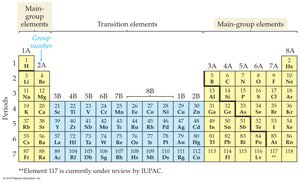
Periodic trends: Polarizability increases down a group and decreases across a period.
Step-by-Step Guidance
Locate each atom (F, Br, Po, Pb, He) on the periodic table.
Recall that polarizability increases as you move down a group (atomic size increases).
Polarizability decreases as you move across a period (effective nuclear charge increases).
Compare the atomic sizes and positions of the listed elements to determine which is largest and most polarizable.
Try solving on your own before revealing the answer!
Final Answer: Pb
Lead (Pb) is the largest atom listed, so it has the greatest polarizability.
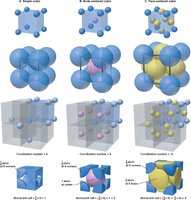
Q4. Polonium crystallizes in the simple cubic lattice. What is the coordination number for Po?
Background
Topic: Crystal Lattice Structures
This question tests your knowledge of crystal lattice types and the concept of coordination number.
Key Terms:
Simple cubic lattice: A crystal structure where each atom is at the corner of a cube.
Coordination number: The number of nearest neighbors surrounding an atom in a crystal lattice.
Step-by-Step Guidance
Recall the definition of a simple cubic lattice: atoms are located at each corner of the cube.
Determine how many nearest neighbors each atom has in this arrangement.
Compare with other lattice types (body-centered cubic, face-centered cubic) to understand the differences in coordination number.
Visualize or refer to a diagram of the simple cubic lattice to count the nearest neighbors.
Try solving on your own before revealing the answer!
Final Answer: 6
In a simple cubic lattice, each atom has 6 nearest neighbors.
