Back
BackGeneral Chemistry Final Exam Practice Guidance
Study Guide - Smart Notes
 Tailored notes based on your materials, expanded with key definitions, examples, and context.
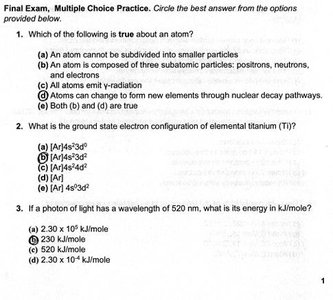
Q1. Which of the following is true about an atom?
Background
Topic: Atomic Structure
This question tests your understanding of the basic properties and composition of atoms, including subatomic particles and nuclear processes.
Key Terms:
Atom: The smallest unit of an element, consisting of protons, neutrons, and electrons.
Subatomic particles: Protons, neutrons, electrons (and sometimes positrons).
Nuclear decay: Process by which atoms change into new elements.
Step-by-Step Guidance
Review the definition of an atom and its subatomic particles.
Consider whether atoms can be subdivided further (think about nuclear reactions).
Recall the types of radiation atoms can emit (e.g., gamma, alpha, beta).
Think about nuclear decay and whether atoms can change into new elements.
Try solving on your own before revealing the answer!
Q2. What is the ground state electron configuration of elemental titanium (Ti)?
Background
Topic: Electron Configuration
This question tests your ability to write the electron configuration for a transition metal using the Aufbau principle, Hund's rule, and the Pauli exclusion principle.
Key Terms and Formula:
Electron configuration: The arrangement of electrons in an atom's orbitals.
Aufbau principle: Electrons fill orbitals from lowest to highest energy.
Hund's rule: Electrons fill degenerate orbitals singly before pairing.
Pauli exclusion principle: No two electrons in an atom can have the same set of quantum numbers.
Step-by-Step Guidance
Find the atomic number of titanium (Ti) to determine the number of electrons.
List the order of orbital filling: .
Distribute the electrons according to the order above, making sure to follow Hund's rule and the Pauli exclusion principle.
Write out the full electron configuration for Ti, stopping before the final step.
Try solving on your own before revealing the answer!
Q3. If a photon of light has a wavelength of 520 nm, what is its energy in kJ/mole?
Background
Topic: Quantum Chemistry / Photochemistry
This question tests your ability to convert wavelength to energy using Planck's equation and Avogadro's number.
Key Terms and Formulas:
Photon: A quantum of electromagnetic radiation.
Planck's equation:
Where is Planck's constant ( J·s), is the speed of light ( m/s), and is wavelength in meters.
Avogadro's number: photons/mole.
Step-by-Step Guidance
Convert the wavelength from nanometers to meters: .
Plug the values into Planck's equation to find the energy of one photon: .
Multiply the energy per photon by Avogadro's number to get the energy per mole of photons.
Convert the answer from joules to kilojoules (divide by 1000).
Try solving on your own before revealing the answer!