 Back
BackGeneral Chemistry Gas Law and Stoichiometry Study Guidance
Study Guide - Smart Notes
 Tailored notes based on your materials, expanded with key definitions, examples, and context.
Q1. How many moles of gas are in a sample given pressure, volume, and temperature?
Background
Topic: Ideal Gas Law
This question tests your ability to use the ideal gas law to determine the number of moles of a gas when given the pressure, volume, and temperature.
Key formula:
Where:
= pressure (in atm)
= volume (in liters)
= number of moles
= ideal gas constant ()
= temperature (in Kelvin)
Step-by-Step Guidance
Identify the known values for , , and from the question.
Write out the ideal gas law equation: .
Rearrange the equation to solve for : .
Check that all units are compatible (pressure in atm, volume in liters, temperature in Kelvin).
Try solving on your own before revealing the answer!
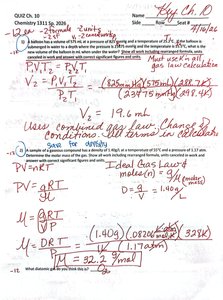
Q2. Using the combined gas law to find the new volume when conditions change
Background
Topic: Combined Gas Law
This question tests your ability to use the combined gas law to solve for a new volume when pressure and temperature change.
Key formula:
Where:
= initial pressure
= initial volume
= initial temperature (in Kelvin)
= final pressure
= final volume (what you're solving for)
= final temperature (in Kelvin)
Step-by-Step Guidance
Write down all initial and final values for pressure, volume, and temperature.
Plug the values into the combined gas law equation: .
Rearrange the equation to solve for : .
Check that all units are compatible (pressure in atm, volume in liters, temperature in Kelvin).
Try solving on your own before revealing the answer!
Q3. Calculating molar mass using the ideal gas law and density
Background
Topic: Molar Mass Determination from Gas Properties
This question tests your ability to use the ideal gas law and density to determine the molar mass of a gas.
Key formula:
Where:
= molar mass (g/mol)
= density (g/L)
= ideal gas constant ()
= temperature (in Kelvin)
= pressure (in atm)
Step-by-Step Guidance
Identify the density, temperature, and pressure values given in the question.
Write out the formula for molar mass: .
Plug the values into the formula, making sure all units are compatible.
Set up the calculation for but stop before computing the final value.
Try solving on your own before revealing the answer!
