 Back
BackGeneral Chemistry I: Key Concepts, Calculations, and Exam Review
Study Guide - Smart Notes
 Tailored notes based on your materials, expanded with key definitions, examples, and context.
Course Structure and Key Topics
Overview of General Chemistry I
This course covers foundational principles of general chemistry, including matter and measurements, chemical reactions, stoichiometry, thermochemistry, atomic structure, bonding, and properties of gases, liquids, solids, and solutions. The curriculum is structured around major units, each assessed by exams and supported by laboratory activities.
Unit 1: Matter, Measurements, Chemical Quantities, and Reactions
Unit 2: Thermochemistry, Redox Reactions, Electronic Structure, Periodic Properties
Unit 3: Chemical Bonding, Molecular Structure, Geometry
Unit 4: Gases, Liquids, Solids, Solutions
Unit 5: Chemical Equilibrium
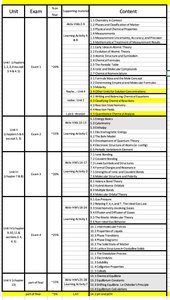
Matter and Measurements
Physical and Chemical Properties
Understanding the distinction between physical and chemical properties is fundamental in chemistry. Physical properties can be observed without changing the substance's identity, while chemical properties involve a change in composition.
Physical Properties: Color, melting point, density, conductivity
Chemical Properties: Reactivity with acids, ability to oxidize, flammability
Example: Copper reacts with nitric acid to produce copper(II) nitrate (chemical property), but it conducts electricity (physical property).
Physical and Chemical Changes
Changes in matter are classified as physical or chemical. Physical changes do not alter the chemical identity, while chemical changes result in new substances.
Physical Change: Melting, evaporation, dissolving
Chemical Change: Combustion, rusting, decomposition
Example: Mercury(II) oxide heated to form mercury and oxygen is a chemical change.
Significant Figures and Measurement
Accurate reporting of measurements requires understanding significant figures, which reflect the precision of a measurement.
Rules: All nonzero digits are significant; zeros between significant digits are significant; trailing zeros in a decimal are significant.
Example: The result of arithmetic operations should be reported with the correct number of significant figures based on the least precise measurement.
Density Calculations
Density is a physical property defined as mass per unit volume. It is used to identify substances and solve quantitative problems.
Formula:
Example: If an 84.6419 g coin displaces 9.11 mL of water, its density is .
Elements, Compounds, and Chemical Quantities
Pure Substances vs. Mixtures
Pure substances have a fixed composition, while mixtures contain two or more substances physically combined.
Pure Substance: Sucrose (table sugar)
Mixture: Seawater, blood, brass
Mole Concept and Molar Mass
The mole is a fundamental unit for counting particles in chemistry. Molar mass is the mass of one mole of a substance.
Avogadro's Number: particles per mole
Formula:
Example: 7.2 mg of cyanidin chloride () is mol.
Empirical and Molecular Formulas
Empirical formulas show the simplest ratio of elements, while molecular formulas show the actual number of atoms in a molecule.
Example: Ibuprofen (75.69% C, 8.80% H, 15.51% O) has an empirical formula of C13H18O2.
Chemical Reactions and Stoichiometry
Balancing Chemical Equations
Balanced equations ensure the conservation of mass and atoms. Stoichiometric coefficients indicate the relative amounts of reactants and products.
Example:
Types of Reactions
Chemical reactions include synthesis, decomposition, single replacement, double replacement, and combustion.
Example: Decomposition of sodium azide in air bags:
Stoichiometric Calculations
Stoichiometry involves calculating the quantities of reactants and products in a chemical reaction.
Limiting Reactant: The reactant that determines the maximum amount of product formed.
Percent Yield:
Example: If 11.60 g of phosphoric acid is produced from a theoretical yield of 13.81 g, percent yield is .
Lab Techniques and Procedures
Laboratory Safety
Safety is paramount in the laboratory. Proper attire, handling of chemicals, and adherence to safety protocols are required.
Wear: Safety goggles, closed-toed shoes, lab coats
Do Not: Eat, drink, or smoke in the lab
Dispose: Chemicals as instructed
Preparation and Completion of Lab Reports
Lab reports document experimental procedures, data, and analysis. Prelabs and synopses are required for some experiments.
Prelab: Questionnaire and synopsis submitted before the experiment
Lab Report: Includes data, calculations, and discussion
Mathematical Operations and Functions
Complex Calculations in Chemistry
Chemistry problems often require multi-step calculations involving arithmetic, algebra, and unit conversions.
Example Calculation:

This calculation demonstrates the use of multiplication, subtraction, division, and addition in solving quantitative chemistry problems.
Solutions, Aqueous Reactions, and Colligative Properties
Solution Concentration
Concentration is expressed in molarity (M), millimolar (mM), and other units. Calculations involve determining the amount of solute in a given volume.
Formula:
Example: To prepare 250.0 mL of 50.0 mM NaCl, calculate mass needed: mol; g.
Precipitation and Solubility
Solubility rules predict whether a precipitate will form when solutions are mixed.
Example: Mixing potassium sulfide and silver nitrate forms Ag2S precipitate.
Acid-Base Equilibria and Neutralization
Acids and Bases
Acids ionize in water to produce hydronium ions; bases produce hydroxide ions. Strong acids ionize completely, while weak acids ionize partially.
Example: Hydrofluoric acid (HF) is a weak acid.
Neutralization Reactions
Acid-base reactions produce water and a salt. Net ionic equations show only the species that change during the reaction.
Example:
Precision, Accuracy, and Experimental Data
Precision vs. Accuracy
Precision refers to the consistency of repeated measurements, while accuracy refers to how close measurements are to the true value.
Example: Results clustered together but far from the known value are precise but inaccurate.
Summary Table: Key Properties and Concepts
Property | Definition | Example |
|---|---|---|
Physical Property | Can be observed without changing substance | Melting point, color |
Chemical Property | Describes reactivity or change in composition | Reacts with acid |
Intensive Property | Independent of amount | Boiling point |
Extensive Property | Depends on amount | Mass, energy released |
Additional info:
Some content was inferred from the syllabus, exam questions, and answer key to provide a comprehensive review of general chemistry topics.
Images included are directly relevant: image_1 (course content table), image_2 (complex calculation example).
