 Back
BackIntermolecular Forces, Liquids, and Solids: Study Notes for General Chemistry
Study Guide - Smart Notes
 Tailored notes based on your materials, expanded with key definitions, examples, and context.
Intermolecular Forces: Liquids and Solids
Van der Waals Forces
Intermolecular forces are the attractions between molecules that determine many physical properties of substances, such as boiling and melting points. Van der Waals forces are a collection of weak attractive forces between groups of atoms or molecules. These include dipole-dipole interactions, dispersion (London) forces, and hydrogen bonding.
Dipole Moment (μ): A measure of the separation of positive and negative charges in a molecule. It is estimated by summing the bond dipoles, considering both direction and magnitude.
Polarizability (α): Indicates how easily the electron cloud of a molecule can be distorted by an electric field or the approach of another molecule.
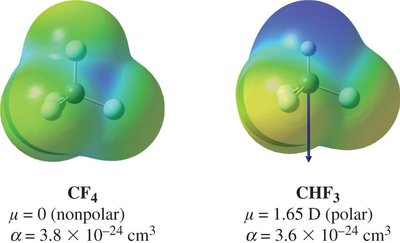
Dipole-Dipole Interactions
Dipole-dipole interactions occur between molecules with permanent dipoles. The positive end of one molecule is attracted to the negative end of another.
Permanent dipoles: Result from differences in electronegativity between atoms in a molecule.
Strength: Generally stronger than dispersion forces for molecules of similar size.
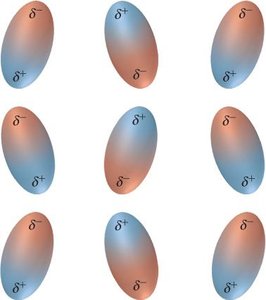
Dispersion (London) Forces
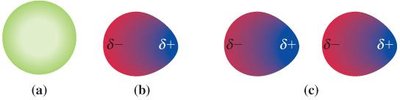
Dispersion forces arise from instantaneous and induced dipoles. Even nonpolar molecules can exhibit these forces due to temporary fluctuations in electron distribution.
Instantaneous dipole: Temporary uneven distribution of electrons in a molecule.
Induced dipole: Neighboring molecules are affected by the instantaneous dipole, creating a dipole in them.
Strength: Increases with molecular size and polarizability.
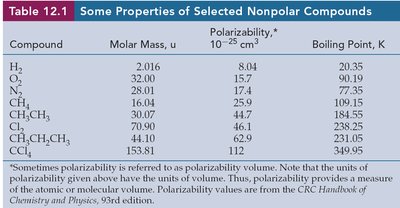
Properties of Nonpolar Compounds
Nonpolar compounds rely primarily on dispersion forces for intermolecular attraction. Their boiling points and polarizabilities are influenced by molecular mass and structure.
Compound | Molar Mass, u | Polarizability, 10-25 cm3 | Boiling Point, K |
|---|---|---|---|
H2 | 2.016 | 8.04 | 20.35 |
O2 | 32.00 | 157 | 90.19 |
N2 | 28.01 | 15.7 | 77.35 |
CF4 | 16.04 | 25.9 | 145.0 |
CH3CH3 | 30.07 | 44.7 | 184.55 |
Cl2 | 70.90 | 100 | 239.11 |
CH3CH2CH3 | 44.10 | 62.9 | 231.05 |
CCl4 | 153.81 | 112 | 349.95 |
Boiling Points and Molecular Mass
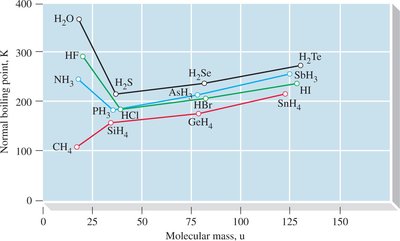
The boiling points of hydrides of elements in groups 14, 15, 16, and 17 show trends based on molecular mass and intermolecular forces. Hydrogen bonding causes anomalies, such as the high boiling point of water.
Hydrogen bonding: Strongest intermolecular force, present in molecules with N-H, O-H, or F-H bonds.
Trend: Boiling points generally increase with molecular mass, except where hydrogen bonding is present.
Hydrogen Bonding
Hydrogen Bonding in Hydrogen Fluoride
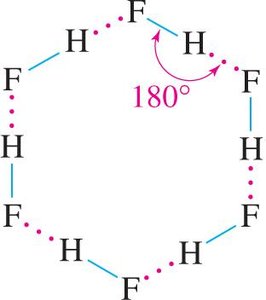
Hydrogen bonding occurs when hydrogen is bonded to highly electronegative atoms (N, O, F). In hydrogen fluoride (HF), hydrogen bonds form between molecules, leading to unique properties.
Bond angle: Hydrogen bonds often form at specific angles, such as 180° in HF clusters.
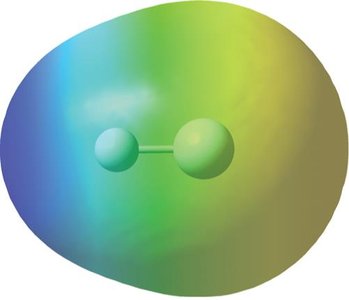
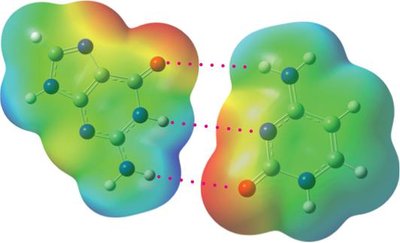
Electrostatic potential: Maps show regions of partial positive and negative charge.
Hydrogen Bonding in Water
Water exhibits extensive hydrogen bonding, which is responsible for its high boiling point, surface tension, and other unique properties.
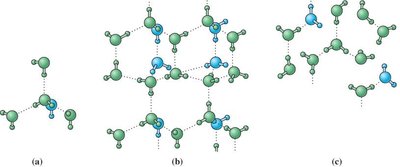
Structure: Each water molecule can form up to four hydrogen bonds.
Effect: Leads to high cohesion, density anomalies, and high heat capacity.
Density of Solids and Liquids
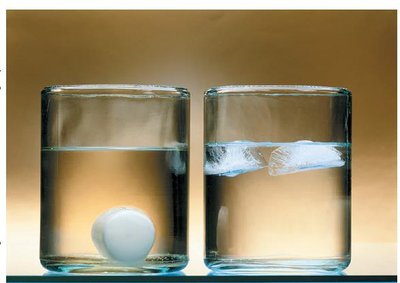
Hydrogen bonding affects the density of water and ice. Ice is less dense than liquid water due to its open, hexagonal structure.
Ice floats: The lower density of ice compared to liquid water causes it to float.
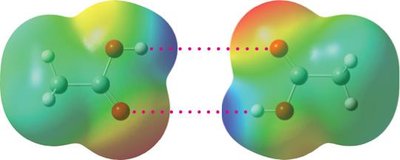
Acetic Acid Dimer
Hydrogen bonding can lead to the formation of dimers, as seen in acetic acid, where two molecules are held together by hydrogen bonds.
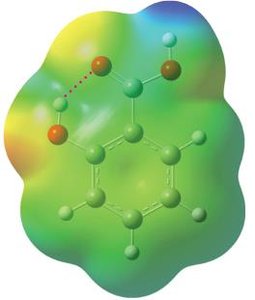
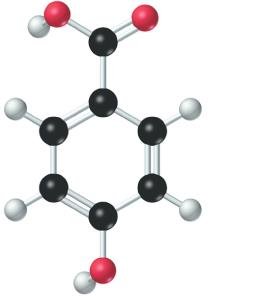
Intermolecular and Intramolecular Hydrogen Bonding
Hydrogen bonds can occur between molecules (intermolecular) or within a single molecule (intramolecular). Salicylic acid exhibits intramolecular hydrogen bonding, while para-hydroxybenzoic acid does not.
Hydrogen Bonding in Living Matter
Hydrogen bonds are crucial in biological systems, such as the pairing of guanine and cytosine in DNA.
Summary of van der Waals Forces
Dispersion forces exist between all molecules and increase with molecular size and shape. Permanent dipole forces are significant for molecules of similar size, but dispersion forces dominate for larger molecules.
Properties of Liquids
Cohesive and Adhesive Forces
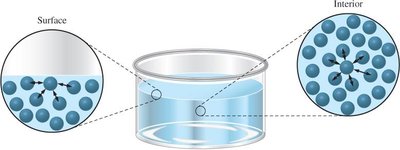
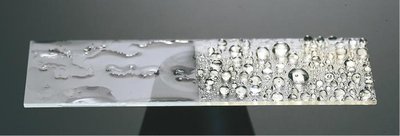
Cohesive forces are intermolecular attractions between like molecules, while adhesive forces are between unlike molecules.
Surface Tension
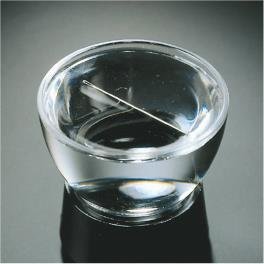
Surface tension is the energy required to increase the surface area of a liquid. It results from cohesive forces and is responsible for phenomena such as droplets and floating objects.
Meniscus Formation and Capillary Action
The meniscus is the curve seen at the surface of a liquid in a container, caused by adhesive and cohesive forces. Capillary action is the movement of liquid in narrow spaces due to these forces.

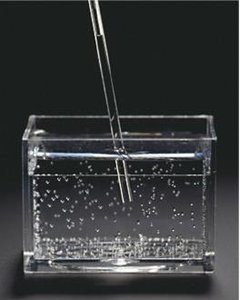
Viscosity
Viscosity is a liquid's resistance to flow. Stronger intermolecular forces result in higher viscosity.
Internal friction: Cohesive forces create friction, reducing flow rate.
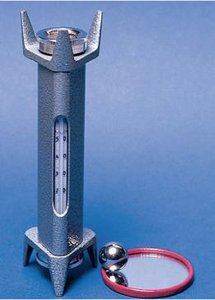
Enthalpy of Vaporization and Vapor Pressure
Enthalpy of Vaporization
The enthalpy of vaporization () is the energy required to convert a liquid to a gas at constant pressure.
Factors affecting vaporization: Temperature, surface area, and strength of intermolecular forces.
Equation:
Liquid-Vapor Equilibrium and Vapor Pressure
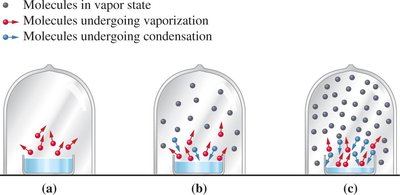
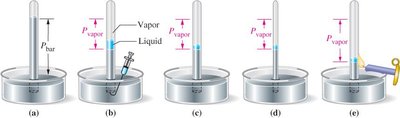
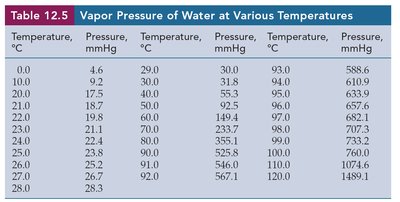
At equilibrium, the rate of vaporization equals the rate of condensation. Vapor pressure is the pressure exerted by a vapor in equilibrium with its liquid.
Vapor Pressure Curves
Vapor pressure increases with temperature. Different liquids have characteristic vapor pressure curves.
Clausius-Clapeyron Equation
The Clausius-Clapeyron equation relates vapor pressure and temperature:
Where
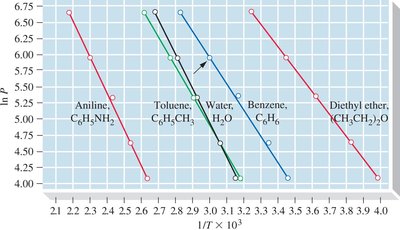
Another form:
Boiling and Boiling Point
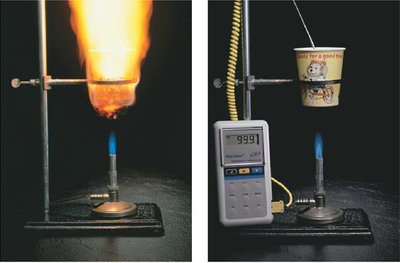
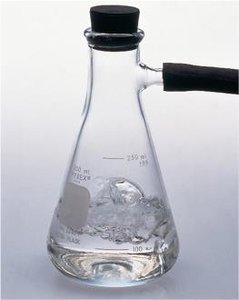
A liquid boils when its vapor pressure equals the external pressure. Boiling point decreases at lower atmospheric pressure.
Properties of Solids
Melting, Melting Point, and Heat of Fusion
Melting is the transition from solid to liquid. The melting point is the temperature at which this occurs, and the heat of fusion () is the energy required.
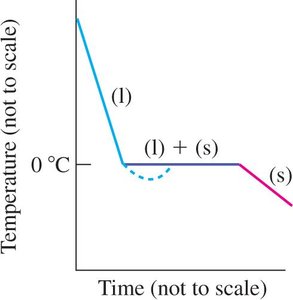
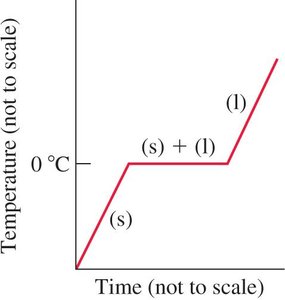
Sublimation
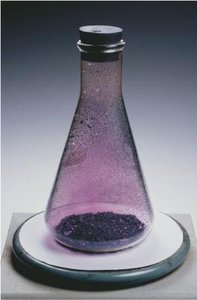
Sublimation is the direct transition from solid to gas. The enthalpy of sublimation () is the sum of the enthalpy of fusion and vaporization.
Phase Diagrams
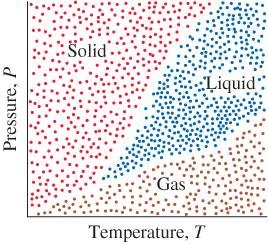
Temperature, Pressure, and States of Matter
Phase diagrams show the relationship between temperature, pressure, and the physical state of a substance.
Phase Diagram for Iodine
Phase Diagram for Carbon Dioxide
Critical Point and Supercritical Fluids
The critical point is where the liquid and gas phases become indistinguishable. Supercritical fluids have unique properties and applications, such as decaffeination of coffee.
Phase Diagram for Water
Network Covalent Solids and Ionic Solids
Diamond and Graphite Structures
Network covalent solids, such as diamond and graphite, have atoms connected by covalent bonds in a continuous network. Graphite conducts electricity due to delocalized electrons.
Fullerenes and Nanotubes
Other allotropes of carbon include fullerenes and nanotubes, which have unique structures and properties.
Ionic Solids
Ionic solids are composed of ions held together by electrostatic forces. Their properties include high melting points and electrical conductivity in molten or dissolved states.
Molecular Solids
Molecular solids are held together by intermolecular forces and generally have lower melting points.
Metallic Solids
Metallic solids consist of positive ions in a sea of delocalized electrons, resulting in high electrical conductivity and strong bonding.
Crystal Structures
Cubic Lattice and Unit Cells
Crystal lattices are regular arrangements of atoms, ions, or molecules. The cubic lattice is a common structure, with unit cells as the basic repeating units.
Closest Packed Structures
Atoms can be packed in cubic closest packed (ccp) or hexagonal closest packed (hcp) structures, maximizing density.
Coordination Number and Atoms per Unit Cell
The coordination number is the number of nearest neighbors to an atom in a crystal. The number of atoms per unit cell depends on how atoms are shared among cells.
X-Ray Diffraction
X-ray diffraction is used to determine crystal structures by analyzing the pattern of X-rays scattered by a crystal.
Ionic Crystal Structures
Ionic crystals, such as sodium chloride and cesium chloride, have specific arrangements of ions in their unit cells.
Energy Changes in the Formation of Ionic Crystals
The formation of ionic crystals involves energy changes, including lattice energy, which is the energy released when ions form a crystal lattice.
Additional info: Academic context and explanations have been expanded for clarity and completeness. Only images directly relevant to the adjacent paragraph have been included.
