 Back
BackInternal Energy and Enthalpy in Chemical Systems
Study Guide - Smart Notes
 Tailored notes based on your materials, expanded with key definitions, examples, and context.
Internal Energy and Enthalpy
The First Law of Thermodynamics
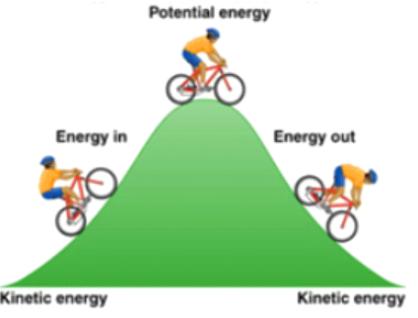
The First Law of Thermodynamics states that energy cannot be created or destroyed, only transferred or transformed. In chemistry, this law is applied to understand how energy changes during chemical reactions and physical processes.
Internal energy (E) is the sum of all kinetic and potential energies of the particles in a system.
Energy can be transferred as heat (q) or work (w).
The change in internal energy is given by:
Types of Chemical Systems
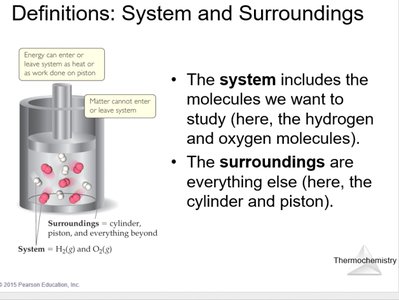
Chemical systems are classified based on their ability to exchange energy and matter with their surroundings:
Open system: Can exchange both energy and matter with surroundings.
Closed system: Can exchange energy but not matter.
Isolated system: Cannot exchange either energy or matter.
Defining the system and surroundings is crucial for thermodynamic calculations.
Internal Energy
Defining Internal Energy
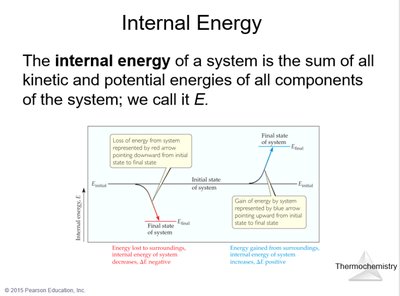
The internal energy of a system, denoted as E, is the total energy contained within the system, including both kinetic and potential energies of all particles. Because measuring all individual energies is impractical, chemists focus on changes in internal energy ().
Energy can be lost or gained by the system, affecting .
Sign conventions help track these changes.
Sign Conventions for Energy Changes
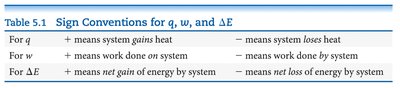
Sign conventions are used to indicate the direction of energy transfer:
Quantity | Positive (+) | Negative (-) |
|---|---|---|
q (heat) | System gains heat | System loses heat |
w (work) | Work done on system | Work done by system |
Net gain of energy by system | Net loss of energy by system |
Work in Chemical Systems
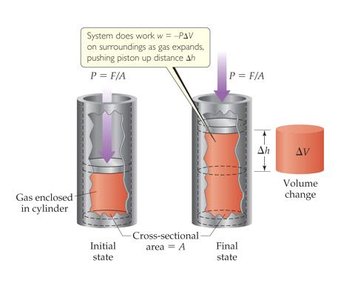
Work is often associated with changes in volume, especially in reactions involving gases. The mathematical model for work done by or on a system is:
Where P is pressure and is the change in volume.
Work is negative when the system does work on the surroundings (expansion).
Enthalpy
Defining Enthalpy
Enthalpy (H) is a thermodynamic quantity that is particularly useful for processes occurring at constant pressure. It is defined as:
Change in enthalpy:
At constant pressure:
Enthalpy changes are easier to measure than absolute enthalpy values, so chemists focus on .
Enthalpy Under Constant Volume and Pressure
Enthalpy changes differ depending on whether a reaction occurs at constant volume or constant pressure:
At constant volume: (since )
At constant pressure:
Enthalpy of Reaction
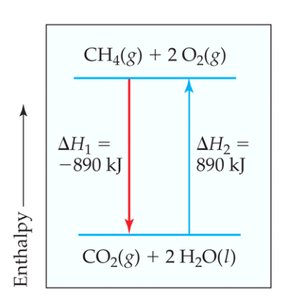
The enthalpy of reaction () is the heat absorbed or released during a chemical reaction at constant pressure. It is calculated as the difference in enthalpy between products and reactants:
Endothermic and Exothermic Reactions
Bond Breaking and Formation
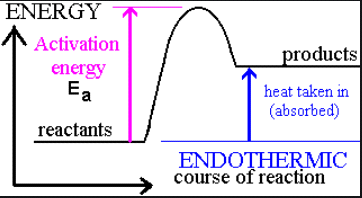
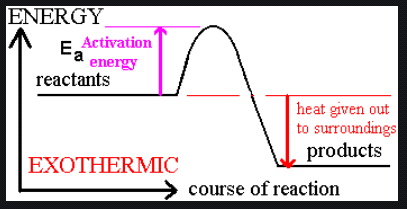
Breaking chemical bonds requires energy (endothermic), while forming bonds releases energy (exothermic). The overall enthalpy change depends on the balance between these two processes:
Endothermic reaction: Energy absorbed;
Exothermic reaction: Energy released;
Whether a reaction is endothermic or exothermic depends on the relative magnitudes of energy invested in breaking bonds and energy released in forming new bonds.
Quantitative Assessment of Enthalpy
Enthalpy changes can be measured experimentally or calculated using bond energies, standard enthalpies of formation, or Hess's Law. These quantitative assessments are essential for predicting reaction behavior and energy requirements.
Example: Combustion of methane:
(exothermic)
