 Back
BackIntroduction to Chemistry: Matter, Change, and Measurement
Study Guide - Smart Notes
 Tailored notes based on your materials, expanded with key definitions, examples, and context.
Introduction to Chemistry
The Nature of Chemistry
Chemistry is the science that seeks to understand the behavior of matter and the changes it undergoes. Matter is defined as anything that has mass and occupies space. Everyday objects such as desks, chairs, and even our bodies are composed of matter.
Matter: Anything with mass and volume.
Chemical Change: Transformation resulting in new substances.
Physical Change: Transformation that does not alter the chemical identity.
The Scientific Method
Steps in Scientific Investigation
The scientific method is a systematic approach used by scientists to explore observations, formulate hypotheses, and test them through experiments. This process leads to the development of scientific laws and theories.
Observation: Gathering information about phenomena.
Hypothesis: A tentative explanation for observations.
Experiment: Controlled procedures to test hypotheses.
Law: A statement summarizing consistent observations and predicting future events.
Theory: A well-supported explanation that accounts for laws and observations, often predicting behavior beyond the observed data.
Key Distinction: A law summarizes what happens; a theory explains why it happens.
Classification of Matter
States and Composition of Matter
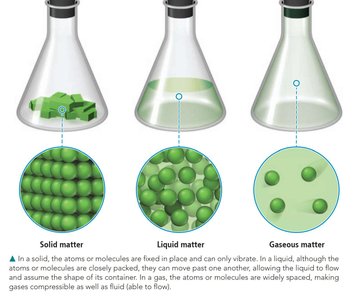
Matter can be classified by its physical state (solid, liquid, gas) and by its composition (element, compound, mixture). The arrangement and movement of particles differ in each state.
Solid: Particles are closely packed and vibrate in place.
Liquid: Particles are close but can move past one another, allowing liquids to flow.
Gas: Particles are widely spaced and move freely, making gases compressible and able to flow.
Classification by Composition
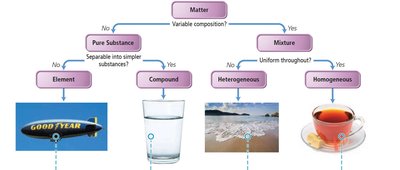
Matter is further classified as pure substances or mixtures. Pure substances have a constant composition, while mixtures contain variable proportions of components.
Element: Cannot be broken down into simpler substances.
Compound: Composed of two or more elements in fixed proportions.
Mixture: Contains two or more substances in variable proportions.
Heterogeneous Mixture: Composition varies throughout the sample.
Homogeneous Mixture: Uniform composition throughout (also called a solution).
Atomic and Molecular Representations
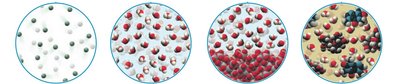
Visual models help distinguish between elements, compounds, and mixtures at the molecular level.
Separation of Mixtures
Physical Methods of Separation
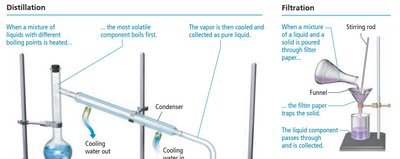
Mixtures can be separated into their components by physical means, such as distillation and filtration.
Distillation: Separates substances based on differences in boiling points.
Filtration: Separates solids from liquids using a filter medium.

Physical and Chemical Changes
Types of Changes in Matter
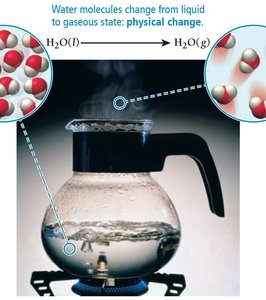
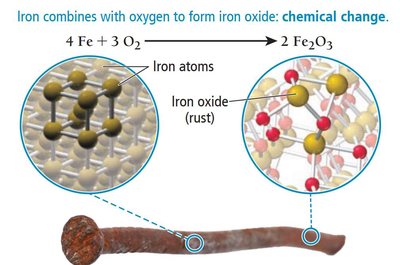
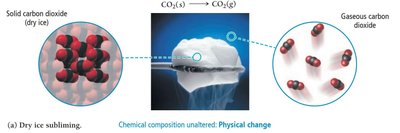
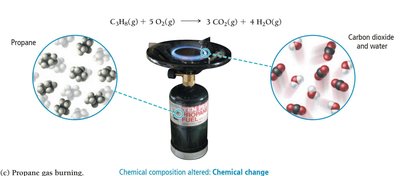
Changes in matter are classified as physical or chemical based on whether the composition of the substance is altered.
Physical Change: Alters state or appearance without changing composition (e.g., melting, boiling).
Chemical Change: Alters the composition, resulting in new substances (e.g., burning, rusting).
Physical and Chemical Properties
Properties are classified based on whether they can be observed without changing the substance's composition.
Physical Properties: Odor, taste, color, melting point, boiling point, density.
Chemical Properties: Flammability, acidity, reactivity, toxicity.
Energy in Chemistry
Forms and Conservation of Energy
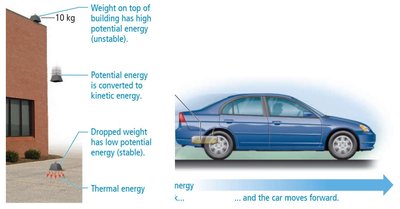
Energy is the capacity to do work. It exists in various forms and is always conserved in physical and chemical changes.
Kinetic Energy: Energy of motion.
Potential Energy: Energy due to position or composition.
Thermal Energy: Associated with temperature; a form of kinetic energy.
Law of Conservation of Energy: Energy cannot be created or destroyed, only transformed.
Measurement in Chemistry
Quantitative Data and Units
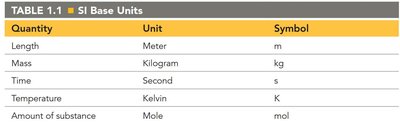
Measurements in chemistry consist of a number and a unit. The International System of Units (SI) provides standard units for scientific measurements.
Base Units: Meter (m), kilogram (kg), second (s), kelvin (K), mole (mol).
Common Units and Conversions
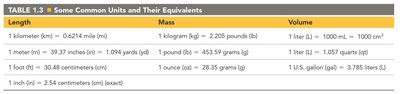
Other units are commonly used and can be converted to SI units as needed.
Temperature Scales
Temperature can be measured in Celsius (°C), Fahrenheit (°F), or Kelvin (K). The Kelvin scale is the SI standard and has no negative values.
Kelvin (K): Absolute temperature scale; 0 K is absolute zero.
Conversion Formulas:
$K = \text{°C} + 273.15$
$\text{°F} = 1.8(\text{°C}) + 32$
SI Prefixes and Derived Units
Prefix Multipliers
SI prefixes indicate powers of ten and are used to express very large or small quantities conveniently.

Derived Units: Volume and Density
Some properties require combinations of base units. Volume and density are common derived units in chemistry.
Volume: $V = x^3$ (for a cube), measured in $\text{m}^3$, $\text{cm}^3$, or $\text{mL}$.
Density: $d = \frac{\text{mass}}{\text{volume}}$, typically in $\text{g/cm}^3$ or $\text{kg/m}^3$.
Intensive Property: Independent of amount (e.g., density).
Extensive Property: Dependent on amount (e.g., volume).
Example Calculation:
$d = \frac{3.15\ \text{g}}{0.233\ \text{cm}^3} = 13.5\ \text{g/cm}^3$
This density is less than that of platinum (21.4 g/cm3), indicating the ring is not genuine platinum.
