 Back
BackIntroduction to Solutions and Aqueous Reactions: Solution Concentration and Stoichiometry
Study Guide - Smart Notes
 Tailored notes based on your materials, expanded with key definitions, examples, and context.
Introduction to Solutions and Aqueous Reactions
What is a Solution?
A solution is a homogeneous mixture of two or more substances. The substance present in the largest amount is called the solvent, while the substance(s) present in lesser amounts are called solutes. When water is the solvent, the solution is termed an aqueous solution.
Homogeneous mixture: Uniform composition throughout.
Solvent: Major component (e.g., water in saltwater).
Solute: Minor component (e.g., salt in saltwater).
Concentration of Solutions
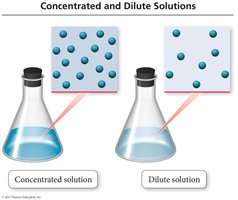
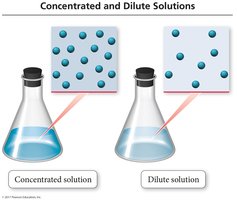
The concentration of a solution quantifies the amount of solute relative to the solvent. Solutions can be described as dilute (small amount of solute) or concentrated (large amount of solute).
Dilute solution: Low solute-to-solvent ratio.
Concentrated solution: High solute-to-solvent ratio.
Quantitative Expression: Molarity (M)
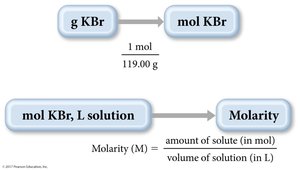
Molarity (M) is the most common unit for expressing solution concentration in chemistry. It is defined as the number of moles of solute per liter of solution:
Formula:
To calculate molarity, convert the mass of solute to moles using the molar mass, then divide by the total volume of solution in liters.
Example: Calculating Solution Concentration
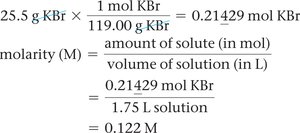
Calculate the molarity of a solution prepared by dissolving 25.5 g of KBr in enough water to make 1.75 L of solution.
Step 1: Convert grams KBr to moles KBr using molar mass (119.00 g/mol).
Step 2: Divide moles of KBr by volume of solution in liters.
Using Molarity in Calculations
Molarity can be used as a conversion factor between moles of solute and volume of solution. For example, a 0.500 M NaCl solution contains 0.500 mol NaCl per liter of solution.
To find moles from volume:
To find volume from moles:


Example: Using Molarity to Find Volume
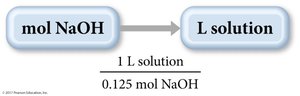
How many liters of a 0.125 M NaOH solution contain 0.255 mol NaOH?
Step 1: Use the conversion factor from molarity to convert moles to liters.
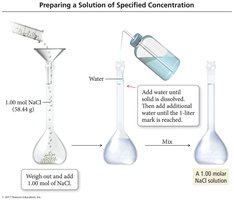
Preparing a Solution of Specified Concentration
To prepare a solution of a specific molarity, weigh out the required amount of solute, dissolve it in a small amount of solvent, and then dilute to the desired final volume.
Solution Dilution
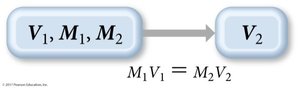
To make a less concentrated solution from a more concentrated stock solution, add more solvent. The amount of solute remains constant:
Dilution equation:
and are the molarity and volume of the stock solution; and are those of the diluted solution.
Example: Solution Dilution Calculation
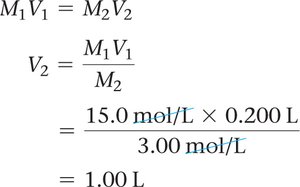
To what volume should you dilute 0.200 L of a 15.0 M NaOH solution to obtain a 3.00 M NaOH solution?
Step 1: Use the dilution equation to solve for the final volume.
Solution Stoichiometry
Molarity allows chemists to relate the volume of a solution to the amount of reactant or product in a chemical reaction. The general approach is:
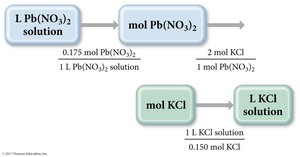
Volume of solution → Moles of solute (using molarity) → Moles of other reactant/product (using stoichiometry) → Volume of other solution (using molarity)
Example: Solution Stoichiometry Calculation
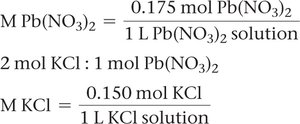
What volume of 0.150 M KCl solution will completely react with 0.150 L of a 0.175 M Pb(NO3)2 solution?
Step 1: Convert volume of Pb(NO3)2 to moles using molarity.
Step 2: Use the balanced equation to find moles of KCl required.
Step 3: Convert moles of KCl to volume using molarity.

Summary Table: Key Equations
Concept | Equation (LaTeX) |
|---|---|
Molarity | |
Dilution |
Additional info: These notes cover the foundational concepts of solution concentration, preparation, dilution, and stoichiometric calculations in aqueous reactions, which are essential for laboratory and theoretical chemistry work.
