 Back
BackLab Techniques: The Range of a Spring Gun – Experimental Design, Data Analysis, and Error Considerations
Study Guide - Smart Notes
 Tailored notes based on your materials, expanded with key definitions, examples, and context.
Lab Techniques and Procedures
Introduction to the Spring Gun Experiment
This experiment investigates the relationship between the range of a spring gun and its trigger setting, focusing on determining the spring constant (k) and the friction coefficient (μ). The experiment also introduces students to the concepts of random errors and the statistical analysis of experimental data. The spring gun launches a steel ball horizontally from a table, and the range is measured for different trigger settings, corresponding to different spring displacements.
Experimental Apparatus and Setup
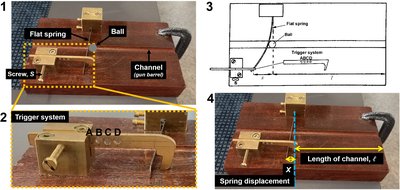
Spring Gun: Consists of a flat spring, a channel (barrel), a trigger system with multiple settings (A, B, C, D), and a steel ball.
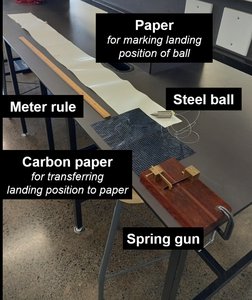
Measurement Tools: Meter rule for measuring distances, paper strip for marking landing positions, and carbon paper for transferring the impact mark.
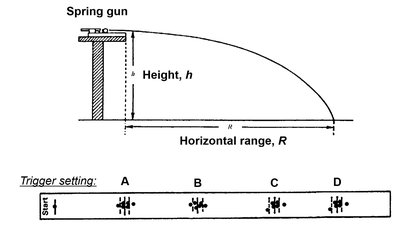
Variables: Length of channel (l), height from table to floor (h), mass of steel ball (m), spring displacement (X), and horizontal range (R).
Experimental Procedure
Clamp the spring gun to the edge of the table. Measure and record l, h, and m.
Lay a strip of white paper on the floor below the gun, with carbon paper on top to mark the ball's landing position.
Perform trial shots to ensure accurate marking of the ball's impact.
For each trigger setting (A, B, C, D):
Measure the spring displacement (X).
Fire the gun and measure the horizontal range (R), repeating at least six times per setting to analyze random errors.
Record all measurements for subsequent data analysis.
Data Analysis and Theoretical Background
Energy Considerations and Equations
The velocity (v0) of the ball as it leaves the spring gun is determined using energy conservation. The initial energy stored in the spring is partially converted to kinetic and rotational energy, with some energy lost to friction. The relevant equations are:
Energy Conservation (including friction):
Horizontal Range (R):
Where the time of flight (t) is determined by the vertical drop from height h:
Combined Range Equation (with friction):
Range Equation (neglecting friction):
Graphical Analysis
Plot R2 versus X2 for all trigger settings.
Include error bars to represent random errors in measurement.
The slope and intercept of the best-fit line allow determination of the spring constant (k) and friction coefficient (μ).
Statistical and Experimental Error Considerations
Random errors are assessed by repeating measurements and analyzing the spread of R values for each trigger setting.
Systematic errors may arise from misalignment, friction, or inaccurate measurements.
Good laboratory practice includes keeping the paper strip in place until all measurements are complete to avoid introducing errors.
Summary Table: Key Variables and Their Roles
Variable | Symbol | Description |
|---|---|---|
Spring constant | k | Measures the stiffness of the spring (N/m) |
Friction coefficient | μ | Quantifies friction between ball and channel |
Spring displacement | X | Distance spring is bent at trigger |
Channel length | l | Distance ball travels in barrel |
Ball mass | m | Mass of steel ball |
Height | h | Vertical distance from table to floor |
Horizontal range | R | Distance from table edge to landing point |
Conclusion
This experiment provides practical experience in experimental design, measurement, and data analysis, reinforcing key concepts in classical mechanics and laboratory techniques. By analyzing the relationship between the spring displacement and the range, students determine important physical constants and gain insight into the effects of friction and random errors in experimental physics and chemistry.
