Back
BackLewis Structures, Formal Charges, and Resonance in General Chemistry
Study Guide - Smart Notes
 Tailored notes based on your materials, expanded with key definitions, examples, and context.
Q1. What are Lewis symbols and how are they used to represent atoms and molecules?
Background
Topic: Lewis Symbols and Structures
This question tests your understanding of how Lewis symbols are used to represent valence electrons in atoms and how these symbols are applied to construct Lewis structures for molecules.
Key Terms and Formulas
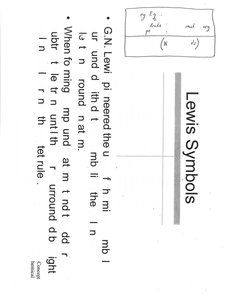
Lewis Symbol: A representation of an atom showing its valence electrons as dots around the element's symbol.
Valence Electrons: Electrons in the outermost shell of an atom, involved in bonding.
Octet Rule: Atoms tend to gain, lose, or share electrons to achieve eight valence electrons.
Step-by-Step Guidance
Identify the element and determine the number of valence electrons using the periodic table.
Draw the element's symbol and place dots around it to represent each valence electron.
For molecules, combine Lewis symbols for each atom, arranging them to show shared pairs (bonds) and lone pairs.
Apply the octet rule to ensure each atom (except exceptions like H, He) has eight electrons around it.
Try solving on your own before revealing the answer!
Q2. How do you calculate formal charge in a Lewis structure?
Background
Topic: Formal Charge Calculation
This question tests your ability to use the formal charge formula to determine the charge on atoms within a molecule based on their Lewis structure.
Key Terms and Formulas
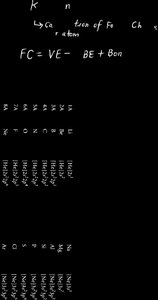
Formal Charge (FC): The charge assigned to an atom in a molecule, calculated as:
VE = Number of valence electrons in the free atom
BE = Number of electrons assigned to bonds (shared electrons/2)
BON = Number of non-bonding (lone pair) electrons
Step-by-Step Guidance
Draw the Lewis structure for the molecule or ion.
For each atom, count the number of valence electrons it would have as a free atom.
Count the number of electrons assigned to bonds (shared electrons divided by 2).
Count the number of non-bonding electrons (lone pairs).
Apply the formal charge formula for each atom.
Try solving on your own before revealing the answer!
Q3. How do you draw Lewis structures for molecules and ions, including resonance structures?
Background
Topic: Drawing Lewis Structures and Resonance
This question tests your ability to construct Lewis structures for molecules and ions, and to identify resonance structures where applicable.
Key Terms and Formulas
Resonance Structure: Different possible Lewis structures for a molecule or ion that differ only in the placement of electrons, not atoms.
Octet Rule: Most atoms strive for eight electrons in their valence shell.
Steps for Drawing Lewis Structures:
Step-by-Step Guidance
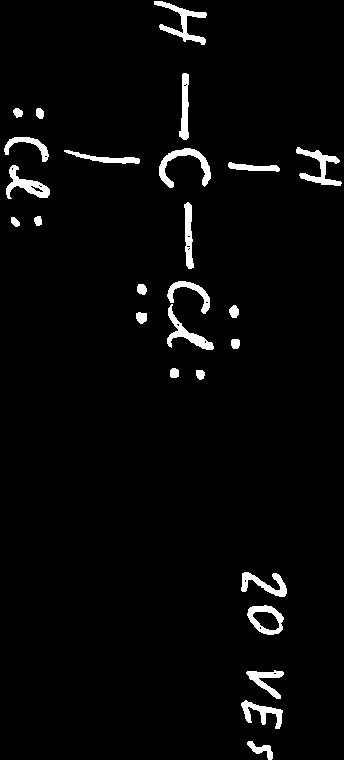
Count the total number of valence electrons for all atoms in the molecule or ion.
Choose the central atom (usually the least electronegative, except hydrogen).
Connect the atoms with single bonds and distribute remaining electrons as lone pairs.
Check if all atoms satisfy the octet rule; if not, form double or triple bonds as needed.
If multiple valid structures exist, draw all resonance forms and indicate them with double-headed arrows.
Try solving on your own before revealing the answer!
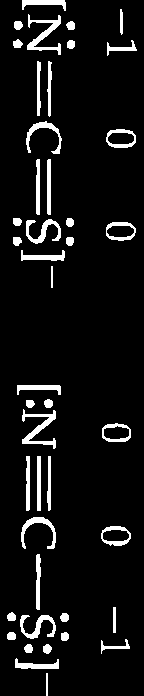
Q4. How do you determine if a Lewis structure obeys the octet rule?
Background
Topic: Octet Rule in Lewis Structures
This question tests your ability to evaluate whether atoms in a Lewis structure have eight electrons in their valence shell, and to identify exceptions to the rule.
Key Terms and Formulas
Octet Rule: Atoms (except H, He, B, Be, and some transition elements) strive for eight valence electrons.
Exceptions: Some elements can have fewer or more than eight electrons (expanded octet, incomplete octet).
Step-by-Step Guidance
Draw the Lewis structure for the molecule or ion.
Count the number of electrons around each atom (including bonding and lone pairs).
Compare the electron count to the octet rule (eight electrons).
Identify any atoms that do not obey the octet rule and note if they are exceptions.
Try solving on your own before revealing the answer!
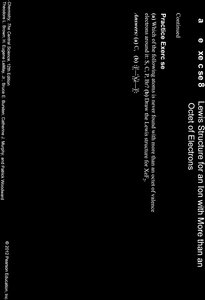
Q5. How do you draw Lewis structures for ions with more than an octet of electrons?
Background
Topic: Expanded Octet in Lewis Structures
This question tests your understanding of how certain elements (usually in period 3 or higher) can have more than eight electrons in their valence shell.
Key Terms and Formulas
Expanded Octet: Elements in period 3 or higher can accommodate more than eight electrons due to available d orbitals.
Lewis Structure: Shows all valence electrons, including those in expanded octets.
Step-by-Step Guidance
Count the total number of valence electrons for the ion.
Draw the basic skeleton structure, placing the central atom (often a period 3 or higher element).
Distribute electrons to satisfy the octet rule for surrounding atoms first.
Place remaining electrons on the central atom, allowing it to exceed eight electrons if necessary.
Try solving on your own before revealing the answer!