 Back
BackLiquids and Solids: Intermolecular Forces, Properties, and Structures
Study Guide - Smart Notes
 Tailored notes based on your materials, expanded with key definitions, examples, and context.
Liquids and Solids
Phases of Matter
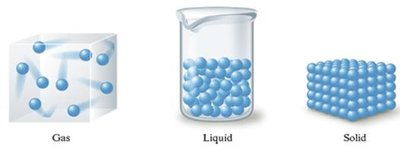
The three primary phases of matter—solid, liquid, and gas—differ in their molecular arrangement, density, and movement. These differences are governed by the strength and type of intermolecular forces present.
Solid: Definite shape and volume; particles are closely packed in a fixed arrangement.
Liquid: Definite volume but takes the shape of its container; particles are close but can move past one another.
Gas: Indefinite shape and volume; particles are far apart and move freely.
Intermolecular Forces (IMFs)
Overview of Intermolecular Forces
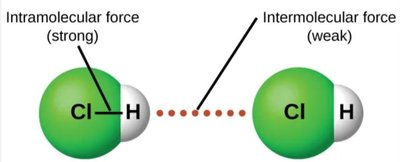
Intermolecular forces are the attractive forces between separate molecules. They are much weaker than intramolecular (covalent or ionic) bonds but are crucial in determining the physical properties of substances, such as boiling and melting points.
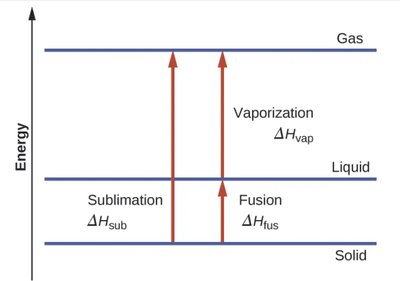
Measured by: Boiling point (ΔHvap), melting point (ΔHfus), and sublimation point (ΔHsub).
Types of IMFs: Dipole-dipole, ion-dipole, hydrogen bonding, and London dispersion forces.
Dipole-Dipole Forces
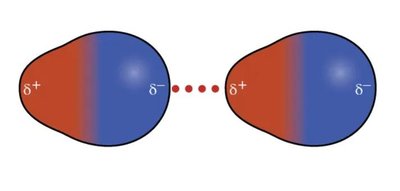
Dipole-dipole forces occur between polar molecules, where the positive end of one molecule is attracted to the negative end of another. These interactions lead to higher boiling and melting points compared to nonpolar molecules of similar size.
Example: Hydrogen chloride (HCl) molecules exhibit dipole-dipole attractions.
Ion-Dipole Forces
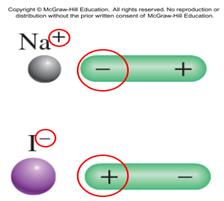
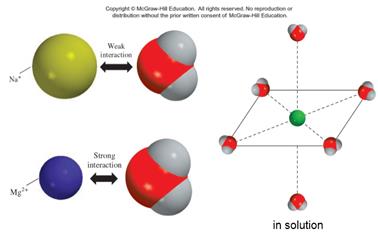
Ion-dipole forces are electrostatic attractions between an ion and a polar molecule. These are especially important in solutions where ionic compounds dissolve in polar solvents like water.
Example: Sodium ion (Na+) interacting with the negative end of a water molecule.
London Dispersion Forces (LDF)
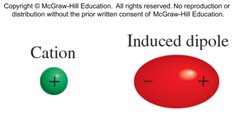
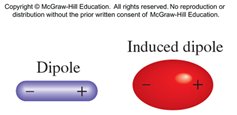
London dispersion forces are the weakest type of intermolecular force and are present in all molecules, whether polar or nonpolar. They arise from temporary, instantaneous dipoles created by the movement of electrons.
Polarizability: The ease with which an electron cloud can be distorted to form a dipole. Increases with more electrons and larger, more diffuse electron clouds.
Strength: Increases with molecular weight and surface area.
Hydrogen Bonding
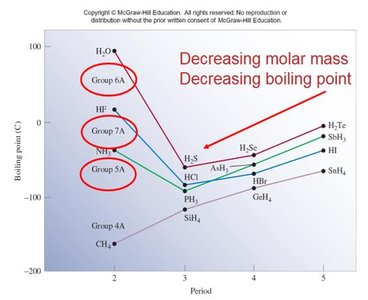
Hydrogen bonding is a special, strong type of dipole-dipole interaction that occurs when hydrogen is bonded to highly electronegative atoms (N, O, or F). The hydrogen atom interacts with a lone pair on another electronegative atom.
Depicted as: Dotted or dashed lines between molecules.
Significance: Responsible for unique properties of water, DNA structure, and protein folding.
Properties of Liquids
Surface Tension
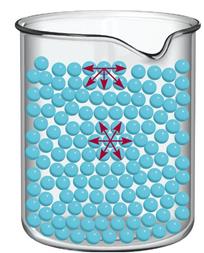
Surface tension is the energy required to increase the surface area of a liquid. It results from cohesive forces between molecules at the surface. Stronger intermolecular forces lead to higher surface tension.
Viscosity
Viscosity is a measure of a liquid's resistance to flow. Liquids with strong intermolecular forces (e.g., glycerol) have higher viscosity than those with weaker forces (e.g., water).
Cohesion and Adhesion
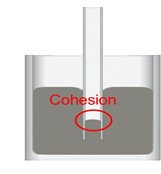
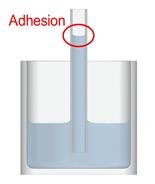
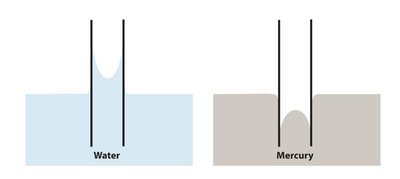
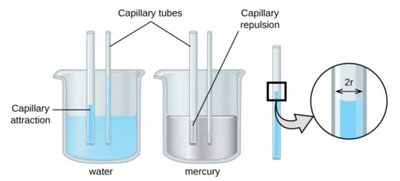
Cohesion refers to the attraction between like molecules, while adhesion is the attraction between unlike molecules. These forces explain phenomena such as meniscus formation and capillary action.
Cohesion: Responsible for surface tension and the spherical shape of droplets.
Adhesion: Allows liquids to climb surfaces and explains the concave meniscus of water in glass.

Capillary Action
Capillary action is the movement of liquid within narrow spaces due to adhesive and cohesive forces. The height a liquid rises in a capillary tube is given by:
Phase Transitions and Phase Diagrams
Phase Transitions
Phase transitions are changes between solid, liquid, and gas states. Common transitions include:
Vaporization (evaporation): Liquid to gas
Condensation: Gas to liquid
Melting (fusion): Solid to liquid
Freezing: Liquid to solid
Sublimation: Solid to gas
Deposition: Gas to solid
Vapor Pressure and Boiling Point
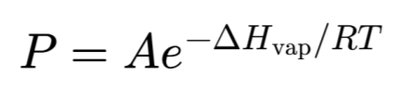
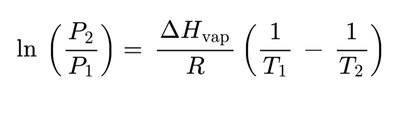
Vapor pressure is the pressure exerted by a vapor in equilibrium with its liquid. The boiling point is the temperature at which vapor pressure equals external pressure. The Clausius-Clapeyron equation relates vapor pressure and temperature:
Or, in a linearized form:
Phase Diagrams
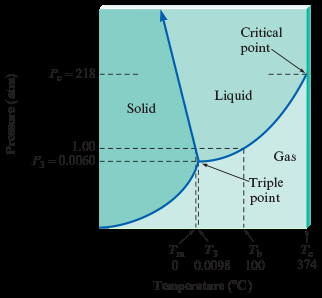
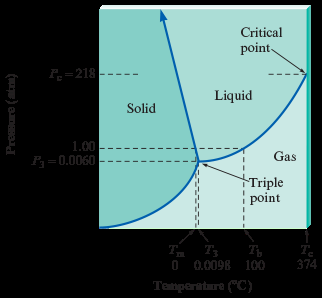
A phase diagram shows the state of a substance as a function of temperature and pressure. Key features include:
Triple point: All three phases coexist in equilibrium.
Critical point: The end point of the liquid-gas boundary; above this, the substance is a supercritical fluid.
The Solid State
Types of Solids
Solids can be classified based on the nature of their constituent particles and the forces holding them together:
Ionic solids: Composed of cations and anions; high melting points, hard, brittle.
Metallic solids: Metal atoms in a sea of delocalized electrons; conductive, malleable, ductile.
Covalent network solids: Atoms connected by covalent bonds; very hard, high melting points (e.g., diamond).
Molecular solids: Neutral molecules held by IMFs; low melting points, non-conductive.
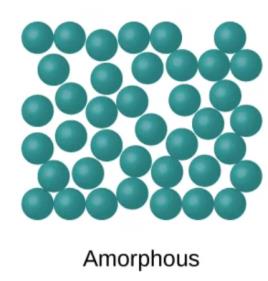
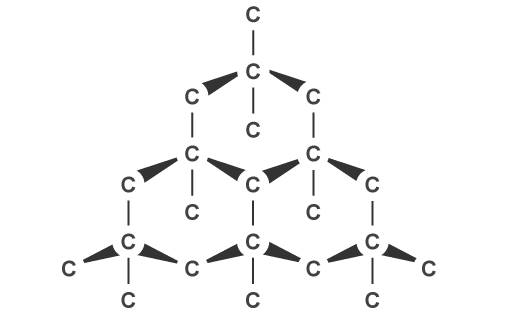
Crystal Defects
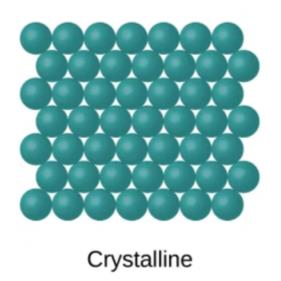
Crystalline solids may contain defects such as vacancies (missing particles), interstitials (extra particles in spaces), and substitutional impurities (different atoms replacing host atoms).
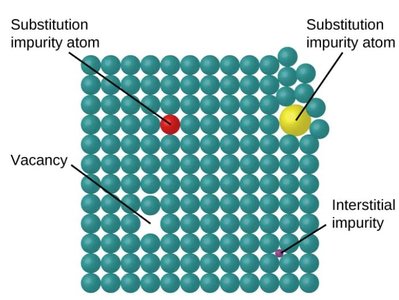
Unit Cells and Lattice Structures
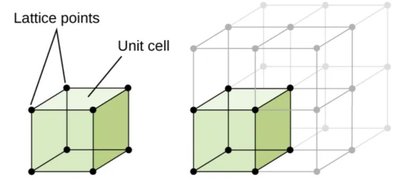
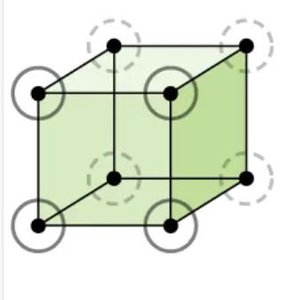
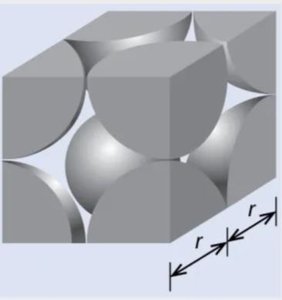
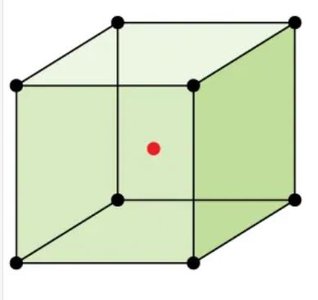
The unit cell is the smallest repeating unit in a crystal lattice. The arrangement of atoms within the unit cell determines the overall structure and properties of the solid.
Simple cubic: Atoms at each corner; coordination number 6; 1 atom per unit cell.
Body-centered cubic (BCC): Atoms at corners and one in the center; coordination number 8; 2 atoms per unit cell.
Face-centered cubic (FCC): Atoms at corners and centers of faces; coordination number 12; 4 atoms per unit cell.
Type | Particles | Attraction | Properties | Examples |
|---|---|---|---|---|
Ionic | Ions | Ionic bonds | Hard, brittle, non-conductive (as solid), very high MP | NaCl, KBr |
Metallic | Metal atoms | Metallic bonds | Shiny, malleable, ductile, conduct heat and electricity | Fe, Cu |
Covalent network | Nonmetal atoms/molecules | Covalent bonds | Very hard, non-conductive, very high MP | Diamond, SiO2 |
Molecular | Molecules | IMFs | Non-conductive, low MP | Ice, CO2 |
