 Back
BackLiquids, Solids, and Intermolecular Forces: Study Notes
Study Guide - Smart Notes
 Tailored notes based on your materials, expanded with key definitions, examples, and context.
Liquids, Solids, and Intermolecular Forces
Introduction
This chapter explores the properties of liquids and solids, focusing on the role of intermolecular forces in determining the physical behavior of substances. Understanding these forces is essential for explaining phenomena such as boiling, melting, and solubility.
The States of Matter
Three States of Water
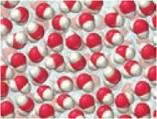
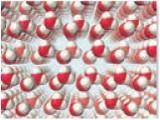
Water exists in three states: solid (ice), liquid (water), and gas (steam). The physical properties of each state are determined by the arrangement and movement of water molecules.
Solid (Ice): Molecules are packed closely in a regular pattern, resulting in a definite shape and volume. Ice is less dense than liquid water, which is unusual and vital for life.
Liquid (Water): Molecules are close together but can move past each other, giving water an indefinite shape but a definite volume.
Gas (Steam): Molecules are far apart and move freely, resulting in both indefinite shape and volume.
Properties of the States of Matter
State | Density | Shape | Volume | Strength of Intermolecular Forces |
|---|---|---|---|---|
Gas | Low | Indefinite | Indefinite | Weak |
Liquid | High | Indefinite | Definite | Moderate |
Solid | High | Definite | Definite | Strong |
Liquids
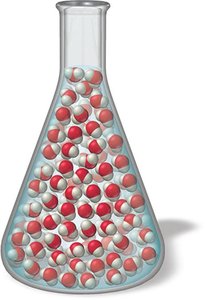
Liquids are nearly incompressible due to close molecular packing, but their particles can move, allowing them to flow and take the shape of their container.
Gases
Gas particles have complete freedom of motion and are widely spaced, making gases compressible and able to expand to fill their container.

Solids
Solids have particles fixed in position, resulting in incompressibility and a definite shape and volume. Solids can be crystalline (ordered) or amorphous (disordered).

Phase Changes
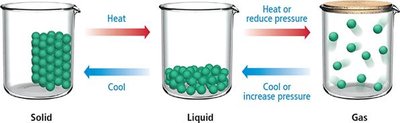
Changing the state of matter involves altering the kinetic energy of particles or their freedom of movement. Heating causes melting and boiling, while cooling or increasing pressure can induce condensation or freezing.
Intermolecular Forces
Types of Intermolecular Forces
Intermolecular forces are the attractions between molecules that determine the physical properties of substances. They are generally much weaker than chemical bonds.
Dispersion Forces (London Forces): Present in all molecules and atoms, caused by temporary dipoles due to electron movement.
Dipole–Dipole Forces: Occur in polar molecules with permanent dipoles, increasing boiling and melting points compared to nonpolar molecules.
Hydrogen Bonds: A special, strong type of dipole–dipole force when H is bonded to F, O, or N.
Ion–Dipole Forces: Occur in mixtures of ionic compounds and polar molecules, crucial for dissolving salts in water.

Dispersion Forces
Dispersion forces arise from temporary shifts in electron density, creating instantaneous dipoles that induce dipoles in neighboring molecules. The strength increases with molar mass and molecular size.

Effect of Molecular Size and Shape
Larger molecules with more electrons have stronger dispersion forces. Molecules with more surface area (less branching) also have stronger attractions and higher boiling points.

Dipole–Dipole Forces
Polar molecules experience dipole–dipole attractions, which add to the overall intermolecular forces and raise boiling and melting points compared to similar nonpolar molecules.
Hydrogen Bonding
Hydrogen bonds are especially strong dipole–dipole attractions that occur when hydrogen is bonded to highly electronegative atoms (F, O, N). Substances with hydrogen bonding have much higher boiling and melting points than expected.
Ion–Dipole Forces
Ion–dipole forces are the strongest intermolecular attractions and are important in solutions of ionic compounds in polar solvents like water.
Summary Table: Types and Relative Strength of Intermolecular Forces
Type | Relative Strength | Occurs Between |
|---|---|---|
Dispersion | Weakest* | All molecules/atoms |
Dipole–Dipole | Intermediate | Polar molecules |
Hydrogen Bonding | Strong | H bonded to F, O, or N |
Ion–Dipole | Strongest | Ions and polar molecules |
*Dispersion forces can be strong for large molecules.
Properties of Liquids
Surface Tension
Surface tension is the energy required to increase the surface area of a liquid. It results from cohesive forces pulling surface molecules inward, causing liquids to form droplets and allowing objects denser than water to float if placed gently.
Viscosity
Viscosity is a liquid's resistance to flow. It increases with stronger intermolecular forces and decreases with higher temperature. More spherical molecules have lower viscosity due to easier rolling motion.
Capillary Action and Meniscus
Capillary action is the ability of a liquid to rise in a narrow tube due to adhesive (liquid-tube) and cohesive (liquid-liquid) forces. The meniscus shape (concave or convex) depends on the balance between these forces.
Phase Changes and Energetics
Vaporization and Condensation
Vaporization is the process by which molecules escape from the liquid phase to the gas phase. It is endothermic, requiring energy input. Condensation is the reverse, exothermic process.
Heat of Vaporization (ΔHvap): The energy required to vaporize one mole of liquid.
Heat of Condensation (ΔHcond): Equal in magnitude but opposite in sign to ΔHvap.
Dynamic Equilibrium and Vapor Pressure
In a closed system, the rates of vaporization and condensation become equal, establishing dynamic equilibrium. The pressure exerted by the vapor at equilibrium is the vapor pressure. Higher temperature and weaker intermolecular forces increase vapor pressure.
Boiling Point
The boiling point is the temperature at which the vapor pressure equals the external pressure. The normal boiling point is defined at 1 atm. Lower external pressure lowers the boiling point.
Clausius–Clapeyron Equation
The Clausius–Clapeyron equation relates vapor pressure and temperature:
Where and are vapor pressures at temperatures and , is the heat of vaporization, and is the gas constant.
Supercritical Fluids and Critical Point
At the critical temperature and pressure, the distinction between liquid and gas disappears, forming a supercritical fluid with properties of both states.
Sublimation and Deposition
Sublimation is the direct transition from solid to gas, while deposition is the reverse. Both can occur at temperatures below the melting point in closed systems.
Fusion (Melting) and Freezing
Melting (fusion) is the transition from solid to liquid, requiring energy input (endothermic). Freezing is the reverse (exothermic). The heat of fusion () is the energy required to melt one mole of solid.
Heating Curves
Heating a substance involves temperature changes and phase changes. During phase changes, temperature remains constant as energy is used to break intermolecular forces.
Where is heat, is mass, is specific heat, and is the temperature change.
Phase Diagrams
Phase diagrams show the state of a substance at various temperatures and pressures. Key features include:
Regions: Represent solid, liquid, and gas phases.
Lines: Indicate phase transitions (melting, boiling, sublimation).
Triple Point: All three phases coexist.
Critical Point: End of the liquid-gas boundary; above this, the substance is a supercritical fluid.
Water: An Extraordinary Substance
Water is unique due to its high boiling point, high specific heat, and ability to expand upon freezing. These properties are primarily due to hydrogen bonding. Water is an excellent solvent for ionic and polar substances and plays a crucial role in supporting life.
