 Back
BackMatter and Measurement: Foundations of General Chemistry
Study Guide - Smart Notes
 Tailored notes based on your materials, expanded with key definitions, examples, and context.
Matter and Measurement
Classification of Matter
Matter is anything that occupies space and has mass. It can be classified based on its composition and physical state.
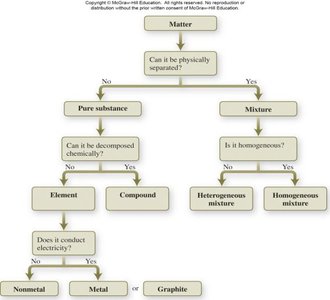
Pure Substances: Have a uniform chemical composition throughout and from sample to sample. They can be elements or compounds.
Mixtures: Composed of two or more pure substances. They may have uniform (homogeneous) or non-uniform (heterogeneous) composition.
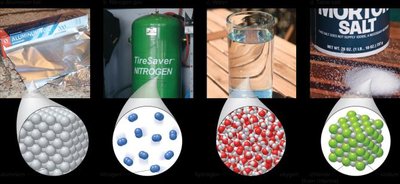
Elements: Substances that cannot be broken down into simpler substances by chemical means.
Compounds: Substances composed of two or more elements in a fixed ratio.
Homogeneous Mixtures (Solutions): Uniform composition throughout.
Heterogeneous Mixtures: Non-uniform composition, components are not evenly distributed.
States of Matter
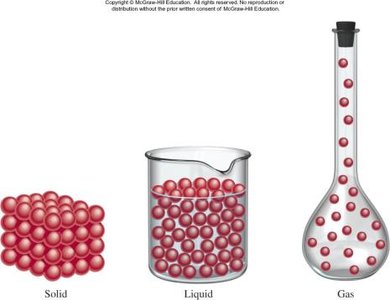
Matter exists in three primary states:
Solid: Definite shape and volume; particles are closely packed.
Liquid: Definite volume but no definite shape; particles are less tightly packed than in solids.
Gas: No definite shape or volume; particles are far apart and move freely.

Properties and Changes of Matter
Properties of matter can be classified as physical or chemical:
Physical Properties: Can be observed or measured without changing the substance's identity (e.g., color, melting point, density).
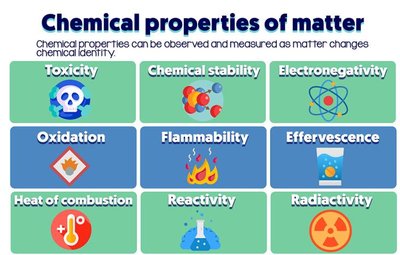
Chemical Properties: Describe a substance's ability to undergo changes that transform it into different substances (e.g., flammability, reactivity).
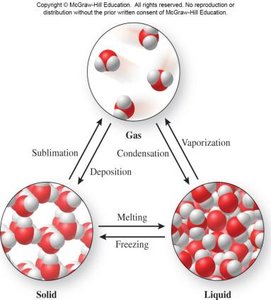
Physical Change: Alters the form or appearance but not the composition (e.g., melting, boiling, dissolving).
Chemical Change: Alters the composition, resulting in new substances (e.g., burning, rusting).
Extensive and Intensive Properties
Extensive Properties: Depend on the amount of matter (e.g., mass, volume).
Intensive Properties: Do not depend on the amount of matter (e.g., density, temperature).
Measurement and Units
Measurements in chemistry require units. The International System of Units (SI) is used for consistency.
Base SI Units: meter (m) for length, kilogram (kg) for mass, second (s) for time, kelvin (K) for temperature, mole (mol) for amount of substance.
Prefixes: Used to indicate multiples or fractions of units (e.g., kilo-, centi-, milli-).
Volume and Density
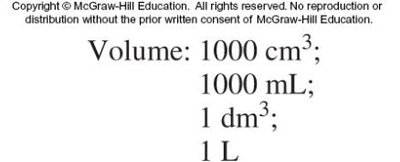
Volume: The amount of space occupied by a substance. SI unit is cubic meter (m3), but liter (L) and milliliter (mL) are commonly used in chemistry.
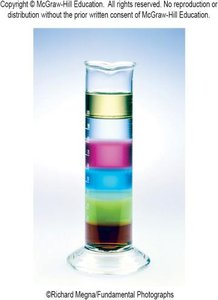
Density: The ratio of mass to volume.
Temperature Scales
Celsius (°C): Water freezes at 0°C and boils at 100°C.
Kelvin (K): Absolute temperature scale.
Fahrenheit (°F):
Significant Figures and Scientific Notation
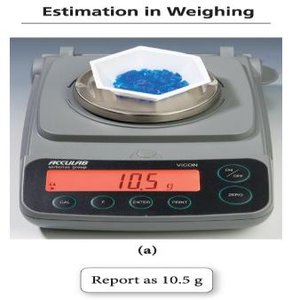
Significant Figures: All the digits in a measurement known with certainty plus one estimated digit.
Rules: Nonzero digits are significant; zeros between nonzero digits are significant; leading zeros are not significant; trailing zeros are significant if there is a decimal point.
Scientific Notation: Used to express very large or small numbers. where is a number between 1 and 10, and is an integer.

Accuracy, Precision, and Error
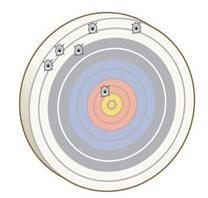
Accuracy: How close a measurement is to the true value.
Precision: How close repeated measurements are to each other.
Random Error: Equal probability of being too high or too low.
Systematic Error: Consistently too high or too low.
Dimensional Analysis and Conversion Factors
Dimensional analysis is a method for converting between units using conversion factors (ratios equal to one).
Example: To convert 2 kilometers to inches:
Summary Table: Common Elements and Their Symbols
Name | Symbol | Name | Symbol | Name | Symbol |
|---|---|---|---|---|---|
Aluminum | Al | Fluorine | F | Oxygen | O |
Gold | Au | Hydrogen | H | Phosphorus | P |
Iron | Fe | Lead | Pb | Silver | Ag |
Magnesium | Mg | Sodium | Na | Sulfur | S |
Zinc | Zn | Chlorine | Cl | Potassium | K |
Lab Techniques and Procedures (Bonus)
Weighing: Use of analytical balances for precise mass measurements.
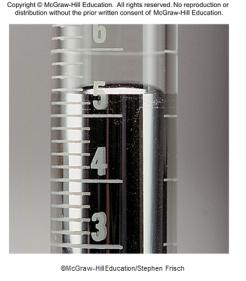
Measuring Volume: Use of graduated cylinders, pipettes, and burettes for accurate volume determination.
Mathematical Operations and Functions (Bonus)
Multiplication/Division: The result should have the same number of significant figures as the measurement with the fewest significant figures.
Addition/Subtraction: The result should have the same number of decimal places as the measurement with the fewest decimal places.
Additional info: This summary covers the foundational concepts of matter and measurement, including classification, properties, changes, units, and measurement reliability, as required for a general chemistry course. Images included are directly relevant to the explanation of each concept.
