 Back
BackPhases of Matter: Solids, Liquids, and Gases
Study Guide - Smart Notes
 Tailored notes based on your materials, expanded with key definitions, examples, and context.
Q3. What are the phases of matter: solid, liquid, and gas, and the properties of each?
Background
Topic: States of Matter
This question tests your understanding of the three main physical states of matter—solid, liquid, and gas—and their characteristic properties. Recognizing these differences is fundamental in general chemistry, as it helps explain how substances behave under different conditions.
Key Terms and Concepts:
Solid: Particles are closely packed in an ordered structure; solids have a definite shape and volume.
Liquid: Particles are close together but not in a fixed position; liquids have a definite volume but take the shape of their container.
Gas: Particles are far apart and move freely; gases have neither a definite shape nor a definite volume and expand to fill their container.
Step-by-Step Guidance
Start by recalling the arrangement and movement of particles in each state of matter (solid, liquid, gas).
Consider how the particle arrangement affects the shape and volume of each phase. For example, why do solids retain their shape while gases do not?
Think about how each phase responds to its container. Does it fill the container completely, or does it retain its own shape?
Review the table below for a summary of these properties and use it to reinforce your understanding.
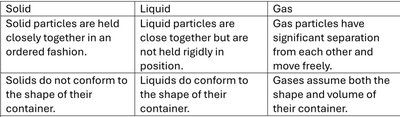
Try summarizing the key differences in your own words before moving on!
Final Answer:
Solids: Particles are tightly packed in an ordered fashion, do not conform to the shape of their container, and have a definite shape and volume. Liquids: Particles are close but not rigidly held, conform to the shape of their container, and have a definite volume but no definite shape. Gases: Particles are far apart and move freely, assume both the shape and volume of their container, and have neither definite shape nor volume.
This classification helps explain the physical behavior of substances in different states.
