 Back
BackQuantum-Mechanical Model of the Atom & Periodic Properties: Study Guide
Study Guide - Smart Notes
 Tailored notes based on your materials, expanded with key definitions, examples, and context.
The Quantum-Mechanical Model of the Atom
Introduction to Quantum Mechanics
The quantum-mechanical model describes how electrons exist in atoms and how their arrangement determines the chemical and physical properties of elements. This model is foundational for understanding atomic structure, chemical bonding, and periodic trends.
Electrons occupy specific energy levels and orbitals within an atom.
The arrangement of electrons determines the formation of ions and the reactivity of elements.
Electromagnetic Radiation Spectrum
Electromagnetic radiation, including visible light, travels through space as waves characterized by their wavelength and frequency.
Wavelength (\(\lambda\)): The distance between two consecutive peaks of a wave (measured in meters or nanometers).
Frequency (\(\nu\)): The number of wave cycles that pass a point per second (measured in s-1 or Hz).
Speed of light (\(c\)): \(c = 3.00 \times 10^8\) m/s.
Planck's constant (\(h\)): \(h = 6.63 \times 10^{-34}\) J·s.
Visible light spectrum: Ranges from 400 nm (violet) to 750 nm (red), remembered as ROYGBIV (Red, Orange, Yellow, Green, Blue, Indigo, Violet).
Key Equations:
Relationship between speed, frequency, and wavelength:
Energy of a photon:
Different colors of light have different frequencies, wavelengths, and energies. For example, red light has a longer wavelength and lower energy than blue light.
Bohr Theory of the Hydrogen Atom
The Bohr model postulates that electrons occupy specific energy levels and can transition between these levels by absorbing or emitting energy. This model successfully explains the emission spectra of hydrogen but does not extend to more complex atoms.
Energy transitions correspond to the absorption or emission of photons.
Each element has a unique emission line spectrum.
Quantum Numbers
Quantum numbers describe the properties of atomic orbitals and the electrons within them:
Principal quantum number (n): Indicates the energy level (n = 1, 2, 3, ...).
Angular momentum quantum number (l): Defines the shape of the orbital (l = 0 for s, 1 for p, 2 for d, 3 for f, 4 for g).
Magnetic quantum number (ml): Specifies the orientation of the orbital (ranges from -l to +l).
Magnetic spin quantum number (ms): Indicates the spin of the electron (+1/2 or -1/2).
Each type of orbital has a specific number of orientations:
s: 1 orbital
p: 3 orbitals
d: 5 orbitals
f: 7 orbitals
Electron Configurations
Electron configurations describe the arrangement of electrons in an atom's orbitals. Three main rules govern electron configurations:
Aufbau Principle: Electrons fill orbitals from lowest to highest energy.
Pauli Exclusion Principle: Each orbital can hold a maximum of two electrons with opposite spins.
Hund’s Rule: Electrons fill degenerate orbitals singly first, with parallel spins, before pairing up.
Valence and Core Electrons
Valence electrons are the outermost electrons involved in chemical bonding, while core electrons are those in inner shells.
The number of valence electrons can often be determined from the group number in the periodic table.
Maximum valence electrons: 8 (s and p subshells in the outermost shell).
Magnetic Properties
Atoms can be classified based on their magnetic properties:
Paramagnetic: Atoms with unpaired electrons; attracted to magnetic fields.
Diamagnetic: Atoms with all electrons paired; weakly repelled by magnetic fields.
Periodic Properties of the Elements
Periodic Law
The periodic law states that the properties of elements are periodic functions of their atomic numbers. This underlies the structure of the periodic table and explains recurring trends in element properties.
Periodic Trends
Several important trends can be observed across periods and down groups in the periodic table:
Atomic radius: Increases down a group, decreases across a period.
Ionization energy: Decreases down a group, increases across a period.
Electron affinity: Generally becomes more negative across a period (increases in magnitude), with some exceptions.
These trends can be used to compare and predict the properties of elements.
Oxides
Oxides can be classified based on their chemical behavior:
Basic oxides: React with acids to form salts and water (typically metal oxides).
Acidic oxides: React with bases to form salts and water (typically nonmetal oxides).
Amphoteric oxides: Can react with both acids and bases (e.g., Al2O3).
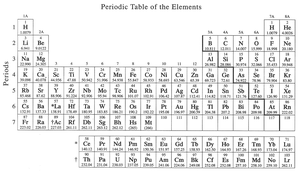
Periodic Table Reference
The periodic table is an essential tool for understanding element properties, electron configurations, and periodic trends.
Practice Problems
Calculate the frequency of red light (632.8 nm).
Calculate the energy of solar radiation (503 nm).
What is the wavelength of the yellow sodium emission, which has a frequency of 5.09 x 10¹⁴ s-1?
The red spectral line of lithium occurs at 671 nm (6.71 x 10⁻⁷ m). Calculate the energy of one photon of this light.
State whether each of the following sets of quantum numbers is permissible for an electron in an atom. If a set is not permissible, explain why.
a) n = 1, l = 1, ml = 0, ms = +1/2
b) n = 3, l = 1, ml = -2, ms = -1/2
c) n = 2, l = 1, ml = 0, ms = +1/2
d) n = 2, l = 0, ml = 0, ms = 1
What is the number of different orbitals in each of the following subshells?
a) 3d
b) 4f
c) 4p
d) 5s
If the n quantum number of an atomic orbital is 4, what are the possible values of l? If the l quantum number is 3, what are the possible values of ml?
Write the electron configuration and orbital notation for the following elements: H, S, C, Fe.
Write the electron configuration and core notation for the following elements: K, F, Ca, Al.
How many valence electrons for B, H, O, N, C, F, & He?
Which of the following orbital diagrams or electron configurations are possible and which are impossible according to the Pauli exclusion principle? Explain.
a)
b)
c)
d) 1s32s1
e) 1s22s12p7
f) 1s22s22p63s23p64s23d8
Give the electron configuration for gallium (Z=31). What is the valence-shell configuration?
What are the configurations for the outer electrons of: Tellurium (Z = 52), Nickel (Z = 28)?
Phosphorous has _______ unpaired electrons.
Write an orbital diagram for the ground state of the iron atom.
Write the noble gas configuration of sodium and determine if the atom is paramagnetic or diamagnetic.
Write the noble gas configuration of mercury and determine if the atom is paramagnetic or diamagnetic.
Refer to the periodic table and use the trends noted for size of atomic radii to arrange the following in order of increasing atomic radius: Al, C, Si.
Using the periodic table only, arrange the following elements in order of increasing ionization energy: Ar, Se, S.
From what you know in a general way about electron affinities, state which member of each of the following pairs has the greater negative value: As or Br; F or Li.
