 Back
BackReaction Stoichiometry: Quantitative Relationships in Chemical Reactions
Study Guide - Smart Notes
 Tailored notes based on your materials, expanded with key definitions, examples, and context.
Chapter 3: Chemical Reactions and Reaction Stoichiometry
Lesson 3.6: Reaction Stoichiometry
Reaction stoichiometry is a fundamental concept in general chemistry that allows chemists to predict the quantities of substances consumed and produced in a chemical reaction. It connects the microscopic world of atoms and molecules with the macroscopic world of laboratory measurements, enabling practical applications in fields such as pollution control, food production, and pharmaceuticals.
Stoichiometry and the Law of Conservation of Mass
Definition and Importance
Stoichiometry is the study of quantitative relationships between the amounts of reactants used and products formed in a chemical reaction.
It is based on the law of conservation of mass, which states that the total mass of reactants equals the total mass of products in a chemical reaction.
Balanced chemical equations are essential for stoichiometric calculations, as they show the exact proportions in which substances react and are produced.
Example: In the reaction of iron with oxygen to form iron(III) oxide, the balanced equation is:
Relationships in a Balanced Chemical Equation
Particle, Mole, and Mass Relationships
A balanced chemical equation provides several types of quantitative relationships:
Particle relationships: The number of atoms, molecules, or formula units involved.
Mole relationships: The number of moles of each substance involved.
Mass relationships: The mass of each reactant and product, calculated using molar masses.
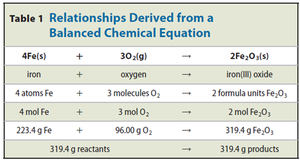
The following table summarizes these relationships for the reaction between iron and oxygen:
4Fe(s) | + | 3O2(g) | → | 2Fe2O3(s) |
|---|---|---|---|---|
iron | oxygen | iron(III) oxide | ||
4 atoms Fe | + | 3 molecules O2 | → | 2 formula units Fe2O3 |
4 mol Fe | + | 3 mol O2 | → | 2 mol Fe2O3 |
223.4 g Fe | + | 96.00 g O2 | → | 319.4 g Fe2O3 |
319.4 g reactants | 319.4 g products |
Mole Ratios
Definition and Use
A mole ratio is a ratio between the numbers of moles of any two substances in a balanced chemical equation.
Mole ratios are used as conversion factors to relate the amounts of reactants and products.
The number of possible mole ratios in a reaction is n(n – 1), where n is the number of substances in the equation.
Example: For the reaction , the mole ratio between Fe and O2 is:
or
Stoichiometric Calculations
Steps for Solving Stoichiometry Problems
To determine the amount of product formed or reactant required, follow these steps:
Convert grams of substance A to moles using its molar mass.
Use the mole ratio from the balanced equation to convert moles of A to moles of B.
Convert moles of substance B to grams using its molar mass.

Example: If you start with 10.0 g of Fe, how many grams of Fe2O3 can be produced?
Step 1: Convert grams Fe to moles Fe:
Step 2: Use mole ratio:
Step 3: Convert moles Fe2O3 to grams:
Limiting Reactant and Theoretical Yield
Key Concepts
A limiting reactant is the reactant that is completely consumed first, thus determining the maximum amount of product that can be formed.
The theoretical yield is the maximum amount of product that can be produced from the given amounts of reactants.
Any reactant that remains after the reaction is complete is called the excess reactant.
Example: If you have 10.0 g Fe and 10.0 g O2, calculate which is the limiting reactant and the theoretical yield of Fe2O3.
Applications of Stoichiometry
Real-World Uses
Pollution control: Calculating the amount of reactants needed to neutralize pollutants.
Food production: Determining the proportions of ingredients for chemical processes in food manufacturing.
Pharmaceutical dosing: Ensuring correct amounts of chemicals are used to produce medications.
Stoichiometry bridges the gap between the microscopic world of atoms and molecules and the macroscopic world of laboratory measurements, making it a vital tool for chemists in both academic and industrial settings.
