 Back
BackStep-by-Step Guidance for Thermochemistry & Kinetics Exam Practice
Study Guide - Smart Notes
 Tailored notes based on your materials, expanded with key definitions, examples, and context.
Q1. Which of the following will have ∆H°f = 0 kJ/mol?
Background
Topic: Standard Enthalpy of Formation
This question tests your understanding of which substances have a standard enthalpy of formation of zero, a key concept in thermochemistry.
Key Terms:
∆H°f: Standard enthalpy of formation, the enthalpy change when 1 mole of a substance is formed from its elements in their standard states.
Standard state: The most stable form of an element at 1 atm and 25°C.
Step-by-Step Guidance
Recall that the standard enthalpy of formation for any element in its most stable form is zero.
Identify which options are elements in their standard state (e.g., Cl2(g) is chlorine gas, its standard state).
Compare the other options to see if they are compounds or elements not in their standard state.
Try solving on your own before revealing the answer!
Q2. When 7.50 g of solid ammonium chloride, NH4Cl, is dissolved in 70.0 g of water in a coffee-cup calorimeter, the temperature cools from 30.00°C to 10.27°C. Calculate ∆H in kJ/mol of NH4Cl for the process. The specific heat of water is 4.184 J/g-°C.
Background
Topic: Calorimetry and Enthalpy Change
This question tests your ability to use calorimetry data to calculate the enthalpy change per mole for a dissolution process.
Key Terms and Formulas:
Specific heat (): Amount of heat required to raise 1 g of a substance by 1°C.
Calorimeter: Device used to measure heat changes in chemical reactions.
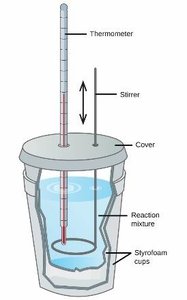
Step-by-Step Guidance
Calculate the temperature change: .
Calculate the heat absorbed/released by the water using .
Remember that for constant pressure calorimetry.
Convert the heat to kJ and divide by the number of moles of NH4Cl dissolved to find per mole.
Try solving on your own before revealing the answer!
Q3. How much heat is needed (in kJ) to raise the temperature of 5.00 kg of water from 40.0°C to 90°C? The specific heat of water is 4.184 J/g-°C.
Background
Topic: Heat Capacity and Calorimetry
This question tests your ability to calculate the heat required to change the temperature of a substance.
Key Terms and Formula:
Specific heat (): Amount of heat required to raise 1 g of a substance by 1°C.
Heat (): Energy transferred due to temperature difference.
Step-by-Step Guidance
Convert mass from kg to g: .
Calculate the temperature change: .
Plug values into the formula: .
Convert the result from J to kJ by dividing by 1000.
Try solving on your own before revealing the answer!
Q4. Calculate ∆E and determine whether the process is endothermic or exothermic for the following case: A system absorbs 122 kJ of heat from the surroundings and does 572 kJ of work on the surroundings.
Background
Topic: First Law of Thermodynamics
This question tests your understanding of energy changes in a system, including heat and work.
Key Terms and Formulas:
∆E: Change in internal energy
q: Heat absorbed by the system
w: Work done by the system
Work done by the system is negative:
Step-by-Step Guidance
Identify the values: (absorbed, so positive), (work done by the system).
Plug values into the formula: .
Determine the sign of and whether the process is endothermic (absorbs energy) or exothermic (releases energy).
Try solving on your own before revealing the answer!
Q5. Calculate ∆Horxn for the reaction: 2 C2H6 (g) + O2 (g) ⇋ 2 C2H4 (g) + 2 H2O (g) at 298 K using the provided data.
Background
Topic: Enthalpy of Reaction Using Standard Enthalpies of Formation
This question tests your ability to use standard enthalpies of formation to calculate the enthalpy change for a reaction.
Key Formula:
Step-by-Step Guidance
Write out the balanced equation and list the values for each reactant and product.
Multiply each value by the number of moles in the equation.
Add up the total for products and reactants separately.
Set up the formula for , but stop before calculating the final value.
Try solving on your own before revealing the answer!
Q6. A fuel is burned in a cylinder equipped with a piston. The initial volume of the cylinder is 50.0 L, and the final volume is 30.0 L. If the piston compresses against a constant pressure of 4.50 atm, how much work (in kJ) is done?
Background
Topic: Work in Thermodynamic Processes
This question tests your ability to calculate work done during a volume change at constant pressure.
Key Formula:
1 L·atm = 101.3 J
Step-by-Step Guidance
Calculate .
Plug values into .
Convert the result from L·atm to J, then to kJ.
Try solving on your own before revealing the answer!
Q13. Using the following graph, the student determines that a reaction is zero order. Unfortunately, they forgot to label the axes. What are the correct labels for the x and y axes?
Background
Topic: Reaction Order and Graphical Analysis
This question tests your ability to interpret kinetic data and recognize the graphical representation of zero-order reactions.
Key Terms:
Zero-order reaction: Rate is independent of concentration.
Graphical representation: For zero-order, [A] vs. time is linear.
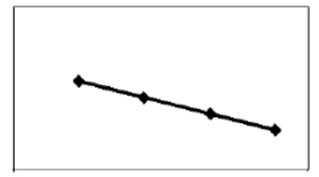
Step-by-Step Guidance
Recall that for zero-order reactions, the concentration of reactant decreases linearly with time.
Identify which axes would show a straight line for zero-order kinetics.
Compare the options to see which matches the graph provided.
Try solving on your own before revealing the answer!
Q20. Which reaction diagram corresponds to a forward reaction that is endothermic overall with the last step being rate limiting?
Background
Topic: Reaction Energy Diagrams and Kinetics
This question tests your ability to interpret energy diagrams and identify endothermic reactions and rate-limiting steps.
Key Terms:
Endothermic reaction: Products have higher energy than reactants.
Rate-limiting step: The step with the highest activation energy (largest peak at the end).
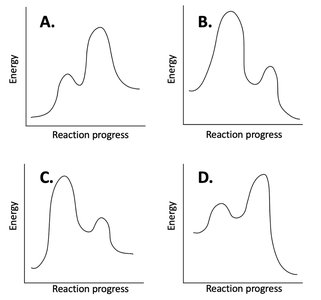
Step-by-Step Guidance
Look for diagrams where the final energy is higher than the initial energy (endothermic).
Identify which diagram has the last peak as the highest, indicating the rate-limiting step.
Compare the diagrams to the question requirements.
Try solving on your own before revealing the answer!
