 Back
BackUnit 8: Chemical Equilibrium, Acids, and Bases – Study Notes
Study Guide - Smart Notes
 Tailored notes based on your materials, expanded with key definitions, examples, and context.
Unit 8: Chemical Equilibrium, Acids, and Bases
Introduction
This unit covers the fundamental concepts of chemical equilibrium, acids and bases, and their quantitative treatment. Students will learn to describe equilibrium, calculate equilibrium constants, predict shifts in equilibrium, and analyze acid-base reactions, including titrations and pH calculations.
Chemical Equilibrium
Dynamic Equilibrium
Chemical equilibrium occurs when the rates of the forward and reverse reactions are equal, resulting in constant concentrations of reactants and products over time. This state is dynamic, meaning both reactions continue to occur, but there is no net change in concentrations.
Dynamic Equilibrium: The condition in which the rate of the forward reaction equals the rate of the reverse reaction.
Reversible Reactions: Reactions that can proceed in both forward and reverse directions.
Example: The decomposition of dinitrogen tetroxide:


At equilibrium, the concentrations of NO2 and N2O4 remain constant, and the rates of the forward and reverse reactions are equal.
Visualizing Equilibrium
Equilibrium can be visualized at the molecular level as a state where the number of molecules converting from reactants to products equals the number converting from products to reactants.
Equilibrium Constant (K)
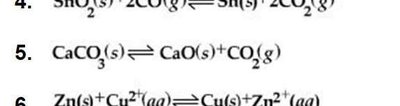
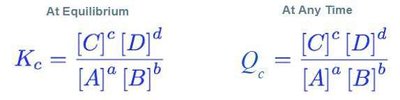
The equilibrium constant, K, quantifies the ratio of product and reactant concentrations at equilibrium for a reversible reaction.
General Expression: For a reaction :
Kc: Uses concentrations in mol/L.
Kp: Uses partial pressures for gaseous reactions.
Heterogeneous Equilibria: Pure solids and liquids are omitted from the K expression.
Reaction Quotient (Q)
The reaction quotient, Q, is calculated using the same expression as K but with initial or non-equilibrium concentrations. Comparing Q to K predicts the direction the reaction will proceed to reach equilibrium.
If Q < K: The reaction proceeds forward (toward products).
If Q > K: The reaction proceeds in reverse (toward reactants).
If Q = K: The system is at equilibrium.
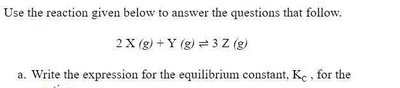
Sample Equilibrium Expressions
For :
Le Châtelier’s Principle
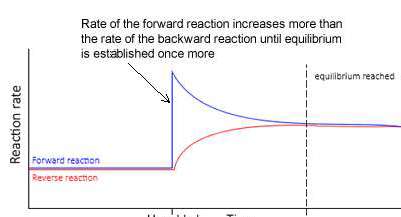
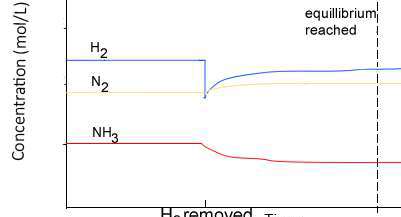
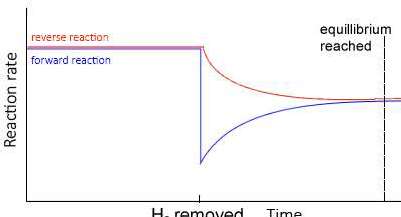
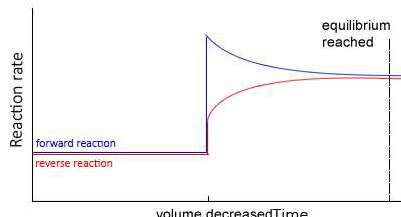
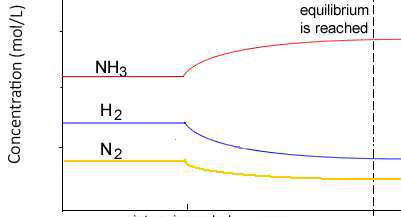
Le Châtelier’s Principle states that if a system at equilibrium is disturbed by a change in concentration, temperature, or pressure (volume), the system will shift to counteract the disturbance and restore equilibrium.
Concentration: Adding reactants shifts equilibrium toward products; removing reactants shifts toward reactants.
Temperature: Increasing temperature favors the endothermic direction; decreasing favors exothermic.
Pressure/Volume: Increasing pressure (decreasing volume) shifts equilibrium toward the side with fewer moles of gas.
Acids and Bases
Definitions of Acids and Bases
Arrhenius Definition: Acids produce H+ in water; bases produce OH-.
Brønsted-Lowry Definition: Acids are proton donors; bases are proton acceptors.
Lewis Definition: Acids accept electron pairs; bases donate electron pairs.
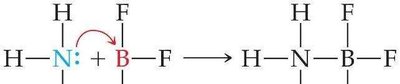
Conjugate Acid-Base Pairs
When an acid donates a proton, it forms its conjugate base; when a base accepts a proton, it forms its conjugate acid.
Example:

Acid and Base Strength
Strong acids/bases: Completely ionize in water.
Weak acids/bases: Partially ionize; equilibrium is established.
Acid Ionization Constant (Ka): Measures acid strength; higher Ka means stronger acid.
Base Ionization Constant (Kb): Measures base strength.
Acid | Conjugate Base | Ka |
|---|---|---|
Chlorous (HClO2) | ClO2- | 1.0 × 10⁻² |
Hydrofluoric (HF) | F- | 6.8 × 10⁻⁴ |
Nitrous (HNO2) | NO2- | 4.5 × 10⁻⁴ |
Benzoic (C6H5COOH) | C6H5COO- | 6.3 × 10⁻⁵ |
Acetic (CH3COOH) | CH3COO- | 1.8 × 10⁻⁵ |
Hydrocyanic (HCN) | CN- | 4.9 × 10⁻¹⁰ |
Phenol (HOC6H5) | C6H5O- | 1.3 × 10⁻¹⁰ |

pH and pOH Calculations
pH: A measure of the hydrogen ion concentration in solution.
pH Formula:
pOH Formula:
Relationship: at 25°C
Ion-product constant for water: at 25°C
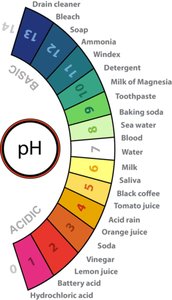
Acid-Base Reactions and Net Ionic Equations
Acid-base reactions can be represented by balanced molecular and net ionic equations.
Net ionic equations focus on the species that change during the reaction.
Example:
Net Ionic:
Titrations and pH Curves
Titration Principles
Titration is a laboratory technique used to determine the concentration of an unknown acid or base by reacting it with a standard solution of known concentration.
Equivalence Point: The point at which the amount of titrant added is stoichiometrically equivalent to the amount of analyte in solution.
Indicator: A substance that changes color at (or near) the equivalence point.
pH Meter: Used for precise determination of the equivalence point.
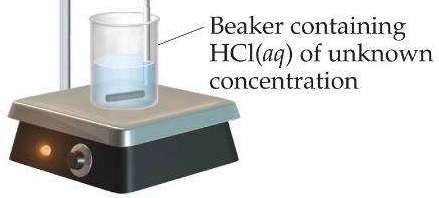


pH Curves
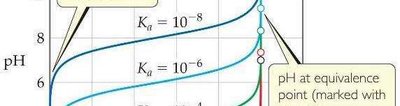
pH curves show how the pH of a solution changes as titrant is added.
The shape of the curve depends on the strength of the acid and base involved.
Strong acid-strong base titrations have a sharp equivalence point at pH 7.
Weak acid-strong base titrations have an equivalence point above pH 7.

Summary Table: Key Equilibrium and Acid-Base Concepts
Concept | Definition/Formula | Key Points |
|---|---|---|
Equilibrium Constant (K) | Describes ratio of products to reactants at equilibrium | |
Reaction Quotient (Q) | Same as K, but for non-equilibrium conditions | Predicts direction of shift to reach equilibrium |
Le Châtelier’s Principle | System shifts to counteract disturbances | Applies to concentration, temperature, pressure/volume |
pH | Measures acidity of solution | |
pOH | Measures basicity of solution | |
Kw | Ion-product constant for water at 25°C | |
Ka/Kb | Acid/Base ionization constants | Indicate strength of acids/bases |
Titration | Lab technique for concentration analysis | Uses standard solution and indicator or pH meter |
Additional info: These notes are aligned with Tro 6th ed. Chemistry, Chapters 16–18, and cover all major learning objectives for equilibrium and acid-base chemistry at the college general chemistry level.
