The distance from Earth to the Moon is approximately 240,000 mi. (c) The speed of light is 3.00 ⨉ 108 m/s. How long does it take for light to travel from Earth to the Moon and back again?
Ch.1 - Introduction: Matter, Energy, and Measurement
Brown14th EditionChemistry: The Central ScienceISBN: 9780134414232Not the one you use?Change textbook
Chapter 1, Problem 72g
Give the derived SI units for each of the following quantities in base SI units: (g) energy = mass × (velocity)2
Verified step by step guidance1
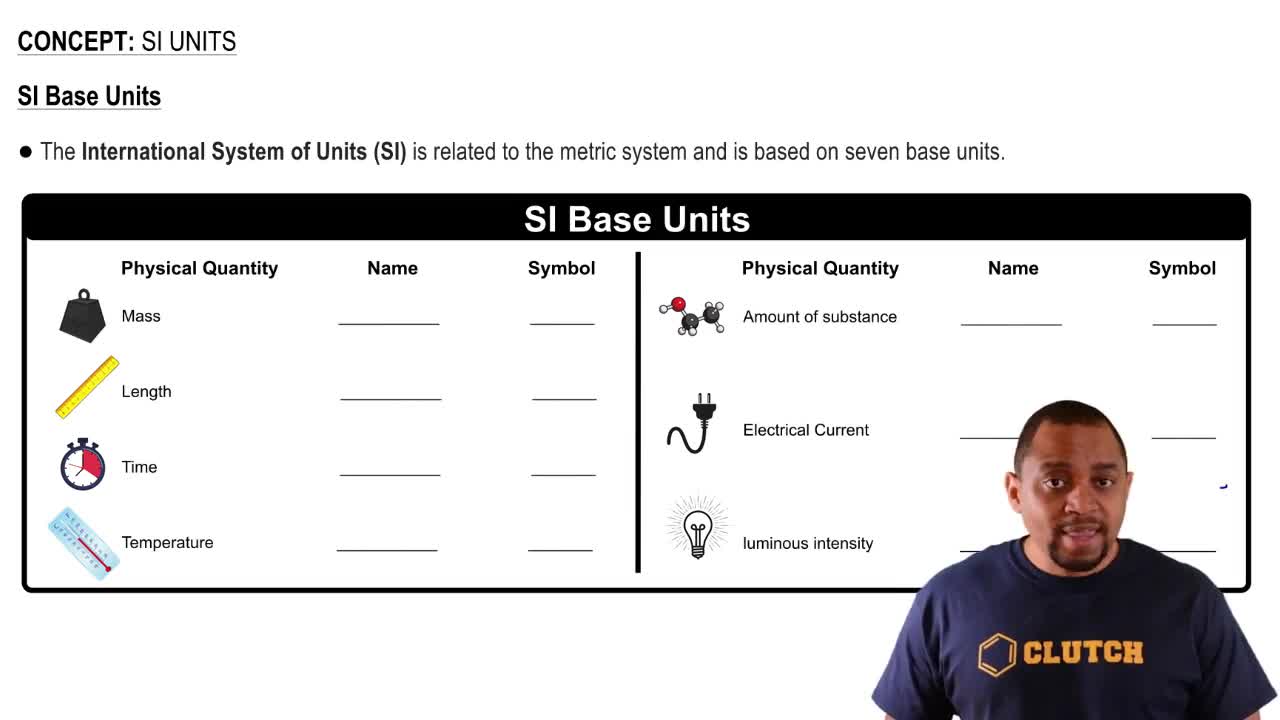
Identify the base SI units for each component in the formula for energy: mass, velocity, and velocity squared.
The base SI unit for mass is the kilogram (kg).
The base SI unit for velocity is meters per second (m/s).
Since energy is mass multiplied by velocity squared, substitute the base units: energy = kg ⨉ (m/s)^2.
Simplify the expression: energy = kg ⨉ m^2/s^2.
Key Concepts
Here are the essential concepts you must grasp in order to answer the question correctly.
SI Units
The International System of Units (SI) is a standardized system of measurement used globally in science and engineering. It is based on seven base units, including the meter for length, kilogram for mass, and second for time. Derived units are formed from these base units to measure other quantities, such as energy, which is expressed in joules.
Recommended video:
Guided course
SI Units
Energy
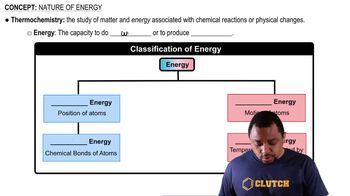
Energy is the capacity to do work or produce heat and is a fundamental concept in physics and chemistry. In the context of mechanics, energy can be expressed as the product of mass and the square of velocity, represented mathematically as E = m × v². The derived SI unit for energy is the joule (J), which is equivalent to one kilogram meter squared per second squared (kg·m²/s²).
Recommended video:
Guided course
Nature of Energy
Derived Units
Derived units are combinations of base SI units that describe physical quantities. For example, energy is a derived unit that combines mass (kilograms), length (meters), and time (seconds) to form joules. Understanding how to derive these units from base units is essential for solving problems in physics and chemistry, as it allows for the conversion and manipulation of different measurements.
Related Practice
Textbook Question
616
views
Textbook Question
The distance from Earth to the Moon is approximately 240,000 mi. (a) What is this distance in meters?
1321
views
Textbook Question
What type of quantity (for example, length, volume, density) do the following units indicate? (g) Pa.
409
views
Textbook Question
Give the derived SI units for each of the following quantities in base SI units: (a) acceleration = distance/time2 (b) force = mass × acceleration (c) work = force × distance (d) pressure = force/area
458
views
Textbook Question
The distance from Earth to the Moon is approximately 240,000 mi. (d) Earth travels around the Sun at an average speed of 29.783 km/s. Convert this speed to miles per hour.
778
views
1
comments
Textbook Question
Give the derived SI units for each of the following quantities in base SI units: (e) power = work/time
1141
views