The distance from Earth to the Moon is approximately 240,000 mi. (c) The speed of light is 3.00 ⨉ 108 m/s. How long does it take for light to travel from Earth to the Moon and back again?
Ch.1 - Introduction: Matter, Energy, and Measurement
Brown14th EditionChemistry: The Central ScienceISBN: 9780134414232Not the one you use?Change textbook
Chapter 1, Problem 73a
The distance from Earth to the Moon is approximately 240,000 mi. (a) What is this distance in meters?
Verified step by step guidance1
insert step 1> Start by identifying the conversion factor between miles and meters. You know that 1 mile is equal to 1,609.34 meters.
insert step 2> Set up the conversion by multiplying the distance in miles by the conversion factor to convert it to meters.
insert step 3> Write the equation: \( \text{Distance in meters} = 240,000 \text{ mi} \times 1,609.34 \text{ m/mi} \).
insert step 4> Perform the multiplication to find the distance in meters.
insert step 5> Ensure that your final answer is in the correct units, which should be meters.

Verified video answer for a similar problem:
This video solution was recommended by our tutors as helpful for the problem above.
Video duration:
3mWas this helpful?
Key Concepts
Here are the essential concepts you must grasp in order to answer the question correctly.
Unit Conversion
Unit conversion is the process of converting a quantity expressed in one unit to another unit. In this case, we need to convert miles to meters. Understanding the conversion factors, such as 1 mile being equal to 1,609.34 meters, is essential for accurately performing this calculation.
Recommended video:
Guided course
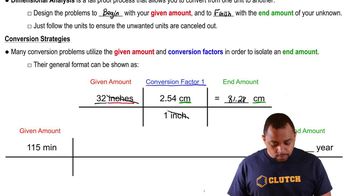
Conversion Factors
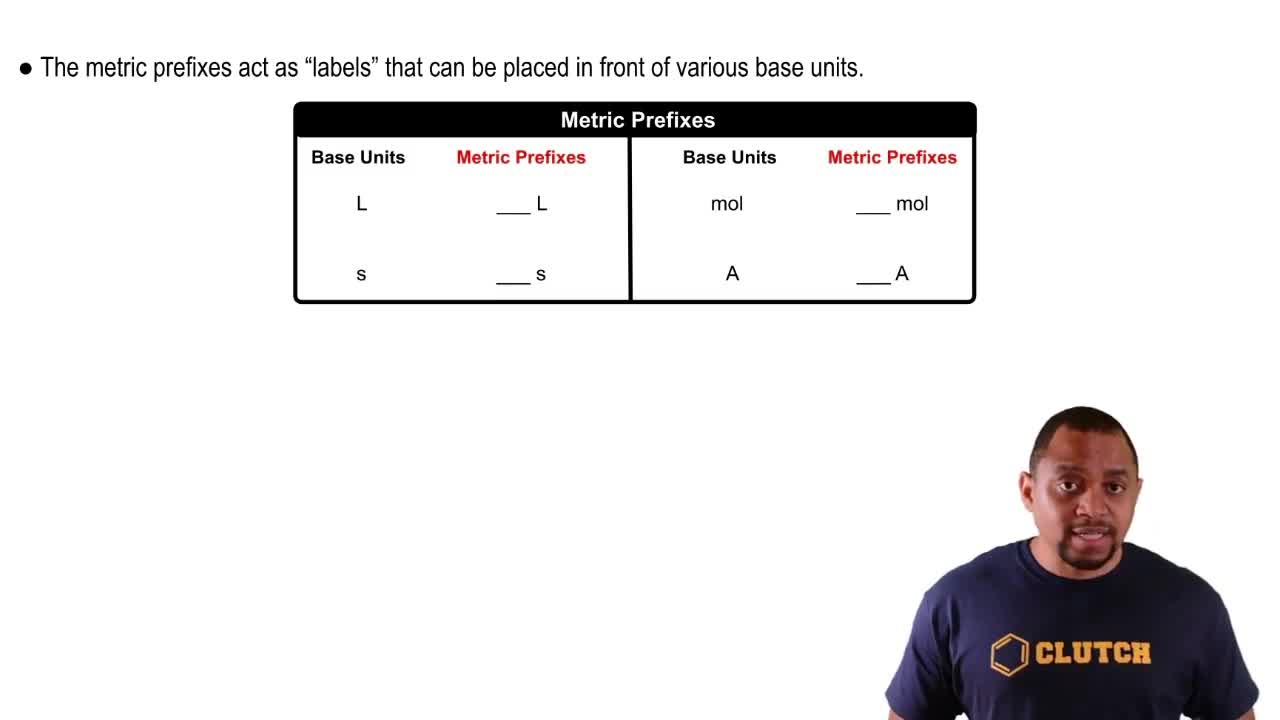
Metric System
The metric system is an internationally recognized decimal-based system of measurement. It includes units such as meters for length, grams for mass, and liters for volume. Familiarity with the metric system is crucial for scientific calculations and ensures consistency in measurements across different fields.
Recommended video:
Guided course
Metric Prefixes Usage
Dimensional Analysis
Dimensional analysis is a mathematical technique used to convert one set of units to another by multiplying by conversion factors. This method helps ensure that the units cancel appropriately, leading to the correct final unit. It is a fundamental skill in chemistry and physics for solving problems involving different measurement systems.
Recommended video:
Guided course
Dimensional Analysis
Related Practice
Textbook Question
616
views
Textbook Question
Give the derived SI units for each of the following quantities in base SI units: (a) acceleration = distance/time2 (b) force = mass × acceleration (c) work = force × distance (d) pressure = force/area
458
views
Textbook Question
The distance from Earth to the Moon is approximately 240,000 mi. (d) Earth travels around the Sun at an average speed of 29.783 km/s. Convert this speed to miles per hour.
778
views
1
comments
Textbook Question
Which of the following would you characterize as pure or nearly pure substance? (a) stomach acid; (b) dry ice; (c) ice-cream; (d) stainless steel; (e) petroleum; (f) distilled water; (g) carbon monoxide gas; (h) compressed air in balloon.
876
views
Textbook Question
Give the derived SI units for each of the following quantities in base SI units: (g) energy = mass × (velocity)2
405
views
Textbook Question
Give the derived SI units for each of the following quantities in base SI units: (e) power = work/time
1141
views