
Ch.1 - Introduction: Matter, Energy, and Measurement
Brown - Chemistry: The Central Science 14th Edition
Brown14th EditionChemistry: The Central ScienceISBN: 9780134414232Not the one you use?Change textbook
Chapter 1, Problem 19b

The radius of an atom of tungsten (W) is about 2.10 Å. (b) How many tungsten atoms would have to be lined up to create a wire of 2.0 mm?

Verified step by step guidance
1
Convert the wire length from millimeters to angstroms. Since 1 mm = 10^7 Å, multiply 2.0 mm by 10^7 to get the length in angstroms.
Understand that the diameter of a tungsten atom is twice its radius. Therefore, calculate the diameter of a tungsten atom by multiplying the given radius (2.10 Å) by 2.
To find out how many tungsten atoms are needed to line up to the length of the wire, divide the total length of the wire in angstroms by the diameter of one tungsten atom.
Set up the division: (length of wire in Å) / (diameter of one tungsten atom in Å).
Perform the division to find the number of tungsten atoms needed to line up to the length of the wire.

Key Concepts

Here are the essential concepts you must grasp in order to answer the question correctly.

Atomic Radius

The atomic radius is a measure of the size of an atom, typically defined as the distance from the nucleus to the outermost electron shell. For tungsten (W), the atomic radius is approximately 2.10 angstroms (A), which is equivalent to 2.10 x 10^-10 meters. Understanding atomic radius is crucial for calculating how many atoms can fit into a given length.

Unit Conversion

Unit conversion is the process of converting a quantity expressed in one unit to another unit. In this problem, we need to convert the length of the wire from millimeters (mm) to angstroms (A) to match the units of the atomic radius. This involves using conversion factors, where 1 mm equals 10^10 A, allowing for accurate calculations of the number of atoms in the wire.
Recommended video:
Guided course
01:56
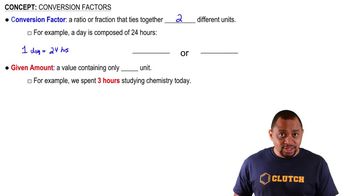
Conversion Factors

Avogadro's Number

Avogadro's number (approximately 6.022 x 10^23) is the number of atoms, ions, or molecules in one mole of a substance. While not directly needed for this specific calculation, understanding Avogadro's number is essential in chemistry for relating macroscopic measurements to atomic-scale quantities, especially when dealing with large numbers of atoms in calculations.
Related Practice
Textbook Question

A solid white substance A is heated strongly in the absence of air. It decomposes to form a new white substance B and a gas C. The gas has exactly the same properties as the product obtained when carbon is burned in an excess of oxygen. Based on these observations, can we determine whether solids A and B and gas C are elements or compounds?

1551
views
Textbook Question

Label each of the following as either a physical process or a chemical process: (a) crushing a metal can (b) production of urine in the kidneys

699
views
Textbook Question

(b) Which properties of zinc can you describe from the photo? Are these physical or chemical properties?

511
views
Textbook Question

Label each of the following as either a physical process or a chemical process: (c) melting a piece of chocolate (d) burning fossil fuel (e) discharging a battery.

625
views
Textbook Question

Zirconia, an oxide of zirconium, is often used as an affordable diamond substitute. Just like diamond, it is a colorless crystal which sparkles under sunlight. Which of the following physical properties do you think would help in differentiating between diamond and Zirconia—melting point, density, or physical state?

983
views
Textbook Question

In the process of attempting to characterize a substance, a chemist makes the following observations: The substance is a silvery white, lustrous metal. It melts at 649 °C and boils at 1105 °C. Its density at 20 °C is 1.738 g/cm3. The substance burns in air, producing an intense white light. It reacts with chlorine to give a brittle white solid. The substance can be pounded into thin sheets or drawn into wires. It is a good conductor of electricity. Which of these characteristics are physical properties, and which are chemical properties?

1161
views
1
rank