Classify each of the following as a pure substance, a solution, or a heterogeneous mixture: (a) a leaf (b) a 999 gold bar
Ch.1 - Introduction: Matter, Energy, and Measurement
Brown14th EditionChemistry: The Central ScienceISBN: 9780134414232Not the one you use?Change textbook
Chapter 1, Problem 69a
Two students determine the percentage of lead in a sample as a laboratory exercise. The true percentage is 22.52%. The students’ results for three determinations are as follows: (1) 22.52, 22.48, 22.54 (2) 22.64, 22.58, 22.62 (a) Calculate the average percentage for each set of data and state which set is the more accurate based on the average.
Verified step by step guidance1
Calculate the average percentage for the first set of data by adding the values 22.52, 22.48, and 22.54, then divide the sum by the number of values, which is 3.
Calculate the average percentage for the second set of data by adding the values 22.64, 22.58, and 22.62, then divide the sum by the number of values, which is 3.
Compare the calculated average of each set to the true percentage value of 22.52% to determine which set is more accurate.
The set with the average percentage closest to the true percentage of 22.52% is considered more accurate.
Discuss the concept of accuracy in measurements, which refers to how close a measured value is to the true value, and how this applies to the results obtained by the students.

Verified video answer for a similar problem:
This video solution was recommended by our tutors as helpful for the problem above.
Video duration:
1mWas this helpful?
Key Concepts
Here are the essential concepts you must grasp in order to answer the question correctly.
Accuracy vs. Precision
Accuracy refers to how close a measured value is to the true value, while precision indicates the consistency of repeated measurements. In this context, the accuracy of the students' results can be assessed by comparing their averages to the true percentage of lead, 22.52%. A set of measurements can be precise but not accurate if they cluster together but are far from the true value.
Recommended video:
Guided course
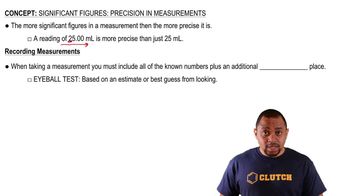
Significant Figures Precision
Calculating Averages
To find the average percentage of lead in each set of data, sum the individual measurements and divide by the number of measurements. This statistical method provides a central value that represents the data set, allowing for a straightforward comparison between the two sets of results.
Recommended video:
Guided course
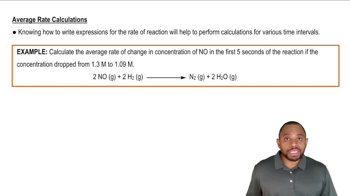
Average Rate Calculation Example
Significant Figures
Significant figures are the digits in a number that contribute to its precision. When reporting the average percentage, it is important to consider the significant figures of the original measurements to ensure that the final result reflects the precision of the data. This practice helps maintain the integrity of the measurements and their reliability.
Recommended video:
Guided course
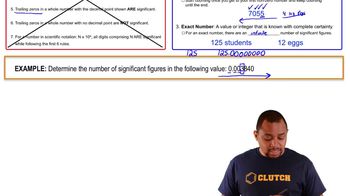
Significant Figures Example
Related Practice
Textbook Question
1152
views
1
rank
Textbook Question
What type of quantity (for example, length, volume, density) do the following units indicate? (g) Pa.
409
views
Textbook Question
Give the derived SI units for each of the following quantities in base SI units: (a) acceleration = distance/time2 (b) force = mass × acceleration (c) work = force × distance (d) pressure = force/area
458
views
Textbook Question
(b) A(n) _________ reliably predicts the behavior of matter, while a(n) _________ provides an explanation for that behavior.
605
views
Textbook Question
What type of quantity (for example, length, volume, density) do the following units indicate? (f) ms-1
527
views
Textbook Question
Classify each of the following as a pure substance, a solution, or a heterogeneous mixture: (c) stainless steel.
864
views