
Ch.10 - Gases
Brown - Chemistry: The Central Science 14th Edition
Brown14th EditionChemistry: The Central ScienceISBN: 9780134414232Not the one you use?Change textbook
Chapter 10, Problem 57

The metabolic oxidation of glucose, C6H12O6, in our bodies produces CO2, which is expelled from our lungs as a gas: C6H12O6(aq) + 6 O2(g) → 6 CO2(g) + 6 H2O(l). (a) Calculate the volume of dry CO2 produced at normal body temperature, 37 °C, and 101.33 kPa when 10.0 g of glucose is consumed in this reaction. (b) Calculate the volume of oxygen you would need, at 100 kPa and 298 K, to completely oxidize 15.0 g of glucose.

Verified step by step guidance
1
Step 1: Calculate the moles of glucose (C6H12O6) consumed using its molar mass. The molar mass of glucose is approximately 180.18 g/mol. Use the formula: moles = mass / molar mass.
Step 2: Use the stoichiometry of the balanced chemical equation to determine the moles of CO2 produced. According to the equation, 1 mole of glucose produces 6 moles of CO2.
Step 3: Apply the ideal gas law to find the volume of CO2 produced at 37 °C and 101.33 kPa. The ideal gas law is PV = nRT, where P is pressure, V is volume, n is moles, R is the ideal gas constant (8.314 J/(mol·K)), and T is temperature in Kelvin.
Step 4: For part (b), calculate the moles of glucose (C6H12O6) using its molar mass for 15.0 g of glucose. Again, use the formula: moles = mass / molar mass.
Step 5: Determine the moles of O2 required using the stoichiometry of the balanced equation, where 1 mole of glucose requires 6 moles of O2. Then, use the ideal gas law to calculate the volume of O2 needed at 100 kPa and 298 K.

Key Concepts

Here are the essential concepts you must grasp in order to answer the question correctly.

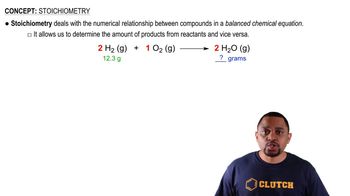
Stoichiometry

Stoichiometry is the calculation of reactants and products in chemical reactions based on the balanced chemical equation. It allows us to determine the relationships between the quantities of substances involved in a reaction. In this question, stoichiometry is essential for converting grams of glucose to moles and then using the mole ratios from the balanced equation to find the volumes of CO2 and O2 produced or required.
Recommended video:
Guided course
01:16
Stoichiometry Concept

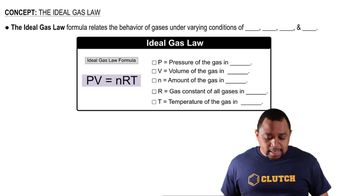
Ideal Gas Law

The Ideal Gas Law relates the pressure, volume, temperature, and number of moles of a gas through the equation PV = nRT. This law is crucial for calculating the volume of gases produced or consumed in a reaction under specific conditions. In this question, it will be used to find the volume of CO2 produced at body temperature and pressure, as well as the volume of O2 needed at different conditions.
Recommended video:
Guided course
01:15
Ideal Gas Law Formula

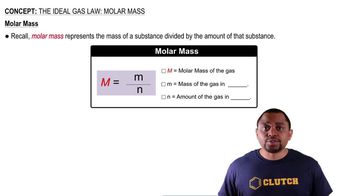
Molar Volume of a Gas

The molar volume of a gas is the volume occupied by one mole of an ideal gas at standard temperature and pressure (STP), which is approximately 22.4 L at 0 °C and 1 atm. However, conditions can vary, so adjustments must be made for different temperatures and pressures. Understanding molar volume is important for converting moles of gas to volume, as required in the calculations for CO2 and O2 in this question.
Recommended video:
Guided course
00:51
The Ideal Gas Law: Molar Mass
Related Practice
Textbook Question
Acetylene gas, C2H21g2, can be prepared by the reaction ofcalcium carbide with water:CaC21s2 + 2 H2O1l2¡Ca1OH221aq2 + C2H21g2Calculate the volume of C2H2 that is collected over water at23 °C by reaction of 1.524 g of CaC2 if the total pressure ofthe gas is 100.4 kPa. (The vapor pressure of water is tabulatedin Appendix B.)
989
views
Textbook Question

Consider the apparatus shown in the following drawing. (a) When the valve between the two containers is opened and the gases are allowed to mix, how does the volume occupied by the N2 gas change?

683
views
Textbook Question
Magnesium can be used as a 'getter' in evacuated enclosuresto react with the last traces of oxygen. (The magnesium isusually heated by passing an electric current through a wireor ribbon of the metal.) If an enclosure of 5.67 L has a partialpressure of O2 of 7.066 mPa at 30 °C, what mass of magnesiumwill react according to the following equation?2 Mg1s2 + O21g2¡2 MgO1s2
550
views
Textbook Question
The molar mass of a volatile substance was determined bythe Dumas-bulb method described in Exercise 10.53. Theunknown vapor had a mass of 2.55 g; the volume of thebulb was 500 mL, pressure 101.33 kPa, and temperature37 °C.Calculate the molar mass of the unknown vapor.
1064
views
Textbook Question
(b) Calculate the molar mass of a vapor thathas a density of 7.135 g>L at 12 °C and 99.06 kPa.
1066
views
Textbook Question
During a person's typical breathing cycle, the CO2 concentration in the expired air rises to a peak of 4.6% by volume.(a) Calculate the partial pressure of the CO2 in the expiredair at its peak, assuming 1 atm pressure and a body temperature of 37 °C.
1363
views