

For the equilibrium Br2(𝑔) + Cl2(𝑔) ⇌ 2 BrCl(𝑔) at 400 K, 𝐾𝑐 = 7.0. If 0.25 mol of Br2 and 0.55 mol of Cl2 are introduced into a 3.0-L container at 400 K, what will be the equilibrium concentrations of Br2, Cl2, and BrCl?
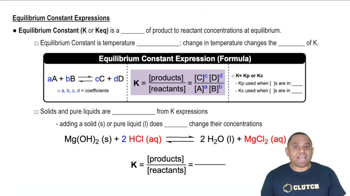
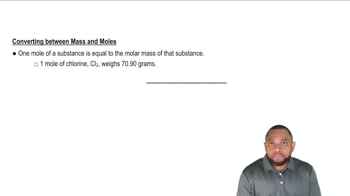
At 1285 _x001F_C, the equilibrium constant for the reaction Br2(g) ⇌ 2 Br(g) is Kc = 1.04 * 10^-3. A 0.200-L vessel containing an equilibrium mixture of the gases has 0.245 g of Br2(g) in it. What is the mass of Br(g) in the vessel?
Verified step by step guidanceKey Concepts
Equilibrium Constant (Kc)
Molar Mass and Mass to Moles Conversion
Stoichiometry in Chemical Reactions
At 900 K, the following reaction has 𝐾𝑝 = 0.345: 2 SO2(𝑔) + O2(𝑔) ⇌ 2 SO3(𝑔) In an equilibrium mixture the partial pressures of SO2 and O2 are 0.135 atm and 0.455 atm, respectively. What is the equilibrium partial pressure of SO3 in the mixture?
At 373 K, 𝐾𝑝 = 0.416 for the equilibrium 2 NOBr(𝑔) ⇌ 2 NO(𝑔) + Br2(𝑔) If the pressures of NOBr(𝑔) and NO(𝑔) are equal, what is the equilibrium pressure of Br2(𝑔)?
At 100°C, the equilibrium constant for the reaction COCl2(𝑔) ⇌ CO(𝑔) + Cl2(𝑔) has the value 𝐾𝑐 = 2.19×10⁻¹⁰. Are the following mixtures of COCl2, CO, and Cl2 at 100°C at equilibrium? If not, indicate the direction that the reaction must proceed to achieve equilibrium.
(a) [COCl2] = 2.00×10⁻³ M, [CO] = 3.3×10⁻⁶ M, [Cl2] = 6.62×10⁻⁶ M
(b) [COCl2] = 4.50×10⁻² M, [CO] = 1.1×10⁻⁷ M, [Cl2] = 2.25×10⁻⁶ M
(c) [COCl2] = 0.0100 M, [CO] = [Cl2] = 1.48×10⁻⁶ M
