
For the equilibrium Br2(π) + Cl2(π) β 2 BrCl(π) at 400 K, πΎπ = 7.0. If 0.25 mol of Br2 and 0.55 mol of Cl2 are introduced into a 3.0-L container at 400 K, what will be the equilibrium concentrations of Br2, Cl2, and BrCl?
Ch.15 - Chemical Equilibrium
Brown14th EditionChemistry: The Central ScienceISBN: 9780134414232Not the one you use?Change textbook
Chapter 15, Problem 46
At 900 K, the following reaction has πΎπ = 0.345: 2 SO2(π) + O2(π) β 2 SO3(π) In an equilibrium mixture the partial pressures of SO2 and O2 are 0.135 atm and 0.455 atm, respectively. What is the equilibrium partial pressure of SO3 in the mixture?
Verified step by step guidance1
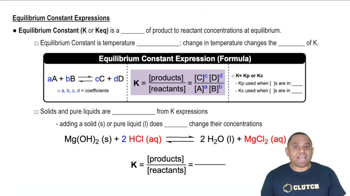
Write the expression for the equilibrium constant, Kp, for the reaction. For the reaction 2 SO2(g) + O2(g) β 2 SO3(g), the expression is Kp = (P_SO3)^2 / ((P_SO2)^2 * P_O2).
Substitute the given values of the partial pressures of SO2 and O2 into the Kp expression. Here, P_SO2 = 0.135 atm and P_O2 = 0.455 atm.
Rearrange the Kp expression to solve for P_SO3. This involves isolating P_SO3 on one side of the equation.
Take the square root of both sides of the equation to solve for P_SO3, since P_SO3 is squared in the Kp expression.
Ensure that the units are consistent and that the calculation is dimensionally correct to find the equilibrium partial pressure of SO3.
Key Concepts
Here are the essential concepts you must grasp in order to answer the question correctly.
Equilibrium Constant (Kp)
The equilibrium constant, Kp, is a dimensionless number that expresses the ratio of the partial pressures of products to reactants at equilibrium for a given reaction at a specific temperature. For the reaction 2 SO2(g) + O2(g) β 2 SO3(g), Kp is calculated using the formula Kp = (P_SO3^2) / (P_SO2^2 * P_O2), where P represents the partial pressures of the gases involved. A Kp value less than 1 indicates that at equilibrium, the reactants are favored over the products.
Recommended video:
Guided course
Equilibrium Constant Expressions
Partial Pressure
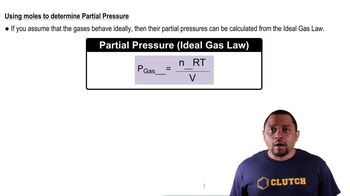
Partial pressure is the pressure exerted by a single component of a gas mixture. According to Dalton's Law of Partial Pressures, the total pressure of a gas mixture is the sum of the partial pressures of each individual gas. In this context, knowing the partial pressures of SO2 and O2 allows us to calculate the partial pressure of SO3 at equilibrium using the equilibrium constant.
Recommended video:
Guided course
Partial Pressure Calculation
Le Chatelier's Principle
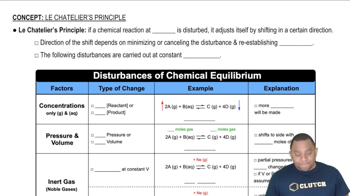
Le Chatelier's Principle states that if a dynamic equilibrium is disturbed by changing the conditions, the system will adjust itself to counteract the change and restore a new equilibrium. This principle helps predict how changes in concentration, pressure, or temperature will affect the position of equilibrium. In this case, understanding how the equilibrium shifts can provide insights into the relationship between the partial pressures of the reactants and products.
Recommended video:
Guided course
Le Chatelier's Principle
Related Practice
Textbook Question
1290
views
1
rank
Textbook Question
(a) If Qc > Kc, how must the reaction proceed to reach equilibrium?
874
views
Textbook Question
At 100Β°C, the equilibrium constant for the reaction COCl2(π) β CO(π) + Cl2(π) has the value πΎπ = 2.19Γ10β10. Are the following mixtures of COCl2, CO, and Cl2 at 100Β°C at equilibrium? If not, indicate the direction that the reaction must proceed to achieve equilibrium.
(a) [COCl2] = 2.00Γ10β3 M, [CO] = 3.3Γ10β6 M, [Cl2] = 6.62Γ10β6 M
(b) [COCl2] = 4.50Γ10β2 M, [CO] = 1.1Γ10β7 M, [Cl2] = 2.25Γ10β6 M
(c) [COCl2] = 0.0100 M, [CO] = [Cl2] = 1.48Γ10β6 M
736
views
