
Ch.15 - Chemical Equilibrium
Brown - Chemistry: The Central Science 14th Edition
Brown14th EditionChemistry: The Central ScienceISBN: 9780134414232Not the one you use?Change textbook
Chapter 15, Problem 83

Nitric oxide (NO) reacts readily with chlorine gas as follows: 2 NO(𝑔) + Cl2(𝑔) β‡Œ 2 NOCl(𝑔) At 700 K, the equilibrium constant Kp for this reaction is 0.26. Predict the behavior of each of the following mixtures at this temperature and indicate whether or not the mixtures are at equilibrium. If not, state whether the mixture will need to produce more products or reactants to reach equilibrium.
(a) PNO = 0.15 atm, PCl2 = 0.31 atm, PNOCl = 0.11 atm
(b) PNO = 0.12 atm, PCl2 = 0.10 atm, PNOCl = 0.050 atm
(c) PNO = 0.15 atm, PCl2 = 0.20 atm, PNOCl = 5.10 Γ— 10-3 atm

Verified step by step guidance
1
Calculate the reaction quotient, Qp, using the formula: Qp = (P_{NOCl}^2) / (P_{NO}^2 * P_{Cl2}).
Substitute the given partial pressures into the Qp expression: P_{NO} = 0.12 atm, P_{Cl2} = 0.10 atm, P_{NOCl} = 0.050 atm.
Compare the calculated Qp value with the given equilibrium constant Kp = 0.26.
If Qp < Kp, the reaction will proceed in the forward direction to produce more products (NOCl) to reach equilibrium.
If Qp > Kp, the reaction will proceed in the reverse direction to produce more reactants (NO and Cl2) to reach equilibrium.

Verified video answer for a similar problem:

This video solution was recommended by our tutors as helpful for the problem above.
Video duration:
5m
Was this helpful?

Key Concepts

Here are the essential concepts you must grasp in order to answer the question correctly.

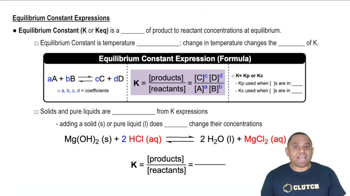
Equilibrium Constant (Kp)

The equilibrium constant (Kp) is a numerical value that expresses the ratio of the partial pressures of the products to the reactants at equilibrium for a given reaction at a specific temperature. For the reaction 2 NO(g) + Cl2(g) β‡Œ 2 NOCl(g), Kp = 0.26 indicates that at equilibrium, the concentration of NOCl is relatively low compared to NO and Cl2. This constant helps predict the direction in which a reaction will shift to reach equilibrium.
Recommended video:
Guided course
03:20
Equilibrium Constant Expressions

Le Chatelier's Principle

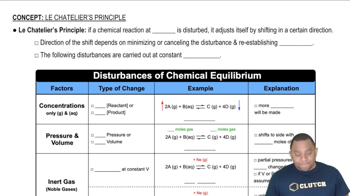
Le Chatelier's Principle states that if a system at equilibrium is subjected to a change in concentration, temperature, or pressure, the system will adjust to counteract that change and restore a new equilibrium. In the context of the given reaction, if the concentrations of reactants or products are altered, the system will shift towards the side that reduces the effect of the change, either producing more products or reactants as needed.
Recommended video:
Guided course
07:32
Le Chatelier's Principle

Reaction Quotient (Q)

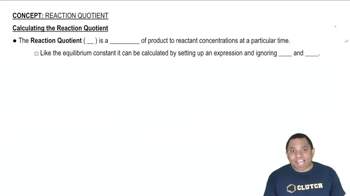
The reaction quotient (Q) is a measure of the relative amounts of products and reactants present in a reaction mixture at any point in time, calculated using the same formula as Kp. By comparing Q to Kp, one can determine the direction in which the reaction will proceed to reach equilibrium. If Q < Kp, the reaction will shift to the right to produce more products; if Q > Kp, it will shift to the left to produce more reactants.
Recommended video:
Guided course
00:49
Reaction Quotient Q