
Ch.15 - Chemical Equilibrium
Brown - Chemistry: The Central Science 14th Edition
Brown14th EditionChemistry: The Central ScienceISBN: 9780134414232Not the one you use?Change textbook
Chapter 15, Problem 85

When 1.50 mol CO2 and 1.50 mol H2 are placed in a 3.00-L container at 395 _x001F_C, the following reaction occurs: CO2(g) + H2(g) ⇌ CO(g) + H2O(g). If Kc = 0.802, what are the concentrations of each substance in the equilibrium mixture?

Verified step by step guidance
1
Step 1: Write the balanced chemical equation for the reaction: CO_2(g) + H_2(g) ⇌ CO(g) + H_2O(g).
Step 2: Set up an ICE (Initial, Change, Equilibrium) table to track the concentrations of each species. Initially, [CO_2] = [H_2] = 1.50 mol / 3.00 L, and [CO] = [H_2O] = 0 mol/L.
Step 3: Define the change in concentration for the reactants and products in terms of x, where x is the amount of CO_2 and H_2 that react. The changes are: [CO_2] = [H_2] = -x, [CO] = [H_2O] = +x.
Step 4: Express the equilibrium concentrations in terms of x: [CO_2] = [H_2] = (1.50/3.00) - x, [CO] = [H_2O] = x.
Step 5: Substitute the equilibrium concentrations into the expression for the equilibrium constant K_c = ([CO][H_2O])/([CO_2][H_2]) and solve for x using K_c = 0.802.

Key Concepts

Here are the essential concepts you must grasp in order to answer the question correctly.

Equilibrium Constant (Kc)

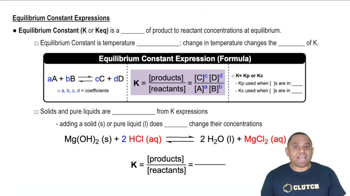
The equilibrium constant (Kc) is a numerical value that expresses the ratio of the concentrations of products to reactants at equilibrium for a given reaction at a specific temperature. For the reaction CO2(g) + H2(g) ⇌ CO(g) + H2O(g), Kc = [CO][H2O] / [CO2][H2]. A Kc value greater than 1 indicates that products are favored at equilibrium, while a value less than 1 suggests that reactants are favored.
Recommended video:
Guided course
03:20
Equilibrium Constant Expressions

Concentration Calculations

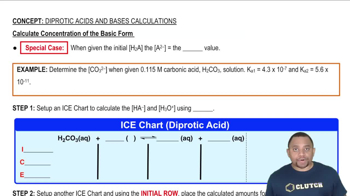
Concentration is defined as the amount of a substance per unit volume of solution, typically expressed in moles per liter (M). To find the equilibrium concentrations of each substance, one must first determine the initial concentrations by dividing the number of moles by the volume of the container. Changes in concentration due to the reaction must then be accounted for using an ICE (Initial, Change, Equilibrium) table.
Recommended video:
Guided course
07:35
Calculate Concentration of the Basic Form

Le Chatelier's Principle

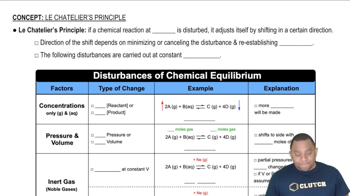
Le Chatelier's Principle states that if a dynamic equilibrium is disturbed by changing the conditions, the system will adjust to counteract the change and restore a new equilibrium. In the context of the given reaction, if the concentration of reactants or products is altered, the system will shift in the direction that reduces the effect of that change, which is crucial for predicting how concentrations will adjust at equilibrium.
Recommended video:
Guided course
07:32
Le Chatelier's Principle