
Ch.15 - Chemical Equilibrium
Brown - Chemistry: The Central Science 14th Edition
Brown14th EditionChemistry: The Central ScienceISBN: 9780134414232Not the one you use?Change textbook
Chapter 15, Problem 81

Solid NH4SH is introduced into an evacuated flask at 24 _x001F_C. The following reaction takes place: NH4SH(s) ⇌ NH3(g) + H2S(g). At equilibrium, the total pressure (for NH3 and H2S taken together) is 0.614 atm. What is Kp for this equilibrium at 24 _x001F_C?

Verified step by step guidance
1
Identify the equilibrium reaction: NH4SH(s) ⇌ NH3(g) + H2S(g). Note that NH4SH is a solid and does not appear in the expression for Kp.
Write the expression for the equilibrium constant Kp for the reaction: Kp = P(NH3) * P(H2S), where P(NH3) and P(H2S) are the partial pressures of NH3 and H2S, respectively.
Recognize that at equilibrium, the total pressure is the sum of the partial pressures of NH3 and H2S: P(total) = P(NH3) + P(H2S) = 0.614 atm.
Assume that the partial pressures of NH3 and H2S are equal at equilibrium due to the stoichiometry of the reaction (1:1 ratio). Therefore, let P(NH3) = P(H2S) = x atm.
Set up the equation for total pressure: x + x = 0.614 atm, solve for x to find the partial pressures, and then substitute back into the Kp expression to find Kp.

Key Concepts

Here are the essential concepts you must grasp in order to answer the question correctly.

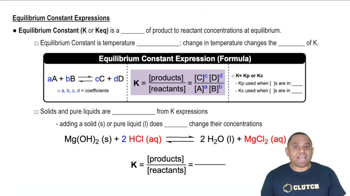
Equilibrium Constant (Kp)

The equilibrium constant (Kp) is a numerical value that expresses the ratio of the partial pressures of the products to the reactants at equilibrium for a given reaction. For the reaction NH4SH(s) ⇌ NH3(g) + H2S(g), Kp is calculated using the formula Kp = (P_NH3 * P_H2S) / P_NH4SH, where P represents the partial pressures of the gases involved. Since NH4SH is a solid, its activity is considered to be 1, simplifying the expression.
Recommended video:
Guided course
03:20
Equilibrium Constant Expressions

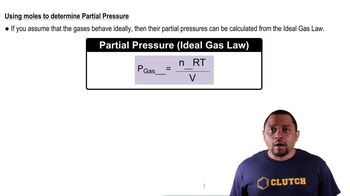
Partial Pressure

Partial pressure is the pressure exerted by a single component of a gas mixture. In this case, the total pressure of the gases NH3 and H2S at equilibrium is given as 0.614 atm. To find Kp, one must determine the individual partial pressures of NH3 and H2S, which can be derived from the total pressure and the stoichiometry of the reaction, assuming equal molar amounts of NH3 and H2S are produced.
Recommended video:
Guided course
00:48
Partial Pressure Calculation

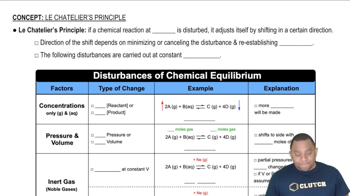
Le Chatelier's Principle

Le Chatelier's Principle states that if a dynamic equilibrium is disturbed by changing the conditions, the system will adjust to counteract the change and restore a new equilibrium. In the context of the reaction NH4SH(s) ⇌ NH3(g) + H2S(g), if the pressure or temperature changes, the equilibrium position will shift to favor the formation of either reactants or products, affecting the values of Kp and the concentrations of the gases involved.
Recommended video:
Guided course
07:32
Le Chatelier's Principle