
Textbook Question
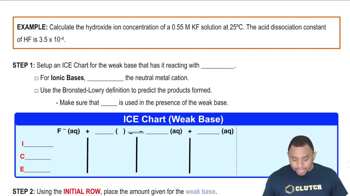
Calculate the pH of a solution made by adding 2.50 g of lithium oxide 1Li2O2 to enough water to make 1.500 L of solution.
390
views

 Verified step by step guidance
 06:12
06:12
 01:09
01:09 02:15
02:15Calculate the pH of a solution made by adding 2.50 g of lithium oxide 1Li2O2 to enough water to make 1.500 L of solution.
Which, if any, of the following statements are true? (a) The stronger the base, the smaller the pKb. (b) The stronger the base, the larger the pKb. (c) The stronger the base, the smaller the Kb. (d) The stronger the base, the larger the Kb. (e) The stronger the base, the smaller the pKa of its conjugate acid. (f) The stronger the base, the larger the pKa of its conjugate acid.
Indicate whether each of the following statements is correct or incorrect. (c) Conjugate acids of weak bases produce more acidic solutions than conjugate acids of strong bases.
Predict how each molecule or ion would act, in the Brønsted-Lowry sense, in aqueous solution by writing 'acid,' 'base,' 'both,' or 'neither' on the line provided. (b) Prozac
Identify the Lewis acid and Lewis base in each of the following reactions:
(a) HNO2(aq) + OH-(aq) ⇌ NO2-(aq) + H2O(l)
(b) FeBr3(s) + Br-(aq) ⇌ FeBr4-(aq)
(c) Zn2+(aq) + 4 NH3(aq) ⇌ Zn(NH3)42+(aq)
(d) SO2(g) + H2O(l) ⇌ H2SO3(aq)