
Ch.17 - Additional Aspects of Aqueous Equilibria
Brown - Chemistry: The Central Science 14th Edition
Brown14th EditionChemistry: The Central ScienceISBN: 9780134414232Not the one you use?Change textbook
Chapter 17, Problem 119b

Baking soda (sodium bicarbonate, NaHCO3) reacts with acids in foods to form carbonic acid (H2CO3), which in turn decomposes to water and carbon dioxide gas. In a cake batter, the CO2(g) forms bubbles and causes the cake to rise. (b) The density of baking soda is 2.16 g/cm3. Calculate the concentration of lactic acid in one cup of sour milk (assuming the rule of thumb applies), in units of mol/L. (One cup = 236.6 mL = 48 teaspoons).

Verified step by step guidance
1
Identify the chemical reaction involved: Sodium bicarbonate (NaHCO3) reacts with lactic acid (C3H6O3) to produce carbonic acid (H2CO3), which decomposes into water (H2O) and carbon dioxide (CO2). The balanced chemical equation is: NaHCO3 + C3H6O3 → NaC3H5O3 + H2CO3.
Determine the molar mass of sodium bicarbonate (NaHCO3) using the periodic table: Na (22.99 g/mol), H (1.01 g/mol), C (12.01 g/mol), and O (16.00 g/mol). Calculate the total molar mass: 22.99 + 1.01 + 12.01 + (3 x 16.00).
Calculate the mass of baking soda in one teaspoon using its density: Density = mass/volume. Given the density of baking soda is 2.16 g/cm³, and one teaspoon is approximately 4.93 cm³, calculate the mass of baking soda in one teaspoon.
Convert the mass of baking soda to moles using its molar mass: Use the formula moles = mass/molar mass. This will give you the moles of NaHCO3 per teaspoon.
Calculate the concentration of lactic acid in mol/L: Since one cup is 236.6 mL, convert this volume to liters. Use the stoichiometry of the reaction (1:1 ratio) to find the moles of lactic acid, and then divide by the volume in liters to find the concentration in mol/L.

Verified video answer for a similar problem:

This video solution was recommended by our tutors as helpful for the problem above.
Video duration:
2m
Was this helpful?

Key Concepts

Here are the essential concepts you must grasp in order to answer the question correctly.

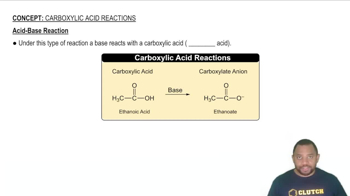
Acid-Base Reactions

Acid-base reactions involve the transfer of protons (H+) between reactants. In this context, baking soda (a base) reacts with acids in food, such as lactic acid, to produce carbonic acid, which then decomposes into water and carbon dioxide. Understanding this reaction is crucial for grasping how baking soda acts as a leavening agent in baking.
Recommended video:
Guided course
01:09
Acid-Base Reaction

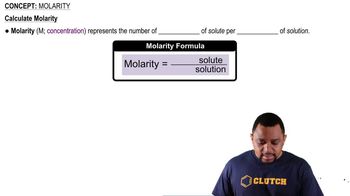
Concentration and Molarity

Concentration refers to the amount of solute present in a given volume of solution, typically expressed in moles per liter (mol/L), known as molarity. To calculate the concentration of lactic acid in sour milk, one must convert the volume of milk into liters and relate it to the amount of lactic acid present, which is essential for determining its strength in the solution.
Recommended video:
Guided course
00:53
Molarity Concept

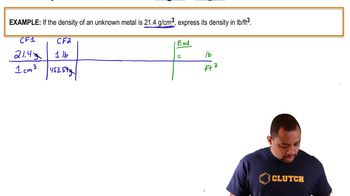
Density and Volume Conversion

Density is defined as mass per unit volume, and it plays a key role in converting between different units of measurement. In this problem, the density of baking soda is given, which can be used to find the mass of baking soda in a specific volume. Understanding how to convert between grams, milliliters, and liters is vital for accurately calculating concentrations in chemical solutions.
Recommended video:
Guided course
05:30
Density Conversion Example