
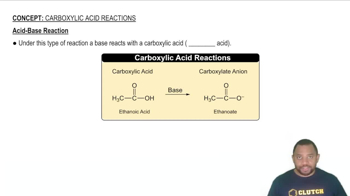
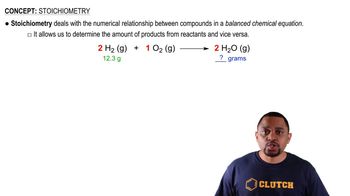
Baking soda (sodium bicarbonate, NaHCO3) reacts with acids in foods to form carbonic acid (H2CO3), which in turn decomposes to water and carbon dioxide gas. In a cake batter, the CO2(g) forms bubbles and causes the cake to rise. (b) The density of baking soda is 2.16 g/cm3. Calculate the concentration of lactic acid in one cup of sour milk (assuming the rule of thumb applies), in units of mol/L. (One cup = 236.6 mL = 48 teaspoons).
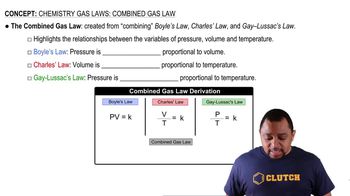
Baking soda (sodium bicarbonate, NaHCO3) reacts with acids in foods to form carbonic acid (H2CO3), which in turn decomposes to water and carbon dioxide gas. In a cake batter, the CO2(g) forms bubbles and causes the cake to rise. (c) If 1/2 teaspoon of baking soda is indeed completely neutralized by the lactic acid in sour milk, calculate the volume of carbon dioxide gas that would be produced at 1 atm pressure, in an oven set to 350 F.
Verified step by step guidanceKey Concepts
Acid-Base Reactions
Gas Laws
Stoichiometry
A concentration of 10–100 parts per billion (by mass) of Ag+ is an effective disinfectant in swimming pools. However, if the concentration exceeds this range, the Ag+ can cause adverse health effects. One way to maintain an appropriate concentration of Ag+ is to add a slightly soluble salt to the pool. Using Ksp values from Appendix D, calculate the equilibrium concentration of Ag+ in parts per billion that would exist in equilibrium with (b) AgBr (c) AgI.
In nonaqueous solvents, it is possible to react HF to create H2F+. Which of these statements follows from this observation? (a) HF can act like a strong acid in nonaqueous solvents, (b) HF can act like a base in nonaqueous solvents, (c) HF is thermodynamically unstable, (d) There is an acid in the nonaqueous medium that is a stronger acid than HF.
