
Ch.19 - Chemical Thermodynamics
Brown - Chemistry: The Central Science 14th Edition
Brown14th EditionChemistry: The Central ScienceISBN: 9780134414232Not the one you use?Change textbook
Chapter 19, Problem 67

For a particular reaction, ΔH = -32 kJ and ΔS = -98 J>K. Assume that ΔH and ΔS do not vary with temperature. (a) At what temperature will the reaction have ΔG = 0? (b) If T is increased from that in part (a), will the reaction be spontaneous or nonspontaneous?

Verified step by step guidance
1
Step 1: Recall the Gibbs free energy equation: \( \Delta G = \Delta H - T \Delta S \). For part (a), set \( \Delta G = 0 \) and solve for temperature \( T \).
Step 2: Convert \( \Delta S \) from J/K to kJ/K to match the units of \( \Delta H \). This is done by dividing \( \Delta S \) by 1000.
Step 3: Substitute \( \Delta H = -32 \text{ kJ} \) and the converted \( \Delta S \) into the equation \( 0 = \Delta H - T \Delta S \) and solve for \( T \).
Step 4: For part (b), consider the sign of \( \Delta G \) when \( T \) is increased. Since \( \Delta G = \Delta H - T \Delta S \), increasing \( T \) will affect the term \( -T \Delta S \).
Step 5: Analyze the sign of \( \Delta S \) to determine the effect on \( \Delta G \) as \( T \) increases. If \( \Delta S < 0 \), increasing \( T \) makes \( -T \Delta S \) more positive, thus \( \Delta G \) becomes positive, indicating nonspontaneity.

Key Concepts

Here are the essential concepts you must grasp in order to answer the question correctly.

Gibbs Free Energy (ΔG)

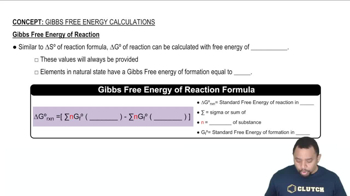
Gibbs Free Energy (ΔG) is a thermodynamic potential that measures the maximum reversible work obtainable from a thermodynamic system at constant temperature and pressure. It is calculated using the equation ΔG = ΔH - TΔS, where ΔH is the change in enthalpy, T is the temperature in Kelvin, and ΔS is the change in entropy. A negative ΔG indicates a spontaneous reaction, while a positive ΔG indicates nonspontaneity.
Recommended video:
Guided course
01:51
Gibbs Free Energy of Reactions

Enthalpy (ΔH)

Enthalpy (ΔH) is a measure of the total heat content of a system and reflects the energy required to break and form bonds during a chemical reaction. A negative ΔH value, such as -32 kJ, indicates that the reaction is exothermic, meaning it releases heat to the surroundings. This factor can influence the spontaneity of a reaction, especially when combined with entropy changes.

Entropy (ΔS)

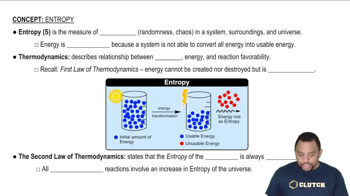
Entropy (ΔS) is a measure of the disorder or randomness in a system. A negative ΔS value, like -98 J/K, suggests that the reaction leads to a decrease in disorder, which can affect the spontaneity of the reaction. In the context of Gibbs Free Energy, the interplay between ΔH and ΔS at a given temperature determines whether a reaction will be spontaneous or nonspontaneous.
Recommended video:
Guided course
02:46
Entropy in Thermodynamics
Related Practice
Textbook Question

Consider the following reaction between oxides of nitrogen: NO2(g) + N2O(g) → 3 NO(g) (b) Calculate ΔG at 800 K, assuming that ΔH° and ΔS° do not change with temperature. Under standard conditions is the reaction spontaneous at 800 K?

654
views
Textbook Question

Consider the following reaction between oxides of nitrogen: NO2(g) + N2O(g) → 3 NO(g) (c) Calculate ΔG at 1000 K. Is the reaction spontaneous under standard conditions at this temperature?

334
views
Textbook Question

Classify each of the following reactions as one of the four possible types summarized in Table 19.3: (i) spontaneous at all temperatures; (ii) not spontaneous at any temperature; (iii) spontaneous at low T but not spontaneous at high T; (iv) spontaneous at high T but not spontaneous at low T.

(c) N2F4(g) ⟶ 2 NF2(g) ΔH° = 85 kJ; ΔS° = 198 J/K

839
views
Textbook Question

From the values given for ΔH° and ΔS°, calculate ΔG° for each of the following reactions at 298 K. If the reaction is not spontaneous under standard conditions at 298 K, at what temperature (if any) would the reaction become spontaneous?

a. 2 PbS(s) + 3 O2(g) → 2 PbO(s) + 2 SO2(g) ΔH° = −844 kJ; ΔS° = −165 J/K

b. 2 POCl3(g) → 2 PCl3(g) + O2(g) ΔH° = 572 kJ; ΔS° = 179 J/K

2787
views
1
rank
1
comments
Textbook Question

Reactions in which a substance decomposes by losing CO are called decarbonylation reactions. The decarbonylation of acetic acid proceeds according to: CH3COOH(l) → CH3OH(g) + CO(g) By using data from Appendix C, calculate the minimum temperature at which this process will be spontaneous under standard conditions. Assume that ΔH° and ΔS° do not vary with temperature.

806
views