
Textbook Question
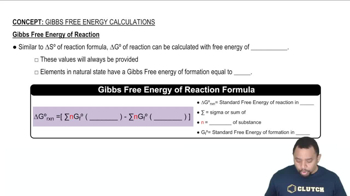
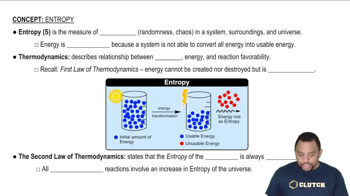
Methanol (CH3OH) can be made by the controlled oxidation of methane: CH4(g) + 12 O2(g) → CH3OH(g) (b) Will ΔG for the reaction increase, decrease, or stay unchanged with increasing temperature?
670
views

 Verified step by step guidance
 01:51
01:51
 02:46
02:46 01:10
01:10Methanol (CH3OH) can be made by the controlled oxidation of methane: CH4(g) + 12 O2(g) → CH3OH(g) (b) Will ΔG for the reaction increase, decrease, or stay unchanged with increasing temperature?
Consider the following reaction between oxides of nitrogen: NO2(g) + N2O(g) → 3 NO(g) (b) Calculate ΔG at 800 K, assuming that ΔH° and ΔS° do not change with temperature. Under standard conditions is the reaction spontaneous at 800 K?
Consider the following reaction between oxides of nitrogen: NO2(g) + N2O(g) → 3 NO(g) (c) Calculate ΔG at 1000 K. Is the reaction spontaneous under standard conditions at this temperature?
From the values given for ΔH° and ΔS°, calculate ΔG° for each of the following reactions at 298 K. If the reaction is not spontaneous under standard conditions at 298 K, at what temperature (if any) would the reaction become spontaneous?
a. 2 PbS(s) + 3 O2(g) → 2 PbO(s) + 2 SO2(g) ΔH° = −844 kJ; ΔS° = −165 J/K
b. 2 POCl3(g) → 2 PCl3(g) + O2(g) ΔH° = 572 kJ; ΔS° = 179 J/K