
Textbook Question
Consider the reaction 3 CH4(g) → C3H8(g) + 2 H2(g). (a) Using data from Appendix C, calculate ΔG° at 298 K.
437
views

 Verified step by step guidance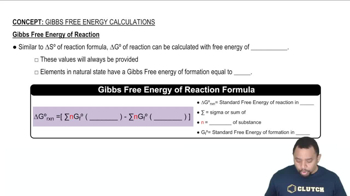
 01:51
01:51
 07:32
07:32 00:49
00:49Consider the reaction 3 CH4(g) → C3H8(g) + 2 H2(g). (a) Using data from Appendix C, calculate ΔG° at 298 K.
The fuel in high-efficiency natural-gas vehicles consists primarily of methane (CH4). (a) How much heat is produced in burning 1 mol of CH4(g) under standard conditions if reactants and products are brought to 298 K and H2O(l) is formed?
Consider the reaction 2 NO2(g) → N2O4(g). (a) Using data from Appendix C, calculate ΔG° at 298 K. (b) Calculate ΔG at 298 K if the partial pressures of NO2 and N2O4 are 0.40 atm and 1.60 atm, respectively.
(a) Using data in Appendix C, estimate the temperature at which the free-energy change for the transformation from I2(s) to I2(g) is zero. (b) Use a reference source, such as Web Elements (www.webelements.com), to find the experimental melting and boiling points of I2. (c) Which of the values in part (b) is closer to the value you obtained in part (a)?