Methanol (CH3OH) can be made by the controlled oxidation of methane: CH4(g) + 12 O2(g) → CH3OH(g) (b) Will ΔG for the reaction increase, decrease, or stay unchanged with increasing temperature?
Ch.19 - Chemical Thermodynamics
Brown14th EditionChemistry: The Central ScienceISBN: 9780134414232Not the one you use?Change textbook
Chapter 19, Problem 74a
The fuel in high-efficiency natural-gas vehicles consists primarily of methane (CH4). (a) How much heat is produced in burning 1 mol of CH4(g) under standard conditions if reactants and products are brought to 298 K and H2O(l) is formed?
Verified step by step guidance1
Identify the chemical reaction for the combustion of methane: CH_4(g) + 2O_2(g) \(\rightarrow\) CO_2(g) + 2H_2O(l).
Determine the standard enthalpy change (\( \Delta H^\circ \)) for the reaction using standard enthalpies of formation: \( \Delta H^\circ = \sum \Delta H^\circ_f(\text{products}) - \sum \Delta H^\circ_f(\text{reactants}) \).
Look up the standard enthalpies of formation for each substance involved: CH_4(g), O_2(g), CO_2(g), and H_2O(l).
Substitute the values into the enthalpy change equation: \( \Delta H^\circ = [\Delta H^\circ_f(\text{CO}_2(g)) + 2 \times \Delta H^\circ_f(\text{H}_2O(l))] - [\Delta H^\circ_f(\text{CH}_4(g)) + 2 \times \Delta H^\circ_f(\text{O}_2(g))] \).
Calculate the \( \Delta H^\circ \) for the reaction to find the heat produced when 1 mol of CH_4 is burned.

Verified video answer for a similar problem:
This video solution was recommended by our tutors as helpful for the problem above.
Video duration:
8mWas this helpful?
Key Concepts
Here are the essential concepts you must grasp in order to answer the question correctly.
Combustion Reaction
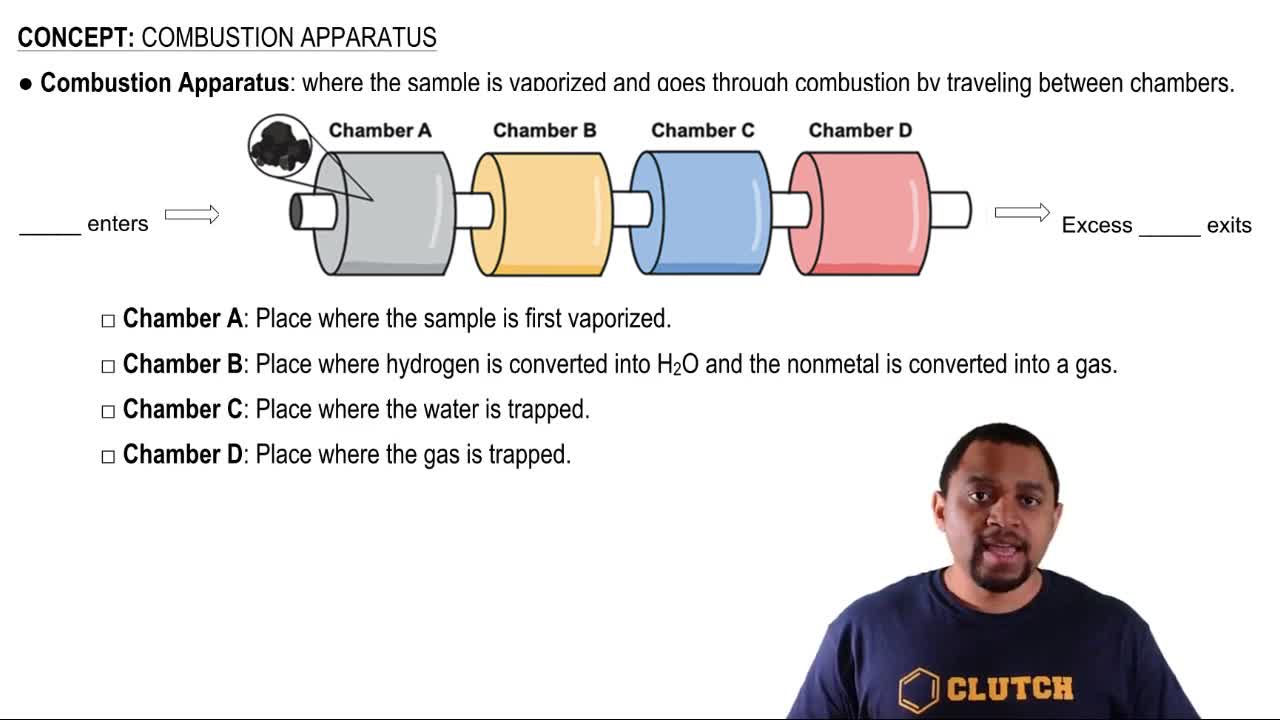
A combustion reaction is a chemical process in which a substance (typically a hydrocarbon) reacts with oxygen to produce heat, carbon dioxide, and water. In the case of methane (CH4), the reaction releases energy as it converts the reactants into products, making it a key process in energy production for fuels.
Recommended video:
Guided course
Combustion Apparatus
Enthalpy of Combustion
The enthalpy of combustion is the amount of heat released when one mole of a substance is completely burned in oxygen under standard conditions. For methane, this value is crucial for determining the energy output of natural gas vehicles and is typically expressed in kilojoules per mole (kJ/mol).
Recommended video:
Guided course
Combustion Apparatus
Standard Conditions
Standard conditions refer to a set of specific conditions used as a reference point in thermodynamics, typically defined as 1 atmosphere of pressure and a temperature of 298 K (25°C). These conditions are important for calculating thermodynamic properties, such as enthalpy changes, ensuring consistency in measurements and comparisons.
Recommended video:
Guided course
Standard Reduction Potentials
Related Practice
Textbook Question
670
views
Textbook Question
Consider the reaction 2 NO2(g) → N2O4(g). (a) Using data from Appendix C, calculate ΔG° at 298 K. (b) Calculate ΔG at 298 K if the partial pressures of NO2 and N2O4 are 0.40 atm and 1.60 atm, respectively.
843
views
Textbook Question
(a) Using data in Appendix C, estimate the temperature at which the free-energy change for the transformation from I2(s) to I2(g) is zero. (b) Use a reference source, such as Web Elements (www.webelements.com), to find the experimental melting and boiling points of I2. (c) Which of the values in part (b) is closer to the value you obtained in part (a)?
678
views