Complete the exercises below. Complete and balance the following equations: b. Al₂O₃ (s) + H⁺ (aq) →
Verified step by step guidance
1
Identify the reactants and products in the reaction. Here, we have aluminum oxide (Al₂O₃) reacting with hydrogen ions (H⁺) to form a product. Since Al₂O₃ is a basic oxide, it will react with an acid to form a salt and water.
Determine the possible products. When Al₂O₃ reacts with H⁺, it typically forms aluminum ions (Al³⁺) and water (H₂O).
Write the unbalanced chemical equation: Al₂O₃ (s) + H⁺ (aq) → Al³⁺ (aq) + H₂O (l).
Balance the equation by ensuring the number of atoms of each element is the same on both sides. Start by balancing the aluminum atoms, then the oxygen atoms, and finally the hydrogen atoms.
Check the charges on both sides of the equation to ensure they are balanced. Adjust the coefficients of the reactants and products as necessary to achieve charge balance.
Key Concepts
Here are the essential concepts you must grasp in order to answer the question correctly.
Balancing Chemical Equations
Balancing chemical equations involves ensuring that the number of atoms of each element is the same on both sides of the equation. This is based on the law of conservation of mass, which states that matter cannot be created or destroyed in a chemical reaction. To balance an equation, coefficients are adjusted in front of the chemical formulas to achieve equal atom counts.
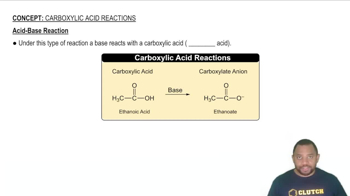
Acid-base reactions involve the transfer of protons (H⁺ ions) between reactants. In this context, H⁺ represents an acid that can react with a base, such as Al₂O₃, which can act as a Lewis base. Understanding the nature of the reactants helps predict the products formed in the reaction, which often results in the formation of water and a salt.
Aluminum oxide (Al₂O₃) is an amphoteric compound, meaning it can react with both acids and bases. In acidic conditions, it can dissolve to form aluminum ions and water. Recognizing the properties of Al₂O₃ is crucial for predicting its behavior in reactions, particularly when it interacts with H⁺ ions in an acid-base context.


 Verified step by step guidance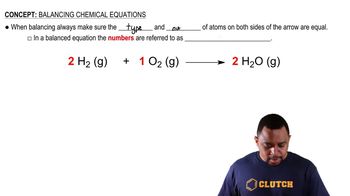
 01:32
01:32