
A method used by the U.S. Environmental Protection Agency (EPA) for determining the concentration of ozone in air is to pass the air sample through a 'bubbler' containing sodium iodide, which removes the ozone according to the following equation: O31g2 + 2 NaI1aq2 + H2O1l2¡ O21g2 + I21s2 + 2 NaOH1aq2 (b) How many grams of sodium iodide are needed to remove 1.3 mg of O3?
Ch.3 - Chemical Reactions and Reaction Stoichiometry
Brown14th EditionChemistry: The Central ScienceISBN: 9780134414232Not the one you use?Change textbook
Chapter 3, Problem 103
A mixture of N21g2 and H21g2 reacts in a closed container to form ammonia, NH31g2. The reaction ceases before either reactant has been totally consumed. At this stage 3.0 mol N2, 3.0 mol H2, and 3.0 mol NH3 are present. How many moles of N2 and H2 were present originally?
Verified step by step guidance1
insert step 1> Write the balanced chemical equation for the reaction: N_2(g) + 3H_2(g) \(\rightarrow\) 2NH_3(g).
insert step 2> Use the stoichiometry of the reaction to set up relationships between the moles of reactants and products. For every 1 mole of N_2, 3 moles of H_2 are required to produce 2 moles of NH_3.
insert step 3> Let x be the initial moles of N_2 and y be the initial moles of H_2.
insert step 4> Set up the equations based on the stoichiometry and the information given: x - a = 3.0 (moles of N_2 remaining), y - 3a = 3.0 (moles of H_2 remaining), and 2a = 3.0 (moles of NH_3 formed).
insert step 5> Solve the system of equations to find the initial moles of N_2 (x) and H_2 (y).

Verified video answer for a similar problem:
This video solution was recommended by our tutors as helpful for the problem above.
Video duration:
1mWas this helpful?
Key Concepts
Here are the essential concepts you must grasp in order to answer the question correctly.
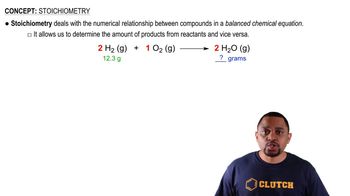
Stoichiometry
Stoichiometry is the branch of chemistry that deals with the quantitative relationships between the reactants and products in a chemical reaction. It allows us to calculate the amounts of substances consumed and produced in a reaction based on balanced chemical equations. In this case, understanding the stoichiometric ratios of nitrogen (N2), hydrogen (H2), and ammonia (NH3) is essential to determine the original amounts of reactants.
Recommended video:
Guided course
Stoichiometry Concept
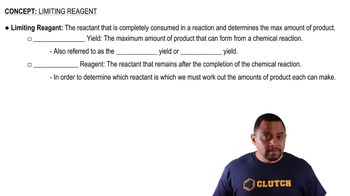
Limiting Reactant
The limiting reactant is the substance that is completely consumed in a chemical reaction, thus determining the maximum amount of product that can be formed. In this scenario, identifying which reactant (N2 or H2) limits the formation of NH3 is crucial for calculating the initial moles of each reactant. The limiting reactant concept helps in understanding how much of each reactant was present before the reaction reached equilibrium.
Recommended video:
Guided course
Limiting Reagent Concept
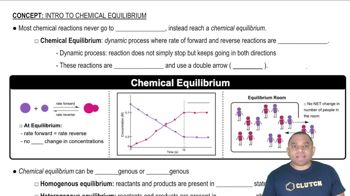
Chemical Equilibrium
Chemical equilibrium occurs when the rates of the forward and reverse reactions are equal, resulting in constant concentrations of reactants and products. In this problem, the reaction between N2 and H2 to form NH3 reaches a point where the amounts of all species remain unchanged. Recognizing that the reaction has not gone to completion but has reached a state of equilibrium is vital for determining the initial amounts of N2 and H2.
Recommended video:
Guided course
Chemical Equilibrium Concepts
Related Practice
Textbook Question
537
views
Textbook Question
When a mixture of 10.0 g of acetylene (C2H2) and 10.0 g of oxygen (O2) is ignited, the resulting combustion reaction produces CO2 and H2O. (c) How many grams of C2H2 are present after the reaction is complete?
799
views
Textbook Question
The fat stored in a camel's hump is a source of both energy and water. Calculate the mass of H2O produced by the metabolism of 1.0 kg of fat, assuming the fat consists entirely of tristearin 1C57H110O62, a typical animal fat, and assuming that during metabolism, tristearin reacts with O2 to form only CO2 and H2O.
1480
views
Textbook Question
When a mixture of 10.0 g of acetylene (C2H2) and 10.0 g of oxygen (O2) is ignited, the resulting combustion reaction produces CO2 and H2O. (c) How many grams of CO2 and H2O are present after the reaction is complete?
394
views
