

Ch.3 - Chemical Reactions and Reaction Stoichiometry
Brown - Chemistry: The Central Science 14th Edition
Brown14th EditionChemistry: The Central ScienceISBN: 9780134414232Not the one you use?Change textbook
Chapter 3, Problem 105c1

When a mixture of 10.0 g of acetylene (C2H2) and 10.0 g of oxygen (O2) is ignited, the resulting combustion reaction produces CO2 and H2O. (c) How many grams of C2H2 are present after the reaction is complete?

Verified step by step guidance
1
Identify the balanced chemical equation for the combustion of acetylene: \( 2 \text{C}_2\text{H}_2 + 5 \text{O}_2 \rightarrow 4 \text{CO}_2 + 2 \text{H}_2\text{O} \).
Calculate the molar mass of \( \text{C}_2\text{H}_2 \) and \( \text{O}_2 \).
Determine the number of moles of \( \text{C}_2\text{H}_2 \) and \( \text{O}_2 \) initially present using their respective masses and molar masses.
Identify the limiting reactant by comparing the mole ratio of \( \text{C}_2\text{H}_2 \) to \( \text{O}_2 \) with the stoichiometric ratio from the balanced equation.
Calculate the amount of \( \text{C}_2\text{H}_2 \) remaining after the reaction by considering the limiting reactant and the initial moles of \( \text{C}_2\text{H}_2 \).

Verified video answer for a similar problem:

This video solution was recommended by our tutors as helpful for the problem above.
Video duration:
4m
Was this helpful?

Key Concepts

Here are the essential concepts you must grasp in order to answer the question correctly.

Stoichiometry

Stoichiometry is the branch of chemistry that deals with the quantitative relationships between the reactants and products in a chemical reaction. It allows us to calculate the amounts of substances consumed and produced in a reaction based on balanced chemical equations. Understanding stoichiometry is essential for determining how much of each reactant is needed and how much product can be formed.
Recommended video:
Guided course
01:16
Stoichiometry Concept

Limiting Reactant

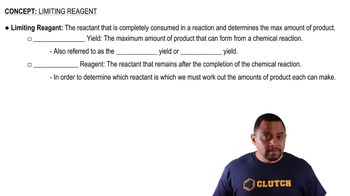
The limiting reactant is the substance that is completely consumed first in a chemical reaction, thus determining the maximum amount of product that can be formed. Identifying the limiting reactant is crucial for calculating the amounts of products and remaining reactants after the reaction. In the case of the combustion of acetylene and oxygen, one of these reactants will limit the formation of CO2 and H2O.
Recommended video:
Guided course
01:30
Limiting Reagent Concept

Combustion Reaction

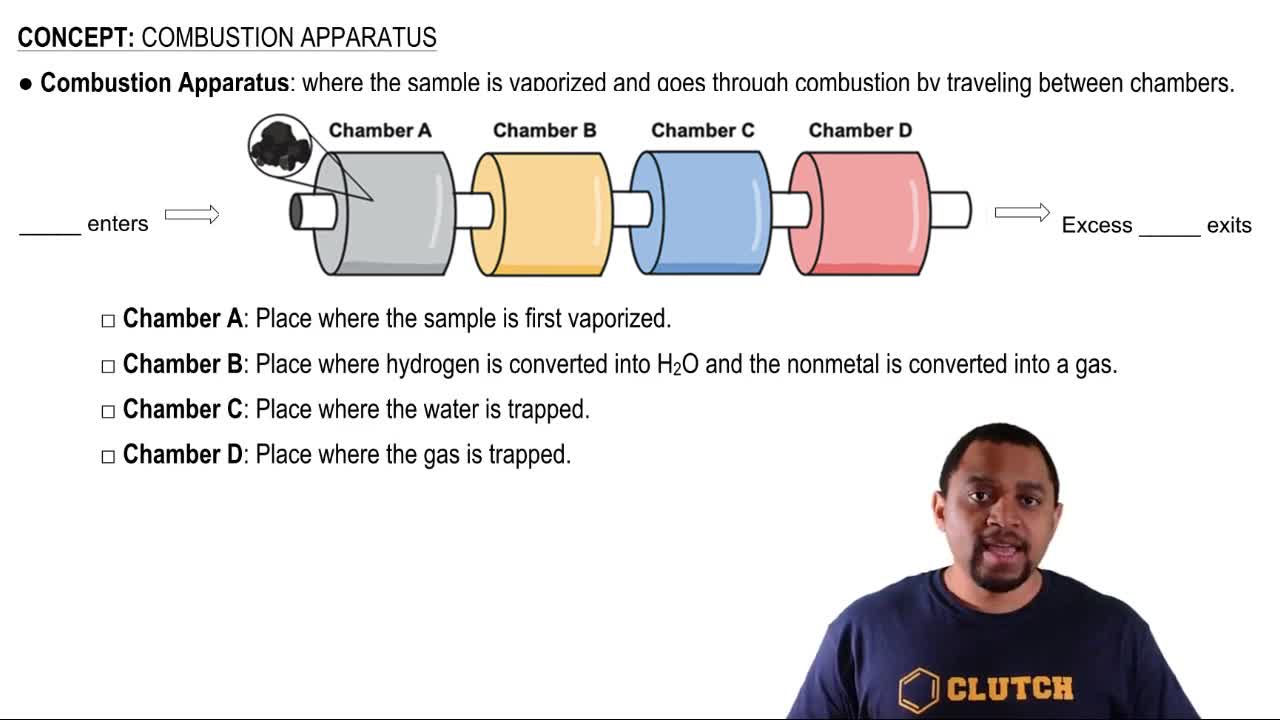
A combustion reaction is a chemical process in which a substance (usually a hydrocarbon) reacts with oxygen to produce carbon dioxide and water, releasing energy in the form of heat and light. The general form of a combustion reaction can be represented as: hydrocarbon + O2 → CO2 + H2O. Understanding the products and the stoichiometry involved in combustion reactions is vital for solving problems related to the amounts of reactants and products.
Recommended video:
Guided course
02:24
Combustion Apparatus