
Ch.3 - Chemical Reactions and Reaction Stoichiometry
Brown - Chemistry: The Central Science 14th Edition
Brown14th EditionChemistry: The Central ScienceISBN: 9780134414232Not the one you use?Change textbook
Chapter 3, Problem 17

(a) When the metallic element lithium combines with the nonmetallic element chlorine, Cl2(g), what is the chemical formula of the product? (b) In the balanced chemical equation for this reaction, what is the coefficient in front of the product if the coefficient in front of Cl2(g) is 1?

Verified step by step guidance
1
Identify the valency of lithium (Li) and chlorine (Cl). Lithium is in Group 1 and has a valency of +1, while chlorine is in Group 17 and has a valency of -1.
Determine the chemical formula of the compound formed by lithium and chlorine. Since lithium has a +1 charge and chlorine has a -1 charge, they combine in a 1:1 ratio to form LiCl.
Write the unbalanced chemical equation for the reaction: Li(s) + Cl_2(g) → LiCl.
Balance the chemical equation. Since Cl_2 contains two chlorine atoms, you need two LiCl to balance the chlorine atoms: 2 Li(s) + Cl_2(g) → 2 LiCl.
Identify the coefficient in front of the product LiCl in the balanced equation. The coefficient is 2.

Key Concepts

Here are the essential concepts you must grasp in order to answer the question correctly.

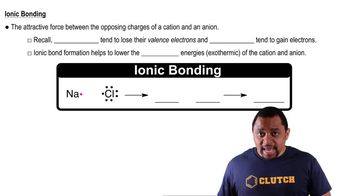
Ionic Bonding

Ionic bonding occurs when a metal and a nonmetal react to form a compound through the transfer of electrons. In this case, lithium (Li), a metal, donates an electron to chlorine (Cl), a nonmetal, resulting in the formation of lithium ions (Li+) and chloride ions (Cl-). The electrostatic attraction between these oppositely charged ions leads to the formation of the ionic compound lithium chloride (LiCl).
Recommended video:
Guided course
01:49
Chemical Bonds

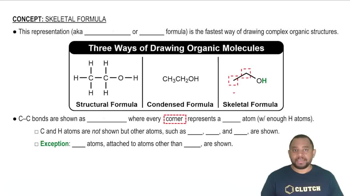
Chemical Formula

A chemical formula represents the composition of a compound using symbols for the elements and numerical subscripts to indicate the number of atoms of each element. For lithium chloride, the formula is LiCl, indicating one lithium atom and one chlorine atom in the compound. Understanding how to derive the chemical formula from the elements involved is crucial for identifying the product of a chemical reaction.
Recommended video:
Guided course
02:26
Skeletal Formula

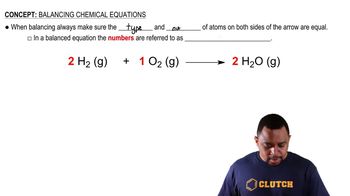
Balancing Chemical Equations

Balancing chemical equations ensures that the number of atoms for each element is the same on both sides of the equation, adhering to the law of conservation of mass. In the reaction between lithium and chlorine, if the coefficient in front of Cl2 is 1, the balanced equation will show that two lithium atoms react with one molecule of chlorine gas to produce two formula units of lithium chloride, resulting in the coefficient of 2 in front of LiCl.
Recommended video:
Guided course
01:32
Balancing Chemical Equations
Related Practice
Textbook Question

Write balanced chemical equations to correspond to each of the following descriptions: (a) When sulfur trioxide gas reacts with water, a solution of sulfuric acid forms. (b) Boron sulfide, B2S3(s), reacts violently with water to form dissolved boric acid, H3BO3, and hydrogen sulfide gas.

879
views
Textbook Question

(b) What products form in this reaction?

447
views
Textbook Question

Write balanced chemical equations corresponding to each of the following descriptions: (a) Potassium cyanide reacts with an aqueous solution of sulfuric acid to form hydrogen cyanide gas. (b) When an aqueous solution of ammonium nitrite (NH4NO2) reacts with an aqueous solution of potassium hydroxide, ammonia gas, water and metal nitrate is formed. (c) When hydrogen gas is passed over solid hot iron(III) oxide, the resulting reaction produces iron and gaseous water. (d) When liquid ethanoic acid (CH3COOH) is combusted, carbon dioxide and water are formed.

962
views
Textbook Question

Write balanced chemical equations to correspond to each of the following descriptions: (c) Phosphine, PH3(g), combusts in oxygen gas to form water vapor and solid tetraphosphorus decaoxide.

509
views
Textbook Question

(c) What is the sum of the coefficients in the balanced chemical equation for the combustion of one mole of acetone, C3H6O1l2, in air?

1161
views
Textbook Question

(a) When a compound containing C, H, and O is completely combusted in air, what reactant besides the hydrocarbon is involved in the reaction?

1254
views