

Ch.3 - Chemical Reactions and Reaction Stoichiometry
Brown - Chemistry: The Central Science 14th Edition
Brown14th EditionChemistry: The Central ScienceISBN: 9780134414232Not the one you use?Change textbook
Chapter 3, Problem 98a,b

An element X forms an iodide (XI3) and a chloride (XCl3). The iodide is quantitatively converted to the chloride when it is heated in a stream of chlorine: 2 XI3 + 3 Cl2 → 2 XCl3 + 3 I2 If 0.5000 g of XI3 is treated with chlorine, 0.2360 g of XCl3 is obtained. (a) Calculate the atomic weight of the element X. (b) Identify the element X.

Verified step by step guidance
1
Identify the chemical reaction: \(2 \text{XI}_3 + 3 \text{Cl}_2 \rightarrow 2 \text{XCl}_3 + 3 \text{I}_2\).
Determine the molar mass of \(\text{XI}_3\) and \(\text{XCl}_3\) using the given masses and the stoichiometry of the reaction.
Use the mass of \(\text{XI}_3\) (0.5000 g) and \(\text{XCl}_3\) (0.2360 g) to set up a ratio based on the stoichiometry of the reaction.
Calculate the molar mass of \(\text{XI}_3\) and \(\text{XCl}_3\) using the atomic masses of iodine and chlorine, and the unknown atomic mass of \(X\).
Solve the equations to find the atomic weight of element \(X\) by equating the molar masses derived from the given data.

Verified video answer for a similar problem:

This video solution was recommended by our tutors as helpful for the problem above.
Video duration:
6m
Was this helpful?

Key Concepts

Here are the essential concepts you must grasp in order to answer the question correctly.

Stoichiometry

Stoichiometry is the calculation of reactants and products in chemical reactions based on the conservation of mass. It involves using balanced chemical equations to determine the relationships between the amounts of substances consumed and produced. In this question, stoichiometry is essential for relating the masses of XI3 and XCl3 to find the atomic weight of element X.
Recommended video:
Guided course
01:16
Stoichiometry Concept

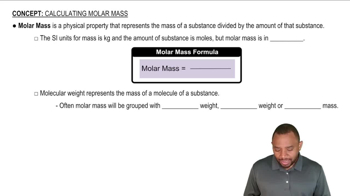
Molar Mass

Molar mass is the mass of one mole of a substance, typically expressed in grams per mole (g/mol). It is calculated by summing the atomic weights of all atoms in a molecule. To find the atomic weight of element X, one must first determine the molar masses of XI3 and XCl3, which will help in calculating the mass contribution of X in the reaction.
Recommended video:
Guided course
02:11
Molar Mass Concept

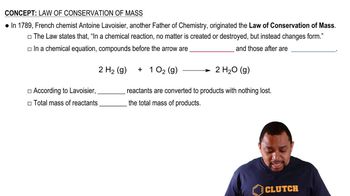
Conservation of Mass

The law of conservation of mass states that mass is neither created nor destroyed in a chemical reaction. This principle allows chemists to account for all reactants and products in a reaction. In this problem, the total mass of XI3 before the reaction must equal the total mass of XCl3 and I2 produced, which is crucial for calculating the atomic weight of X based on the given masses.
Recommended video:
Guided course
01:48
Law of Conservation of Mass