
(b) Because atoms are spherical, they cannot occupy all of the space of the cube. The silver atoms pack in the solid in such a way that 74% of the volume of the solid is actually filled with the silver atoms. Calculate the volume of a single silver atom.
Ch.3 - Chemical Reactions and Reaction Stoichiometry
Brown14th EditionChemistry: The Central ScienceISBN: 9780134414232Not the one you use?Change textbook
Chapter 3, Problem 109c
Burning acetylene in oxygen can produce three different carbon-containing products: soot (very fine particles of graphite), CO(g), and CO2(g). (c) Why, when the oxygen supply is adequate, is CO2(g) the predominant carbon-containing product of the combustion of acetylene?
Verified step by step guidance1
1. The combustion of acetylene (C2H2) in oxygen (O2) can produce three different carbon-containing products: soot (C), carbon monoxide (CO), and carbon dioxide (CO2). The reactions can be represented as follows:
C2H2 + O2 -> C + H2O
C2H2 + 1.5O2 -> CO + H2O
C2H2 + 2.5O2 -> CO2 + H2O
2. The formation of these products depends on the amount of oxygen present during the combustion. When the oxygen supply is limited, incomplete combustion occurs, leading to the formation of soot and CO. This is because there isn't enough oxygen to fully oxidize the carbon in acetylene to CO2.
3. However, when the oxygen supply is adequate, complete combustion occurs, leading to the formation of CO2. This is because there is enough oxygen to fully oxidize the carbon in acetylene to CO2.
4. The reason why CO2 is the predominant product when there is enough oxygen is because the formation of CO2 is more exothermic (releases more energy) than the formation of CO or soot. This makes the reaction that forms CO2 more thermodynamically favorable.
5. In summary, when the oxygen supply is adequate, CO2 is the predominant carbon-containing product of the combustion of acetylene because the reaction that forms CO2 is more exothermic and therefore more thermodynamically favorable.

Verified video answer for a similar problem:
This video solution was recommended by our tutors as helpful for the problem above.
Video duration:
2mWas this helpful?
Key Concepts
Here are the essential concepts you must grasp in order to answer the question correctly.
Combustion Reaction
A combustion reaction is a chemical process in which a substance reacts rapidly with oxygen, producing heat and light. In the case of acetylene (C2H2), complete combustion occurs when there is sufficient oxygen, resulting in carbon dioxide (CO2) and water (H2O) as the primary products. Understanding this reaction is crucial to explaining why CO2 is the predominant product under adequate oxygen conditions.
Recommended video:
Guided course
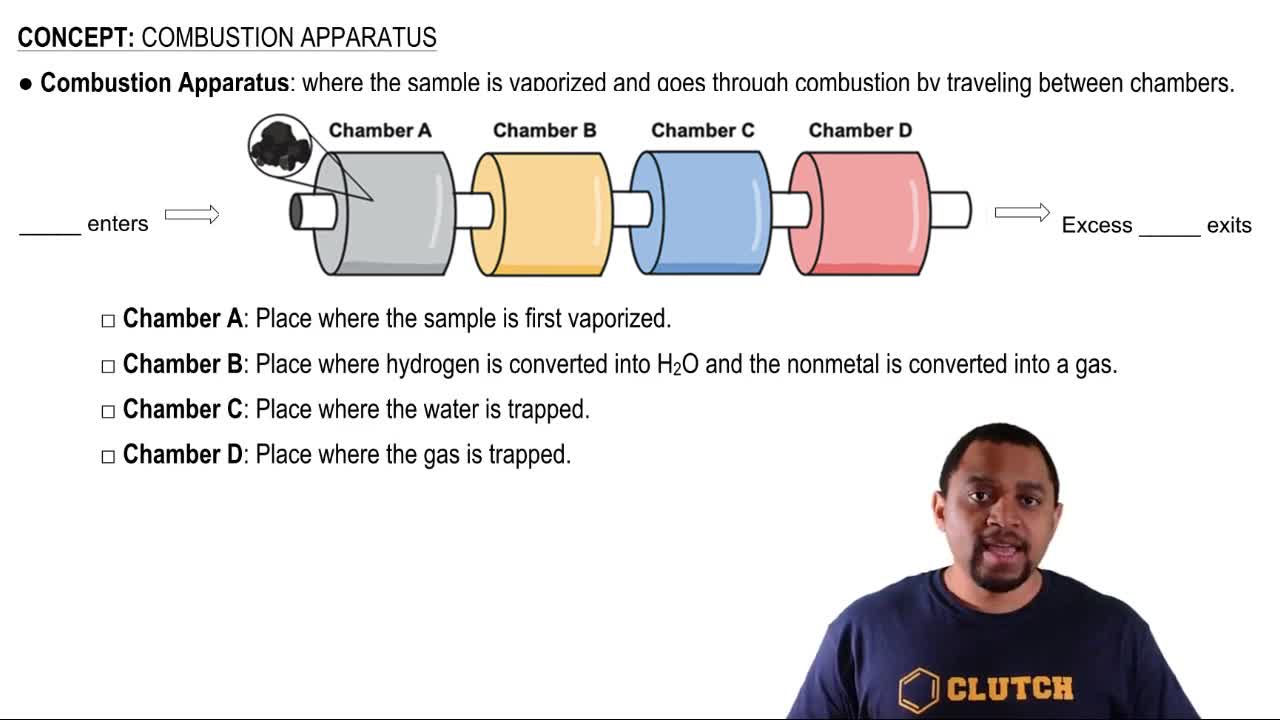
Combustion Apparatus
Stoichiometry of Combustion
Stoichiometry involves the calculation of reactants and products in chemical reactions based on balanced equations. For the complete combustion of acetylene, the balanced equation shows that two moles of acetylene react with five moles of oxygen to produce four moles of carbon dioxide and two moles of water. This ratio indicates that, with sufficient oxygen, CO2 is produced in greater quantities than other carbon products like CO or soot.
Recommended video:
Guided course
Combustion Apparatus
Oxygen Availability and Product Formation
The availability of oxygen significantly influences the products formed during combustion. In conditions of limited oxygen, incomplete combustion can occur, leading to the formation of carbon monoxide (CO) and soot. However, when oxygen is abundant, the combustion of acetylene favors the formation of carbon dioxide (CO2), as it allows for the complete oxidation of carbon, resulting in fewer byproducts.
Recommended video:
Guided course
Production of Hydrogen Example
Related Practice
Textbook Question
Textbook Question
Hydrogen cyanide, HCN, is a poisonous gas. The lethal dose is approximately 300 mg HCN per kilogram of air when inhaled. (a) Calculate the amount of HCN that gives the lethal dose in a small laboratory room measuring 3.5 × 4.5 × 2.5 m. The density of air at 26 °C is 0.00118 g/cm3. (b) If the HCN is formed by reaction of NaCN with an acid such as H2SO4, what mass of NaCN gives the lethal dose in the room? 2 NaCN(s) + H2SO4(aq) → Na2SO4(aq) + 2 HCN(g)
1533
views
Textbook Question
When a mixture of 10.0 g of acetylene (C2H2) and 10.0 g of oxygen (O2) is ignited, the resulting combustion reaction produces CO2 and H2O. (c) How many grams of C2H2 are present after the reaction is complete?
799
views
Textbook Question
A 3.50 g of an alloy which contains only lead and tin is dissolvedin hot HNO3. Excess sulfuric acid is added to thissolution and 1.57g of PbSO4(s) is obtained. (b) Assuming allthe lead in the alloy reacted to form PbSO4, what was theamount, in grams, of lead and tin in the alloy respectively?
569
views
