
Textbook Question
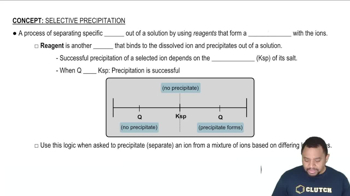
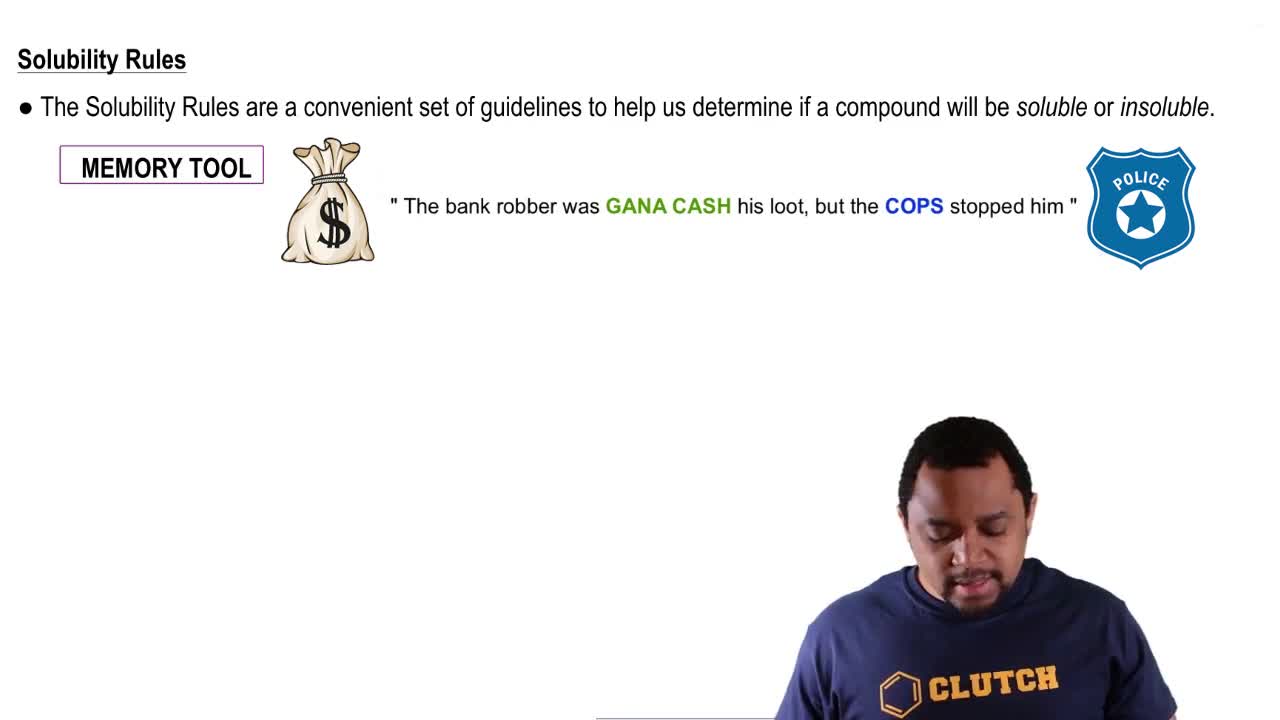
Which ions remain in solution, unreacted, after each of the following pairs of solutions is mixed? (c) ammonium phosphate and calcium chloride
904
views

 Verified step by step guidance
 01:53
01:53
 00:28
00:28 02:11
02:11Which ions remain in solution, unreacted, after each of the following pairs of solutions is mixed? (c) ammonium phosphate and calcium chloride
Separate samples of a solution of an unknown ionic compound are treated with dilute AgNO3, Pb1NO322, and BaCl2. Precipitates form in all three cases. Which of the following could be the anion of the unknown salt: Br-, CO32-, NO3-?
Write balanced net ionic equations for the reactions that occur in each of the following cases. Identify the spectator ion or ions in each reaction.
(a) Ba(OH)2(aq) + FeCl3(aq) →
(b) ZnCl2(aq) + Cs2CO3(aq) →
State whether each of the following statements is true or false. Justify your answer in each case. (b) HCl is a weak acid.
State whether each of the following statements is true or false. Justify your answer in each case. (a) Sulfuric acid is a monoprotic acid.
State whether each of the following statements is true or false. Justify your answer in each case. (c) Methanol is a base.