

Ch.4 - Reactions in Aqueous Solution
Brown - Chemistry: The Central Science 14th Edition
Brown14th EditionChemistry: The Central ScienceISBN: 9780134414232Not the one you use?Change textbook
Chapter 4, Problem 25c

Which ions remain in solution, unreacted, after each of the following pairs of solutions is mixed? (c) ammonium phosphate and calcium chloride

Verified step by step guidance
1
Step 1: Write down the chemical formulas for the reactants. Ammonium phosphate is (NH4)3PO4 and calcium chloride is CaCl2.
Step 2: Predict the possible products of the reaction using the principle of 'cation-anion' exchange. The possible products are ammonium chloride (NH4Cl) and calcium phosphate (Ca3(PO4)2).
Step 3: Check the solubility rules to determine if any of the products will precipitate. According to the solubility rules, all ammonium salts (NH4+) are soluble, so ammonium chloride will not precipitate. However, most phosphate salts are insoluble, with some exceptions including salts of ammonium (NH4+). Therefore, calcium phosphate will precipitate.
Step 4: Since calcium phosphate precipitates, the calcium ions (Ca2+) from calcium chloride will react and will not remain in the solution. However, the chloride ions (Cl-) from calcium chloride will not react and will remain in the solution.
Step 5: Similarly, the phosphate ions (PO4^3-) from ammonium phosphate will react and will not remain in the solution. However, the ammonium ions (NH4+) from ammonium phosphate will not react and will remain in the solution.

Verified video answer for a similar problem:

This video solution was recommended by our tutors as helpful for the problem above.
Video duration:
7m
Was this helpful?

Key Concepts

Here are the essential concepts you must grasp in order to answer the question correctly.

Solubility Rules

Solubility rules are guidelines that help predict whether a compound will dissolve in water. For example, most ammonium salts and phosphates are soluble, while many calcium salts can be insoluble. Understanding these rules is crucial for determining which ions remain in solution after mixing different ionic compounds.
Recommended video:
Guided course
00:28
Solubility Rules

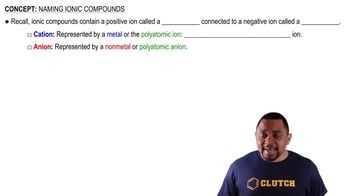
Ionic Compounds and Dissociation

Ionic compounds dissociate into their constituent ions when dissolved in water. For instance, ammonium phosphate dissociates into ammonium (NH4+) and phosphate (PO4^3-) ions, while calcium chloride dissociates into calcium (Ca^2+) and chloride (Cl-) ions. Recognizing how these compounds break apart in solution is essential for analyzing the resulting mixture.
Recommended video:
Guided course
02:11
Ionic Compounds Naming

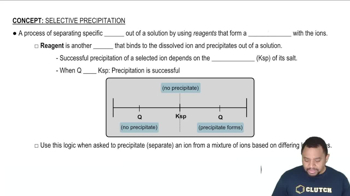
Precipitation Reactions

A precipitation reaction occurs when two soluble ionic compounds react to form an insoluble compound, or precipitate. In the case of mixing ammonium phosphate and calcium chloride, calcium phosphate may precipitate out of solution. Identifying which ions remain unreacted involves understanding the potential for precipitation based on solubility product constants.
Recommended video:
Guided course
01:53
Selective Precipitation
Related Practice
Textbook Question

Separate samples of a solution of an unknown ionic compound are treated with dilute AgNO3, Pb1NO322, and BaCl2. Precipitates form in all three cases. Which of the following could be the anion of the unknown salt: Br-, CO32-, NO3-?

1171
views
Textbook Question

Write balanced net ionic equations for the reactions that occur in each of the following cases. Identify the spectator ion or ions in each reaction.

(a) Ba(OH)2(aq) + FeCl3(aq) →

(b) ZnCl2(aq) + Cs2CO3(aq) →

638
views
1
rank
Textbook Question

Identify the precipitate (if any) that forms when the following solutions are mixed, and write a balanced equation for each reaction. (a) NH4I and CuCl2 (b) LiOH and MnCl2 (c) K3PO4 and CoSO4

1007
views
Textbook Question
You know that an unlabeled bottle contains an aqueous solutionof one of the following: AgNO3, CaCl2, or Al21SO423. Afriend suggests that you test a portion of the solution withBa1NO322 and then with NaCl solutions. According to yourfriend's logic, which of these chemical reactions could occur,thus helping you identify the solution in the bottle?(a) Barium sulfate could precipitate. (b) Silver chloridecould precipitate. (c) Silver sulfate could precipitate.(d) More than one, but not all, of the reactions described inanswers a–c could occur. (e) All three reactions described inanswers a–c could occur.
1517
views
1
rank
Textbook Question

Which ions remain in solution, unreacted, after each of the following pairs of solutions is mixed? (a) potassium carbonate and magnesium sulfate

646
views
Textbook Question

Will precipitation occur when the following solutions are mixed? If so, write a balanced chemical equation for the reaction. (a) Ca(CH3COO)2 and NaOH (b) K2CO3 and NH4NO3, (c) Na2S and FeCl3.

782
views