
Textbook Question
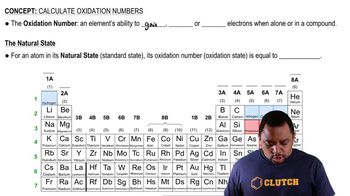
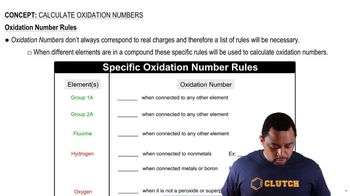
Determine the oxidation number for the indicated element in each of the following substances: (c) P in AgPF6
758
views

 Verified step by step guidance
 02:42
02:42
 03:13 02:42
Determine the oxidation number for the indicated element in each of the following substances: (c) P in AgPF6
Which of the following are redox reactions? For those that are, indicate which element is oxidized and which is reduced. For those that are not, indicate whether they are precipitation or neutralization reactions. (a) P4(s) + 10 HClO(aq) + 6 H2O(l) → 4 H3PO4(aq) + 10 HCl(aq) (b) Br2(l) + 2 K(s)→ 2 KBr(s) (c) CH3CH2OH(l) + 3 O2(g) → 3 H2O(l) + 2 CO2(g) (d) ZnCl2(aq) + 2 NaOH(aq) → Zn(OH)2(s) + 2 NaCl(aq)
Determine the oxidation number for the indicated element in each of the following substances: (e) Pt in PtCl4 (f) O in OF2.
Which element is oxidized, and which is reduced in the following reactions? (a) N2(g) + 3 H2(g) → 2 NH3(g)
Which element is oxidized, and which is reduced in the following reactions? (c) Cl2(aq) + 2 NaI(aq) → I2(aq) + 2 NaCl(aq) (d) PbS(s) + 4 H2O2(aq) → PbSO4(s) + 4 H2O(l)
Determine the oxidation number for the indicated element in each of the following substances: (d) N in HNO3